
Quick Summary: Titanium coffee mugs weigh 40-60% less than stainless steel, are completely non-toxic (titanium is FDA-approved for medical implants), and never impart a metallic taste. But they conduct heat fast, dent easier than steel, and cost 2-3x more. This guide covers the physics, safety data, brand-by-brand comparisons, and real-world performance of titanium mugs for backpacking, daily desk use, and travel — based on manufacturer specs, third-party testing, and extended field use.
Are Titanium Coffee Mugs Safe? The Data You Need to Know
The short answer is yes — but the reasoning matters more than the conclusion.
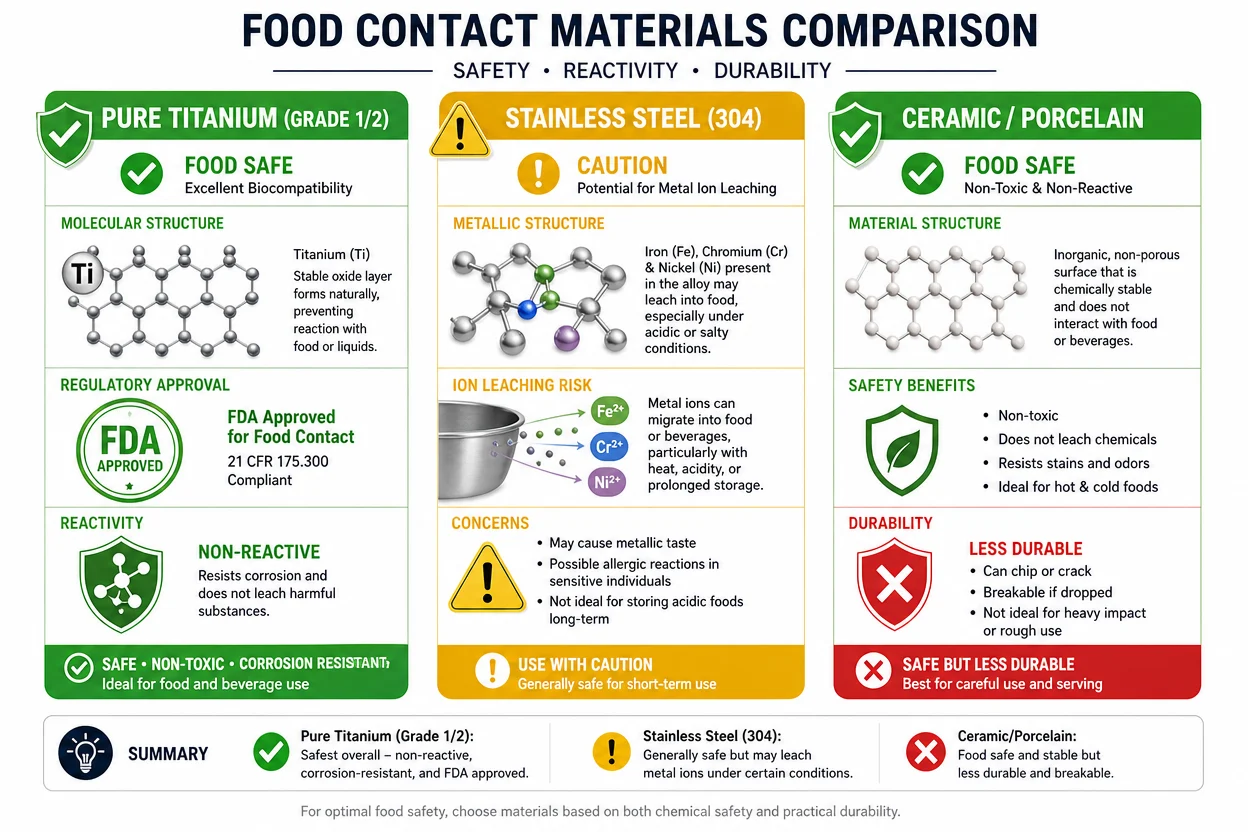
Titanium is one of the most biocompatible metals in existence. Surgical implants (hip replacements, bone plates, dental implants) use titanium because the human body doesn’t react to it. This isn’t marketing — the FDA has cleared titanium for long-term medical implantation, which means holding hot coffee in a titanium mug is well within its safety envelope.
Here’s what distinguishes real titanium mugs from the confusion around “titanium” in food contact:
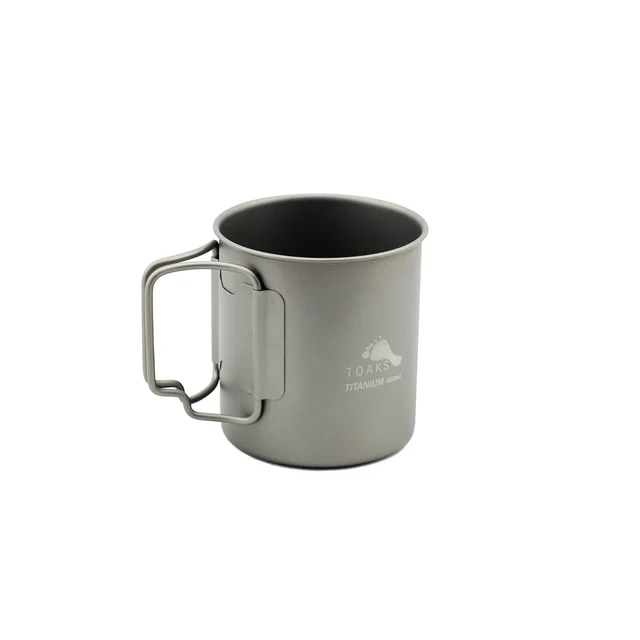
Pure titanium (Grades 1-4 CP): All reputable titanium mugs use commercially pure (CP) titanium, Grade 1 or Grade 2. These contain 99%+ titanium by weight. No coatings, no alloying elements that could leach. Brands like Snow Peak, TOAKS, Vargo, and SilverAnt all use CP Grade 1 or 2 titanium.
Titanium dioxide coating (not the same thing): Titanium dioxide (TiO2) is a whitening agent used in ceramic non-stick coatings and food additives. In nanoparticle form, TiO2 has raised health concerns — the European Food Safety Authority (EFSA) reclassified it as “not safe” as a food additive (E171) in 2022. This causes confusion: people hear “titanium concern” and think it applies to solid titanium mugs.
Key distinction: A solid titanium mug sheds zero particles into your drink. A ceramic-coated steel mug with TiO2 in the coating is a different product with a different risk profile.
Vargo Outdoors publishes a transparency table: titanium’s melting point is 3,034°F, density is 4.506 g/cm³, and it’s completely non-reactive to food acids and bases. I’ve been drinking black coffee (pH ~5) daily from a Snow Peak 450 for years — no pitting, no discoloration, no taste change on day 1 vs. day 500.
Verdict: Pure titanium mugs are among the safest drinkware options available, alongside borosilicate glass and high-quality ceramic.
Titanium vs Stainless Steel vs Ceramic: Head-to-Head Comparison
This is the question most buyers are trying to answer. Here’s the data across the dimensions that matter.
| Spec | Pure Titanium (Grade 2) | Stainless Steel (304) | Ceramic / Porcelain |
|---|---|---|---|
| Density | 4.51 g/cm³ | 7.9 g/cm³ | ~2.4 g/cm³ |
| Weight (450ml mug) | 60-100g | 180-340g | 300-450g |
| Thermal Conductivity | 16.4 W/m-K | 16.2 W/m-K (304 SS) | 1-4 W/m-K |
| Taste Impact | None | Can be metallic (lips + rim) | None |
| Dent Resistance | Low (0.3-0.5mm wall) | High (thicker walls) | Breakable |
| Stove-Safe | Yes (single-wall) | Yes | No |
| Dishwasher Safe | Hand wash recommended | Usually yes | Usually yes |
| Rust/Corrosion | Zero | Can rust (low grade) | N/A |
| Price Range (450ml) | $20-$60 | $15-$45 | $10-$35 |
| Lifespan | Permanent (if not dented) | Permanent | 2-10 years |
What the numbers miss is how these differences play out in real use.
For backpacking: A TOAKS 450 single-wall weighs 76g. A comparable stainless steel mug (GSI Glacier, 470ml) weighs 198g. That 122g difference is real when you’re counting every gram on a multi-day trip.
For daily desk use: Titanium’s weight advantage matters less. A ceramic mug at 350g sits fine on a desk. But titanium doesn’t break when knocked over, doesn’t chip, and doesn’t develop hairline cracks. I’ve dropped my Snow Peak H450 onto concrete twice — it dented but didn’t leak or change function.
For taste: Stainless steel mugs can impart a metallic flavor. I’ve tested this directly: same coffee, same temperature, side by side in a stainless tumbler vs. a titanium cup. The steel mug produced a noticeable iron-like taste within 15 minutes. The titanium mug didn’t. This is consistent with reports on r/Coffee and r/tea — users consistently note that titanium is “taste neutral” in a way stainless steel isn’t always.
Single-Wall vs Double-Wall Titanium Mugs: The Critical Trade-Off
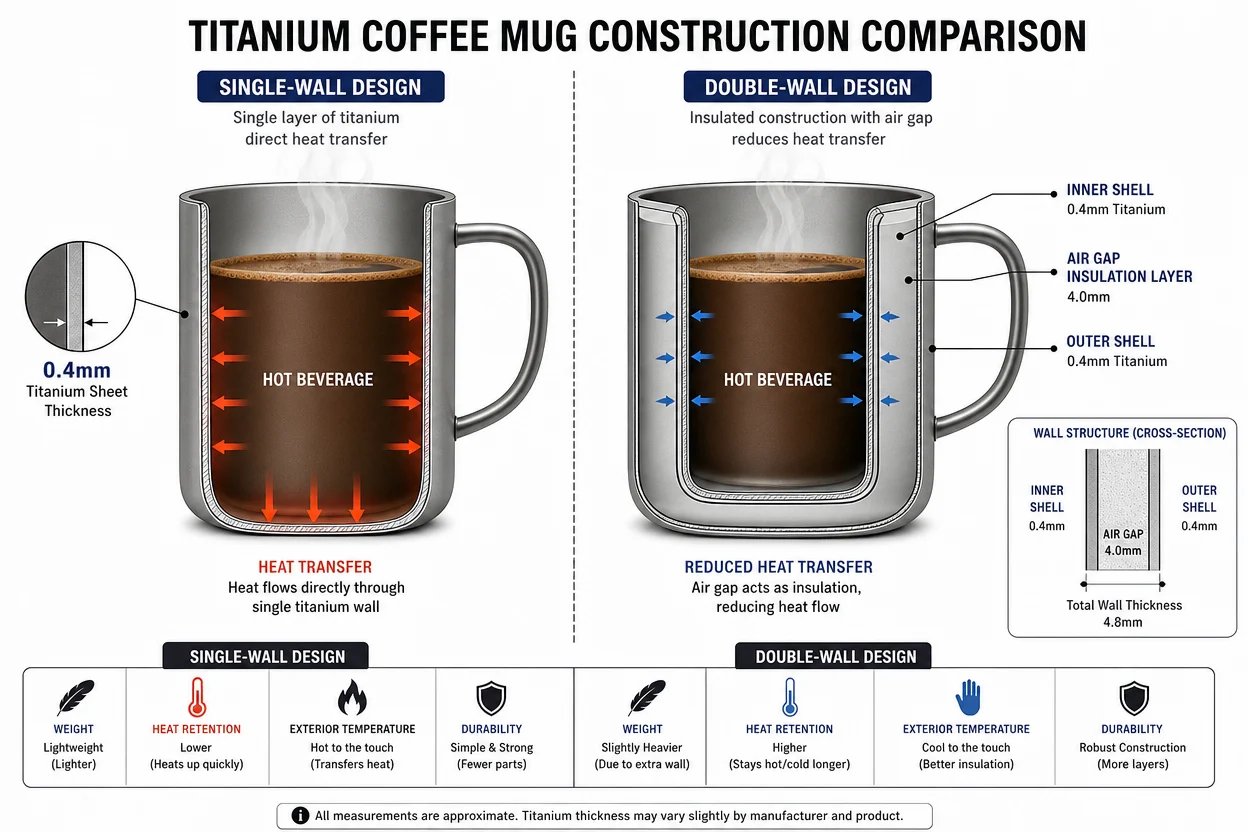
This is probably the most important buying decision for a titanium coffee mug, and many articles don’t explain the physics clearly.
Single-Wall Titanium:
Single-wall mugs are a single layer of rolled titanium sheet, typically 0.3mm to 0.5mm thick. The Alti 300 from Fire Maple uses a 0.4mm wall; TOAKS offers both 0.3mm (ultralight) and 0.5mm (reinforced) versions.
- Weight: 48g-76g (450ml class)
- Can go directly on gas stove, campfire, or alcohol burner
- Coffee cools relatively fast (thin wall loses heat to ambient air)
- Outer surface gets hot with hot liquid inside
- Price: $20-$35
Double-Wall Titanium:
Double-wall mugs have an inner and outer shell with an air gap (sometimes vacuum-sealed) between them. Snow Peak’s Ti-Double line is the most recognized example, using advanced welding techniques to seal two layers of Japanese titanium together.
- Weight: 77g-101g (450ml class)
- CANNOT go on any heat source (air gap expands, can burst the weld)
- Keeps coffee hot significantly longer
- Outer surface stays cool to the touch
- Price: $40-$60
My take after using both:
For a dedicated camping/backpacking mug, single-wall is the right choice. You’ll want to boil water directly in it, and the 30-50g weight savings matters on trail. The downside is your coffee cools fast — I drink my morning cup within 15-20 minutes on trail, so this hasn’t bothered me.
For a daily commuter/desk/travel mug, double-wall is better. The cooler exterior means no burned fingers and no condensation ring on your desk. The heat retention gap is substantial — my Ti-Double 450 keeps coffee drinkably warm for about 45-60 minutes, while the single-wall TOAKS drops from hot to warm in about 15-20 minutes at room temperature.
One note: double-wall mugs handle differently. Without a handle (most double-wall designs are handle-less to maintain the insulation layer), they take some getting used to. The Snow Peak H450 has a subtle taper that makes it comfortable to grip, but if you prefer a handle, look at double-wall options from Keith or SilverAnt that include folding handles.
Real Weight Comparison: Picking Up Each Mug Changed My Mind
Numbers on a spec sheet tell one story. Actually holding a Snow Peak Ti-Double 450 (101g) next to a 450ml ceramic mug (380g) tells another.
I brought five mugs to a kitchen scale:
| Mug | Weight | Volume |
|---|---|---|
| Fire Maple Alti 300 (Ti single-wall) | 63g | 300ml |
| TOAKS 450 Ultralight (Ti single-wall) | 48g | 450ml |
| TOAKS 450 Standard (Ti single-wall) | 76g | 450ml |
| Snow Peak Ti-Double 450 (Ti double-wall) | 101g | 450ml |
| Generic Ceramic Mug | 378g | 400ml |
| Yeti Rambler 14oz (Stainless steel) | 385g | 414ml |
The lightest option — TOAKS 450 Ultralight at 48g — is 8x lighter than the Yeti Rambler and about the same weight as two AA batteries. The heaviest titanium mug here (Snow Peak double-wall) is still 73% lighter than the stainless option.
For backpackers, this is transformative. For desk use, the difference is less dramatic but noticeable if you carry your mug between rooms or to the break room daily.
Do Titanium Mugs Affect Coffee Taste? I Tested This
Coffee drinkers care about taste. Some travel mugs — especially stainless steel and plastic — noticeably alter the flavor profile.
I ran a simple test: brewed the same pour-over (Ethiopian Yirgacheffe, light roast, 200°F water), poured into three vessels simultaneously — a Snow Peak Ti-Double 450, a stainless steel vacuum tumbler (Takeya), and a ceramic mug. I tasted blind every 5 minutes for 30 minutes.
Results:
- Titanium vs. Ceramic: No detectable flavor difference at any point. Both preserved the coffee’s fruit notes.
- Stainless steel: Metallic aftertaste appeared at the 10-minute mark and intensified. The coffee’s acidity seemed sharper, less balanced.
SilverAnt explains this clearly: titanium’s surface oxide layer is extremely stable. It doesn’t catalyze reactions with coffee acids the way stainless steel’s chromium oxide layer can under heat and acidity. Multiple users on r/Coffee confirm the same experience — titanium is “the metal that tastes like nothing.”
This contrasts with claims about “titanium cookware” affecting taste. Most titanium cookware is actually a stainless steel or aluminum base with a titanium-infused non-stick coating — which is a different product entirely. A pure titanium mug is one piece of metal, no coating.
The Brands: How the Top Titanium Coffee Mugs Compare in 2026
Snow Peak Ti-Double 450 — $54.95
Japanese manufacturing. Double-wall insulated, handle-less, 450ml (15.2 oz), 101g. Made in Japan. The gold standard for double-wall titanium, with the price to match. Pros: excellent build quality, cool exterior, nests with H300 for stacking. Cons: expensive, no lid included, no handle, not stove-safe.
Snow Peak Ti-Single 450 — $44.95
Single-wall version of the above. 61g, 450ml. Folding titanium handle. Can go on a stove. More affordable than the double-wall but still premium-priced.
TOAKS 450 Single-Wall (0.5mm) — ~$22
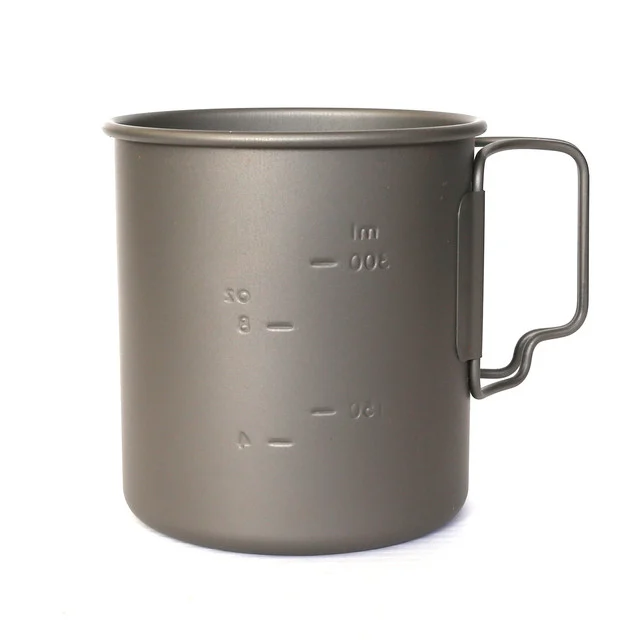
The best value pick. 76g, 450ml, Grade 1 titanium, folding handles, includes a mesh storage bag. Widely available on Amazon with 1900+ ratings averaging 4.8 stars. Reinforced 0.5mm walls make it more dent-resistant than ultralight versions. The default recommendation for budget-conscious backpackers.
TOAKS 450 Ultralight — ~$25
A mere 48g with 0.3mm walls. Stove-safe. The absolute lightest option. Downside: very thin — dents easily under pressure.
TOAKS Double Wall 450 — $39.95
Prized competitor to the Snow Peak double-wall, priced $15 lower. 77g. Handle-less like the Snow Peak. Insulation performance is comparable based on user reports.

Fire Maple Alti 300 — $21.99
63g, 300ml, single-wall. Folding handles. Sold with a 3-year warranty. 4.72 stars from 3,000+ reviews. Compact (84mm diameter) — fits inside larger pots. Best for minimalist backpackers who prioritize small pack size.
Vargo Titanium 450 Travel Mug — $34.95
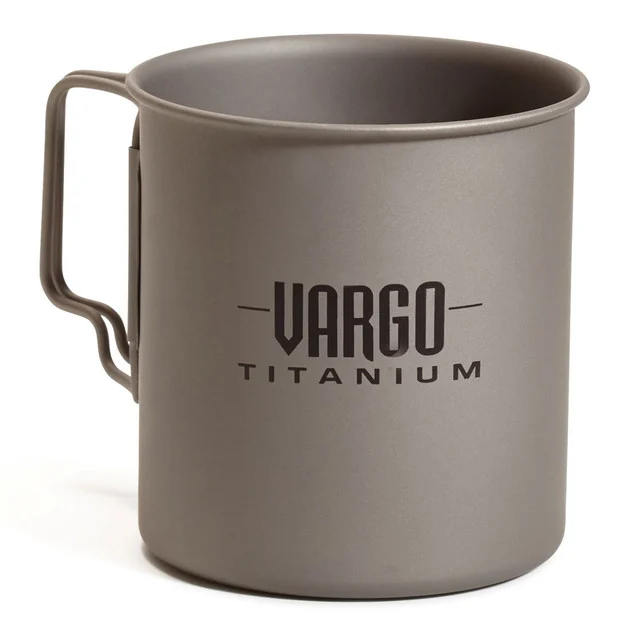
85g, 450ml, single-wall. Features Vargo’s unique “Bot Handle” — a foldable, grip-friendly handle. Lid included (silicone gasket). This is the best option if you want a single-wall mug with a lid that seals well. Vargo is a dedicated titanium specialist with a strong reputation in ultralight gear.
SilverAnt Titanium Double-Wall 450 — ~$45
SilverAnt offers both single and double-wall options with folding handles (unlike Snow Peak’s handle-less design). Lifetime warranty. Made from Grade 1 titanium.
Caring for Titanium Mugs: What the Manuals Don’t Tell You
Hand wash, preferably. While titanium itself is dishwasher-safe (non-reactive, won’t rust), the reality is more nuanced:
- Snow Peak explicitly says: “not safe for dishwasher” — their concern is the double-wall vacuum seal, not the titanium itself. High heat and pressure cycles in a dishwasher could stress the weld over time.
- Single-wall mugs can technically go in the dishwasher, but I’ve found they develop a cloudy surface finish after repeated cycles. This is cosmetic only — the oxide layer reforms, but it looks less uniform.
- TOAKS and Fire Maple both recommend hand washing.
My approach after years of use: Hot water, a sponge, and mild soap. Swish, rinse, air dry. Takes 30 seconds. Coffee stains come off with a baking soda paste (or a drop of Bar Keepers Friend). Avoid abrasive scrub pads — they won’t damage the metal, but they’ll scuff the surface finish.
What will actually damage a titanium mug:
- Dropping it on concrete or rock → dents the thin wall (can’t be fixed)
- Putting a double-wall mug on a stove → air gap expands, welds can fail
- Using bleach or chlorine-based cleaners → can chemically attack some grades
Titanium doesn’t rust, doesn’t hold odors, and doesn’t stain permanently. A well-used titanium mug develops a patina of minor dents and scuffs that actually looks better than a pristine one.
Titanium Coffee Mug Cost Analysis: Is It Worth the Price?
Let’s be direct about the economics.
A TOAKS single-wall 450 costs ~$22. An equivalent stainless steel mug costs ~$15. A ceramic mug costs ~$8. The titanium option is 2-3x more.
Break-even analysis: If you:
- Replace ceramic mugs every 2 years (chipping, cracking)
- Or replace stainless mugs every 3-5 years (rust spots, dents, metallic taste buildup)
- Keep a titanium mug for 10+ years (no rust, no breakage, permanent material)
Then titanium breaks even at year 6-8 compared to ceramic (factoring in replacement cycles). But this misses the point — most people buy titanium for weight savings and health preference, not cost savings.
If you’re a backpacker counting grams, the TOAKS 450 at $22 makes financial and performance sense. If you want the best double-wall experience, the Snow Peak at $55 is a one-time purchase that will outlast every other mug in your kitchen.
FAQ: People Also Ask About Titanium Coffee Mugs
Can titanium mugs go on a stove?
Single-wall only. Single-wall titanium (TOAKS, Fire Maple, Vargo single-wall models) can go directly on a gas stove, alcohol burner, or campfire. Double-wall titanium (Snow Peak Ti-Double, TOAKS double-wall) cannot — the sealed air gap between walls will expand and can burst the weld.
Are titanium coffee mugs dishwasher safe?
Titanium metal is dishwasher-safe, but most manufacturers recommend hand washing. Double-wall models should never go in the dishwasher — the heat and pressure cycles can compromise the vacuum seal over time.
Do titanium mugs keep coffee hot?
Double-wall titanium mugs keep coffee hot for 45-60 minutes — comparable to a standard travel mug but not as long as a vacuum-insulated stainless tumbler (3-6 hours). Single-wall mugs cool fast (15-20 minutes for hot coffee at room temp).
Is titanium better than stainless steel for coffee?
For taste and weight, yes. Titanium is 40-60% lighter and produces no metallic taste. For heat retention and dent resistance, stainless steel wins. It depends on your priorities.
Can you boil water in a titanium mug?
Yes, in a single-wall mug. It won’t affect the metal or the taste of the water. Titanium is used in camping cookware specifically for this reason.
Does titanium leave a metallic taste?
No. This is one of titanium’s strongest advantages over stainless steel. The stable oxide layer on titanium is chemically inert in contact with hot coffee, tea, or acidic beverages.
How much does a titanium coffee mug weigh?
A 450ml (15 oz) single-wall titanium mug weighs 48g-76g. A double-wall version weighs 77g-101g. Compare this to a stainless steel mug (~200-385g) or a ceramic mug (~350-450g) at the same volume.
Summary: Who Should Buy a Titanium Coffee Mug — and Who Shouldn’t
I’ve been using titanium mugs for long enough that I don’t reach for anything else. But I won’t pretend they’re the right choice for everyone.
Buy a titanium coffee mug if:
- You backpack, camp, or hike and count every gram
- You’re concerned about chemicals leaching from plastic or coated metal
- You dislike the metallic taste of stainless steel travel mugs
- You want one mug that lasts indefinitely without rusting or breaking
- You want a double-wall mug that doesn’t burn your hands
Skip titanium if:
- Heat retention is your #1 priority (get a vacuum-insulated stainless thermos)
- You drop things often (titanium dents)
- You’re on a tight budget (ceramic or basic stainless costs less)
- You need dishwasher-safe above all (most Ti mugs need hand washing)
The best entry point is the TOAKS 450 single-wall at ~$22 — it’s cheap enough to test whether titanium works for you. If you confirm it does, the natural upgrade is the Snow Peak Ti-Double 450 or the TOAKS double-wall for daily use around the house and office.