
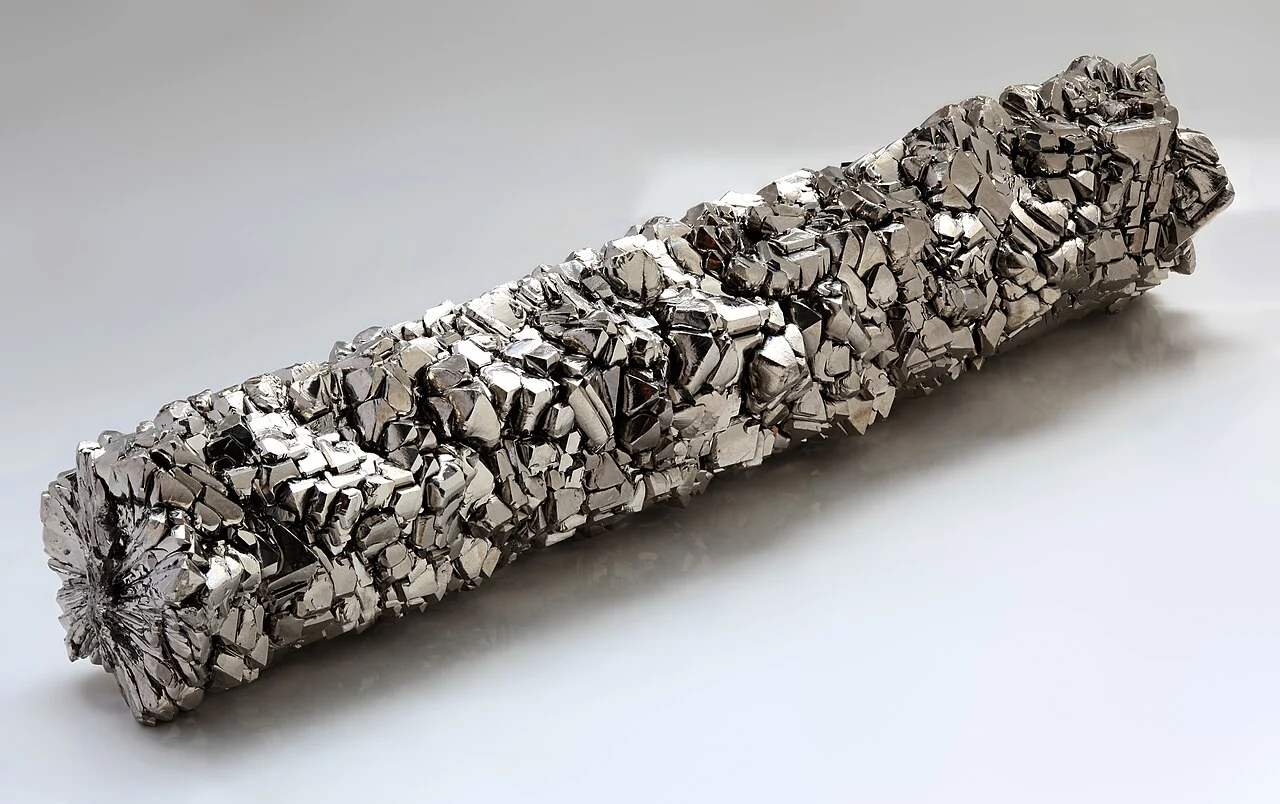
Reines Titan hat eine Dichte von 4,506 g/cm³ (4.506 kg/m³ / 0,163 lb/in³) und liegt damit zwischen Aluminium (2,70 g/cm³) und Kohlenstoffstahl (7,85 g/cm³). Titan ist volumenbezogen etwa 43 % leichter als Edelstahl und rund 67 % schwerer als Aluminium. Grade 5 (Ti-6Al-4V), auf den über 50 % des weltweiten Titanverbrauchs entfallen, weist aufgrund seines Aluminiumanteils mit 4,43 g/cm³ eine etwas geringere Dichte auf. Der entscheidende Kennwert für die Werkstoffauswahl ist jedoch die spezifische Festigkeit – Zugfestigkeit dividiert durch Dichte –, bei der Grade-5-Titan (214 MPa·cm³/g) sowohl Edelstahl (65) als auch die meisten Aluminiumlegierungen übertrifft. Dieser Leitfaden enthält genaue Dichtewerte für alle gängigen Grades, direkte Vergleiche mit Stahl und Aluminium, eine Tabelle zur spezifischen Festigkeit sowie eine Gewichtsberechnungsformel für Einkauf und Konstruktion.
Titan-Dichte in allen gebräuchlichen Einheiten
Die meisten Werkstoffdatenbanken führen Dichtewerte in g/cm³ auf. Ingenieure in nordamerikanischen Betrieben benötigen lb/in³. Einkaufsteams, die tonnenweise bestellen, arbeiten mit kg/m³. Nachfolgend sind die Werte für kommerziell reines (CP) Titan – Grades 1 bis 3 – in allen gängigen Einheiten aufgeführt:
| Einheit | Wert |
|---|---|
| g/cm³ (Gramm pro Kubikzentimeter) | 4.506 |
| kg/m³ (Kilogramm pro Kubikmeter) | 4,506 |
| lb/in³ (Pfund pro Kubikzoll) | 0.163 |
| lb/ft³ (Pfund pro Kubikfuß) | 281.3 |
Diese Werte entstammen den Tabellen physikalischer Eigenschaften von ASM International für CP-Titan. Grade 4 liegt mit 4,54 g/cm³ geringfügig höher – der erhöhte Sauerstoffgehalt steigert die Masse, ohne das Volumen nennenswert zu verändern.
Als grobe Faustregel gilt: Titan ist etwa 4,5-mal dichter als Wasser. Ein massiver Titanstab sollte sich bei gleicher Größe deutlich schwerer anfühlen als ein Aluminiumstab. Ist das nicht der Fall, stimmt etwas mit dem Material nicht.
Nicht jedes Titan hat dieselbe Dichte
Die branchenübliche Angabe eines einzigen “Titan-Dichtewerts” verdeckt die erheblichen Unterschiede zwischen den einzelnen Grades. Legierungselemente verschieben die Enddichte – leichte Elemente wie Aluminium senken sie, schwere Elemente wie Chrom und Molybdän erhöhen sie.
| Klasse | Bezeichnung | Dichte (g/cm³) | Anmerkungen |
|---|---|---|---|
| Klasse 1 | CP Ti | 4.51 | Weichste Variante, höchste Umformbarkeit |
| Klasse 2 | CP Ti | 4.51 | Weltweit gebräuchlichstes CP-Grade |
| Klasse 3 | CP Ti | 4.51 | Höhere Festigkeit als G2, gleiche Dichte |
| Klasse 4 | CP Ti | 4.54 | CP-Grade mit der höchsten Festigkeit |
| Güteklasse 9 | Ti-3Al-2.5V | 4.48 | “Half-6-4”, Fahrradrahmen, Rohre |
| Güteklasse 5 | Ti-6Al-4V | 4.43 | Standardlegierung, ~50 % des weltweiten Ti-Verbrauchs |
| Beta C | Ti-3Al-8V-6Cr-4Zr-4Mo | 4.81 | Hohe Festigkeit, Federanwendungen |
Quelle: AZoM / ASM International, Tabellen physikalischer Eigenschaften
Die Dichte von Grade 5 sinkt auf 4,43 g/cm³, da der 6%ige Aluminiumanteil – Dichte 2,70 g/cm³ – den Gesamtwert absenkt. Beta-Legierungen weisen eine höhere Dichte auf, da Chrom, Molybdän und Vanadium jeweils dichter als Titan sind. Wer Titan für gewichtskritische Anwendungen spezifiziert und einen Wert von ’4,51“ genannt bekommt, sollte nachfragen, welches Grade gemeint ist. Der Austausch von Grade 5 durch Beta C erhöht das Bauteilgewicht bei gleichem Volumen um rund 8 %.
Titan vs. Stahl – Dichte: Der 43%ige Unterschied
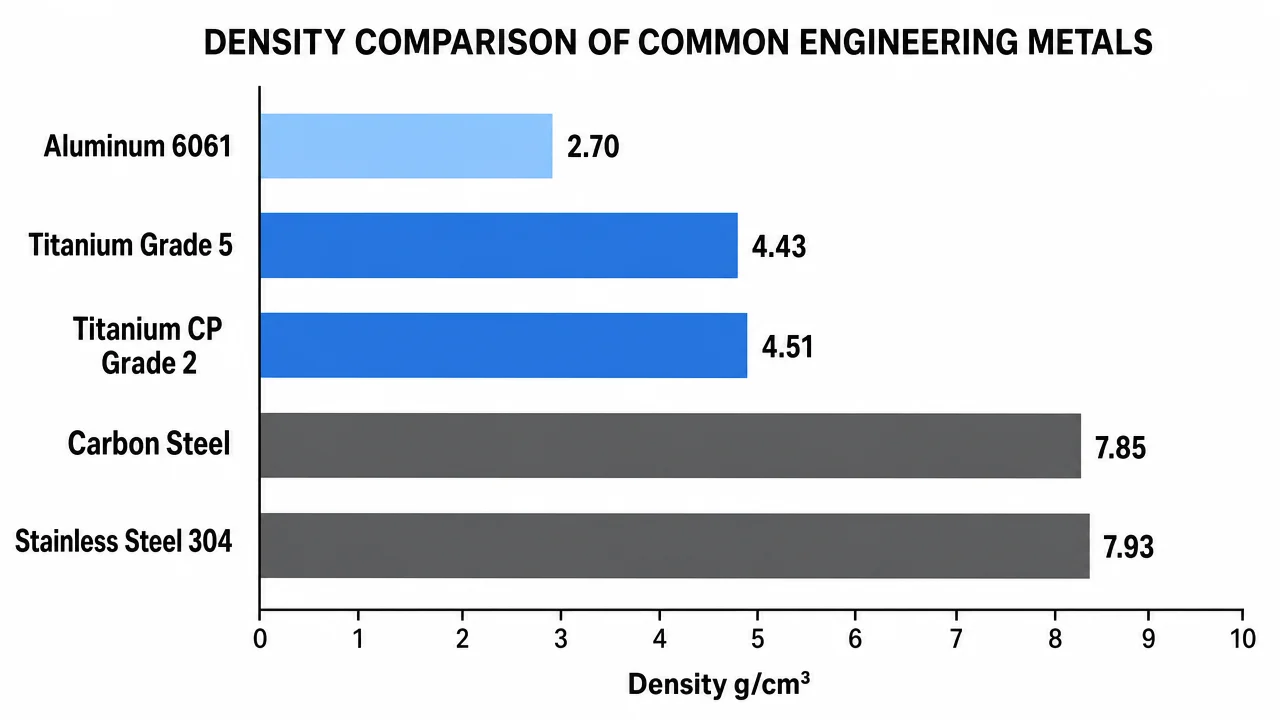
Stahl ist seit über einem Jahrhundert der meistverwendete Konstruktionswerkstoff. Jede Substitutionsanalyse zugunsten von Titan beginnt hier.
| Material | Dichte (g/cm³) | Dichte (kg/m³) |
|---|---|---|
| Titan Grade 2 (CP) | 4.51 | 4,510 |
| Titan Grade 5 (Ti-6Al-4V) | 4.43 | 4,430 |
| Kohlenstoffstahl AISI 1020 | 7.85 | 7,850 |
| Edelstahl 304 | 7.93 | 7,930 |
| Edelstahl 316 | 8.00 | 8,000 |
CP-Titan (Grade 2) ist volumenbezogen 43 % leichter als 304-Edelstahl. Grade 5 bringt darüber hinaus eine weitere Gewichtsersparnis. Ein Bauteil aus 304-Edelstahl mit einem Gewicht von 10 kg würde bei identischer Geometrie aus CP-Titan gefertigt ca. 5,7 kg wiegen – gleiches Volumen, 4,3 kg weniger.
Dieser Unterschied summiert sich schnell. Bei einer Produktionsserie von 5.000 Verbindungselementen entspricht das mehreren hundert Kilogramm Gewichtseinsparung in der fertigen Baugruppe. In der Luft- und Raumfahrt, wo der Treibstoffverbrauch direkt mit der Flugzeugmasse skaliert, hat eine solch systematische Gewichtsreduzierung messbaren wirtschaftlichen Nutzen über die gesamte Betriebslebensdauer einer Flotte.
Der weitaus bedeutendere Faktor ist jedoch die Festigkeit. Austenitischer Edelstahl 304 erreicht eine Zugfestigkeit (UTS) von rund 515 MPa. Grade-5-Titan erzielt im geglühten Zustand 950 MPa. Da sich durch dünnere Wandstärken gleichwertige Lasten tragen lassen, übersteigt der tatsächliche Gewichtsvorteil bei festigkeitsoptimierten Konstruktionen den reinen Dichteunterschied von 43% deutlich. Luft- und Raumfahrtingenieure berichten bei der Neukonstruktion von Stahlbauteilen in Titan regelmäßig von Gesamtgewichtseinsparungen von 50–65% – der zusätzliche Gewinn ergibt sich aus der Reduzierung des Querschnitts.
Titan vs. Aluminium – Dichte: Schwereres Metall, oft leichteres Bauteil
Aluminium gilt in der Automobil-, Unterhaltungselektronik- und Fahrradbranche als das Standard-Leichtmetall. Titan ist nach allen Dichtekennwerten schwerer. Hier wird es jedoch kontraintuitiv.
| Material | Dichte (g/cm³) | UTS typisch (MPa) | Spezifische Festigkeit (MPa·cm³/g) |
|---|---|---|---|
| Aluminum 6061-T6 | 2.70 | 310 | 115 |
| Aluminum 7075-T6 | 2.81 | 572 | 204 |
| Titan Grade 2 (CP) | 4.51 | 340 | 75 |
| Titan Grade 5 (Ti-6Al-4V) | 4.43 | 950 | 214 |
| Edelstahl 304 | 7.93 | 515 | 65 |
UTS-Quellen: AMS 4928 (Grade 5 geglüht), ASTM A276 (304 SS), ASTM B209 (6061-T6, 7075-T6)
Titan ist volumenbezogen um rund 67% dichter als Aluminium. Ein geometrisch identischer Stab aus Titan wiegt 1,67× mehr als ein vergleichbarer Stab aus Aluminium.
Betrachtet man jedoch die spezifische Festigkeit, ergibt sich ein anderes Bild. Grade-5-Titan (214 MPa·cm³/g) übertrifft 7075-T6-Aluminium (204) knapp und erreicht mehr als das Doppelte von 6061-T6 (115). Bei Anwendungen, bei denen Zugfestigkeit und Ermüdungslebensdauer maßgeblich für die Auslegung sind – etwa Fahrwerksanschlüsse, chirurgische Implantate oder hochbelastete Fahrradkomponenten – lässt sich das Titanbauteil mit kleinerem Querschnitt auslegen. Das fertige Titanbauteil kann dadurch ein mit seinem Aluminiumäquivalent vergleichbares Gewicht erreichen, trotz der höheren Dichte.
Grade 2 CP titanium tells a different story: specific strength of 75 falls below even 6061 aluminum. CP titanium is chosen for corrosion resistance and biocompatibility, not structural efficiency. If you’re sourcing CP titanium for a weight-critical structure, you’re probably using the wrong grade. Grade 5 is the answer.
The other argument that closes the Ti-vs-Al decision is temperature. 7075-T6 aluminum begins losing strength above approximately 150°C. Grade 5 titanium maintains its mechanical properties to around 315°C. For structures near engine bays, exhaust systems, or re-entry vehicles, aluminum fails the thermal requirement regardless of specific strength.
The Number That Actually Drives Material Selection: Specific Strength
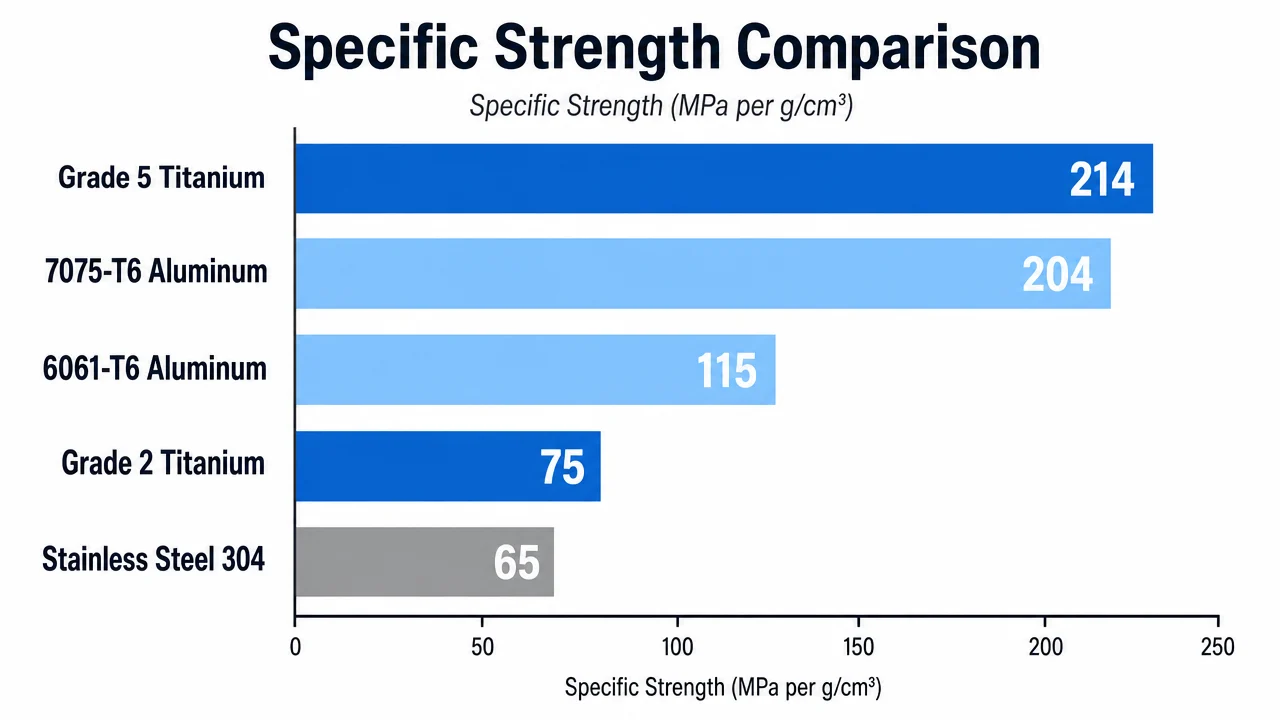
Density tells you how heavy a given volume of metal is. Specific strength tells you how much structural load that metal can carry per unit of mass. For comparing materials across an engineering design, specific strength is the relevant figure.
Specific Strength = UTS (MPa) ÷ Density (g/cm³)
Comparing Grade 5 titanium to 304 stainless: 950 ÷ 4.43 = 214 vs 515 ÷ 7.93 = 65. Grade 5 delivers more than 3× the structural performance per gram. That ratio is why the aerospace industry migrated critical fasteners and structural members from steel to titanium over several decades — not because titanium is lighter in absolute terms, but because for a given structural requirement, the titanium solution is dramatically lighter.
The aluminum-versus-titanium comparison is closer. 7075-T6 at 204 is almost equal to Grade 5 at 214. This is why the choice between them in aerospace isn’t a density argument — it’s a temperature argument. Where temperatures stay below 150°C and cost matters, 7075 wins. Where temperatures exceed 150°C or fatigue life is critical, Grade 5 wins.
For reference: carbon fiber reinforced polymer (CFRP) has a specific strength around 375 — roughly 1.75× Grade 5 titanium. The reason titanium persists alongside CFRP in aerospace is repairability, isotropy, and machinability. Titanium can be welded, machined, and repaired in field conditions. CFRP cannot.
Weight Calculation for B2B Procurement
Once you’ve settled on a grade, calculating part weight is straightforward. The core formula:
Weight = Volume × Density
For a rectangular plate (metric units):
Weight (kg) = [L (mm) × W (mm) × T (mm) × density (g/cm³)] ÷ 1,000,000
Worked example — Grade 5 plate, 500 mm × 300 mm × 6 mm:
500 × 300 × 6 × 4.43 ÷ 1,000,000 = 3.99 kg
Same plate in 304 stainless (density 7.93 g/cm³):
500 × 300 × 6 × 7.93 ÷ 1,000,000 = 7.14 kg
Same geometry: Grade 5 titanium is 44% lighter. On a production run of 500 units, that’s approximately 1,575 kg of weight removed from the final assembly — directly impacting shipping cost and, for aerospace or automotive assemblies, fuel efficiency over the product’s lifetime.
For round bar stock:
Weight (kg) = π × (D/2 in mm)² × L (mm) × density (g/cm³) ÷ 1,000,000
For imperial (lb/in³), replace the density value with 0.160 for Grade 5 or 0.163 for CP Grade 2, and input dimensions in inches. Drop the ÷ 1,000,000 adjustment — the result is in pounds directly.
When Titanium’s Density Advantage Matters — and When It Doesn’t
Titanium’s weight advantage is genuine, but it isn’t always the decision-governing factor.
Titanium density advantage is decisive when:
- Strength-to-weight is the primary design constraint: aerospace structures, performance automotive components, medical implants
- Operating temperatures exceed 150°C, ruling out high-strength aluminum alloys
- Corrosion resistance is required and stainless steel’s weight penalty is unacceptable
- Fatigue life under high-cycle loading is the limiting design criterion
Titanium density advantage is secondary — or irrelevant — when:
- Cost governs: titanium runs 5–10× the price of stainless steel per kg; the weight saving rarely pays off for static, ground-mounted structures
- Machinability matters: titanium’s low thermal conductivity and tendency to work-harden make it significantly slower and more expensive to machine than steel or aluminum
- Volume is high and tolerances are loose: aluminum remains cheaper and faster for high-volume, moderate-performance parts
- The component isn’t weight-constrained: a structural support in a fixed industrial installation doesn’t benefit from saving 4 kg per unit
When evaluating a titanium substitution in B2B manufacturing, the first question isn’t “how dense is titanium?” — it’s whether the weight saving generates measurable value. For a medical implant reducing patient load or a satellite bracket enabling a heavier payload, every gram matters. For a ground-based pump housing, the density advantage is largely academic.
FAQ
What is the density of titanium?
Pure (commercially pure) titanium has a density of 4.506 g/cm³, or 4,506 kg/m³, or 0.163 lb/in³. The most widely used alloy, Grade 5 (Ti-6Al-4V), is 4.43 g/cm³. Beta alloys like Beta C can reach 4.81 g/cm³.
Is titanium lighter than steel?
Yes. Titanium is approximately 43% lighter than stainless steel 304 by volume. A 10 cm³ block of titanium weighs about 45 g; the same block of 304 stainless weighs approximately 79 g.
Is titanium heavier than aluminum?
Yes — by about 67% on a per-volume basis. However, Grade 5 titanium’s specific strength (214 MPa·cm³/g) is comparable to high-strength 7075-T6 aluminum (204), meaning a titanium part designed for the same structural load often ends up at similar weight to its aluminum counterpart.
Why does Grade 5 titanium have lower density than pure titanium?
Grade 5 (Ti-6Al-4V) contains 6% aluminum, which has a density of only 2.70 g/cm³ — well below titanium’s 4.506. Adding this lighter element to the alloy reduces overall density from 4.51 (CP Grade 2) to 4.43 g/cm³.
What is titanium density in kg/m³?
4,506 kg/m³ for CP titanium (Grades 1–3). Grade 5 is 4,430 kg/m³. Grade 4 is 4,540 kg/m³.
Is titanium the lightest structural metal?
No. Aluminum (~2.70 g/cm³) and magnesium (~1.74 g/cm³) are lighter. Titanium’s advantage is its superior specific strength and high-temperature performance relative to those lighter metals — not absolute lightness.
Zusammenfassung
Titanium sits at 4.506 g/cm³ — 43% lighter than stainless steel, 67% heavier than aluminum. The grade you specify matters: Grade 5 at 4.43 g/cm³ is the lightest commonly used structural alloy; Beta C at 4.81 is notably heavier. The density number alone rarely drives the decision. Specific strength — where Grade 5 titanium (214 MPa·cm³/g) outperforms stainless steel (65) and most aluminum alloys — is what justifies titanium’s cost premium in structural applications. For B2B procurement and component design, the weight saving calculation is straightforward: multiply volume by density, compare grades, and evaluate whether the mass reduction generates value proportional to titanium’s price premium.