
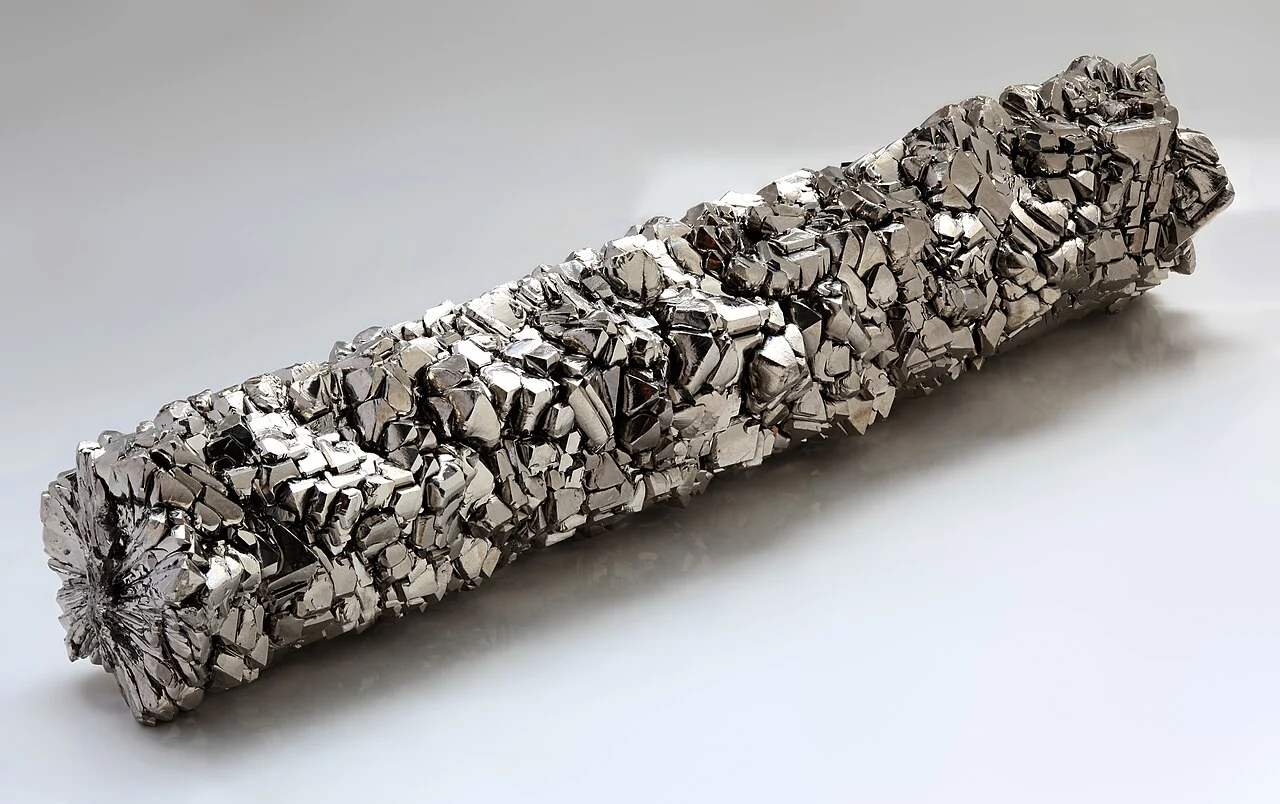
순수 티타늄의 밀도는 4.506 g/cm³(4,506 kg/m³ / 0.163 lb/in³)으로, 알루미늄(2.70 g/cm³)과 탄소강(7.85 g/cm³)의 중간에 위치합니다. 티타늄은 스테인리스 스틸 대비 부피 기준으로 약 43% 가볍고, 알루미늄보다는 약 67% 무겁습니다. 전 세계 티타늄 소비량의 50% 이상을 차지하는 Grade 5(Ti-6Al-4V)는 알루미늄 함량으로 인해 밀도가 4.43 g/cm³으로 다소 낮습니다. 하지만 소재 선정에서 실질적으로 중요한 수치는 비강도(인장강도를 밀도로 나눈 값)입니다. Grade 5 티타늄의 비강도(214 MPa·cm³/g)는 스테인리스 스틸(65)과 대부분의 알루미늄 합금을 크게 앞섭니다. 이 가이드에서는 주요 그레이드별 정확한 밀도 값, 스틸 및 알루미늄과의 직접 비교, 비강도 표, 그리고 구매·설계 팀을 위한 중량 계산 공식을 다룹니다.
모든 단위로 보는 티타늄 밀도
대부분의 소재 데이터베이스는 g/cm³ 기준으로 수록되어 있습니다. 북미 현장의 엔지니어에게는 lb/in³이 필요하고, 톤 단위로 발주하는 구매 담당자에게는 kg/m³이 필요합니다. 아래는 Grade 1~3에 해당하는 상용 순수(CP) 티타늄의 주요 단위별 환산 수치입니다.
| 단위 | 가치 |
|---|---|
| g/cm³ (그램 퍼 세제곱센티미터) | 4.506 |
| kg/m³ (킬로그램 퍼 세제곱미터) | 4,506 |
| lb/in³ (파운드 퍼 세제곱인치) | 0.163 |
| lb/ft³ (파운드 퍼 세제곱피트) | 281.3 |
이 수치는 ASM International의 CP 티타늄 물성표를 기반으로 합니다. Grade 4는 산소 함량이 높아 밀도가 4.54 g/cm³으로 다소 높으며, 이는 부피 변화 없이 질량을 증가시킵니다.
간단한 현장 확인법: 티타늄은 물보다 약 4.5배 밀도가 높습니다. 동일한 크기의 알루미늄 봉과 비교했을 때, 티타늄 봉은 확연히 무겁게 느껴져야 합니다. 그렇지 않다면 소재를 다시 확인해야 합니다.
티타늄 그레이드별 밀도 차이
업계에서 흔히 단일 수치로 “티타늄 밀도'를 표기하는 관행은 그레이드 간 의미 있는 차이를 간과하게 만듭니다. 합금 원소는 최종 밀도에 영향을 미치는데, 알루미늄처럼 가벼운 원소는 밀도를 낮추고, 크롬이나 몰리브덴처럼 무거운 원소는 밀도를 높입니다.
| 등급 | 등급 | 밀도(g/cm³) | 참고 |
|---|---|---|---|
| 1등급 | CP Ti | 4.51 | 가장 연질, 성형성 최고 |
| 2등급 | CP Ti | 4.51 | 전 세계에서 가장 널리 사용되는 CP 그레이드 |
| 3학년 | CP Ti | 4.51 | G2보다 강도 높음, 밀도 동일 |
| 4학년 | CP Ti | 4.54 | CP 그레이드 중 최고 강도 |
| 9학년 | Ti-3Al-2.5V | 4.48 | “Half-6-4”, 자전거 프레임 및 튜빙용 |
| 5학년 | Ti-6Al-4V | 4.43 | 주력 합금, 전 세계 Ti 사용량의 약 50% |
| Beta C | Ti-3Al-8V-6Cr-4Zr-4Mo | 4.81 | 고강도, 스프링 용도 |
출처: AZoM / ASM International 물성표
Grade 5의 밀도가 4.43 g/cm³으로 낮아지는 이유는, 밀도 2.70 g/cm³인 알루미늄이 6% 첨가되어 전체 밀도를 희석하기 때문입니다. 반면 베타 합금은 크롬, 몰리브덴, 바나듐이 모두 티타늄보다 높은 밀도를 가지므로 상대적으로 무겁습니다. 중량이 중요한 용도에서 티타늄 소재를 지정할 때, 누군가 ’4.51“이라는 수치를 제시한다면 어느 그레이드인지 반드시 확인하십시오. 동일 부피에서 Beta C를 Grade 5 대신 사용하면 부품 중량이 약 8% 증가합니다.
티타늄 vs 스틸 밀도: 43% 차이
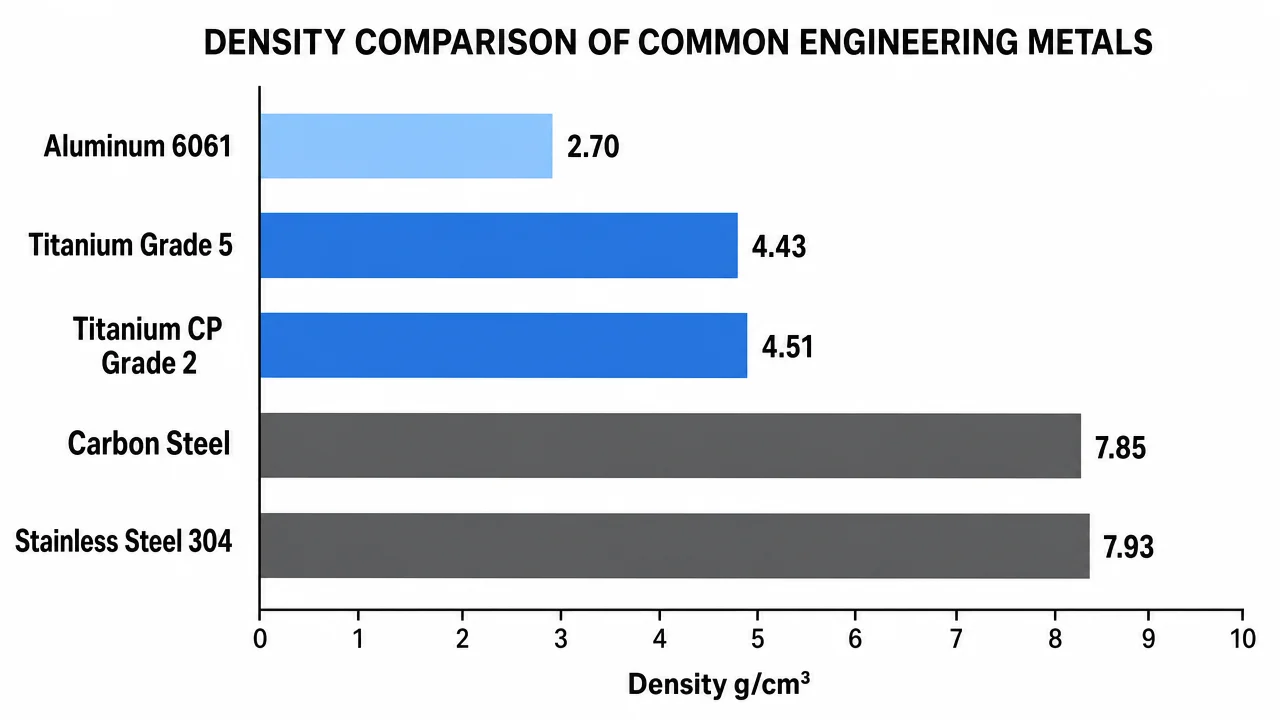
스틸은 한 세기 넘게 구조용 금속의 기본 소재로 자리 잡아 왔습니다. 티타늄 대체 검토는 항상 이 비교에서 시작됩니다.
| 재료 | 밀도(g/cm³) | 밀도 (kg/m³) |
|---|---|---|
| 티타늄 Grade 2 (CP) | 4.51 | 4,510 |
| 티타늄 Grade 5 (Ti-6Al-4V) | 4.43 | 4,430 |
| 탄소강 AISI 1020 | 7.85 | 7,850 |
| 304 스테인리스강 | 7.93 | 7,930 |
| 스테인리스 스틸 316 | 8.00 | 8,000 |
CP 티타늄(Grade 2)은 304 스테인리스 스틸 대비 부피 기준으로 43% 가볍습니다. Grade 5는 여기서 추가적인 중량 절감 효과를 제공합니다. 304 스테인리스 스틸로 만든 10 kg짜리 부품과 동일한 형상으로 CP 티타늄을 적용하면, 무게는 약 5.7 kg으로 줄어들어 4.3 kg을 절감할 수 있습니다.
이 차이는 빠르게 누적된다. 5,000개 파스너 생산 배치 기준으로, 조립 구조물 전체에서 수백 킬로그램의 중량 절감으로 이어진다. 항공우주 분야에서는 연료 소모가 기체 중량에 직접 비례하기 때문에, 이러한 체계적인 경량화는 함대 운용 기간 전반에 걸쳐 측정 가능한 경제적 가치를 창출한다.
그러나 더욱 주목할 부분은 강도다. 304 스테인리스강의 극한 인장 강도(UTS)는 약 515 MPa이며, Grade 5 티타늄은 어닐링 상태에서 950 MPa에 달한다. 동등한 하중을 지지하면서도 벽 두께를 더 얇게 설계할 수 있기 때문에, 강도 중심 설계에서 실질적인 중량 이점은 단순 밀도 차이를 훨씬 초과한다. 항공우주 엔지니어들은 스틸 부품을 티타늄으로 재설계할 때 단면 축소를 통해 총 중량의 50–65%를 절감했다는 사례를 일반적으로 보고하고 있다.
티타늄 대 알루미늄 밀도: 더 무거운 금속, 종종 더 가벼운 부품
알루미늄은 자동차, 소비자 가전, 자전거 제조 분야에서 기본적인 경량 금속으로 통한다. 밀도 기준으로는 티타늄이 더 무겁다. 그러나 여기서 직관에 반하는 결과가 나타난다.
| 재료 | 밀도(g/cm³) | UTS 대표값 (MPa) | 비강도 (MPa·cm³/g) |
|---|---|---|---|
| 알루미늄 6061-T6 | 2.70 | 310 | 115 |
| 알루미늄 7075-T6 | 2.81 | 572 | 204 |
| 티타늄 Grade 2 (CP) | 4.51 | 340 | 75 |
| 티타늄 Grade 5 (Ti-6Al-4V) | 4.43 | 950 | 214 |
| 304 스테인리스강 | 7.93 | 515 | 65 |
UTS 출처: AMS 4928 (Grade 5 어닐링), ASTM A276 (304 SS), ASTM B209 (6061-T6, 7075-T6)
티타늄은 알루미늄보다 부피 기준으로 약 67% 더 무겁다. 동일한 형상의 봉재 기준으로, 티타늄은 알루미늄보다 1.67배 더 나간다.
그러나 비강도에 주목할 필요가 있다. Grade 5 티타늄(214 MPa·cm³/g)은 7075-T6 알루미늄(204)을 소폭 앞서며, 6061-T6(115)의 두 배 이상이다. 인장 강도와 피로 수명이 설계를 결정하는 용도 — 랜딩 기어 피팅, 외과용 임플란트, 고하중 자전거 부품 등 — 에서는 티타늄 부품의 단면을 더 작게 설계할 수 있다. 이렇게 하면 밀도가 더 높음에도 불구하고, 완성된 티타늄 부품의 중량이 알루미늄 동등 부품과 비슷해질 수 있다.
Grade 2 CP titanium tells a different story: specific strength of 75 falls below even 6061 aluminum. CP titanium is chosen for corrosion resistance and biocompatibility, not structural efficiency. If you’re sourcing CP titanium for a weight-critical structure, you’re probably using the wrong grade. Grade 5 is the answer.
The other argument that closes the Ti-vs-Al decision is temperature. 7075-T6 aluminum begins losing strength above approximately 150°C. Grade 5 titanium maintains its mechanical properties to around 315°C. For structures near engine bays, exhaust systems, or re-entry vehicles, aluminum fails the thermal requirement regardless of specific strength.
The Number That Actually Drives Material Selection: Specific Strength
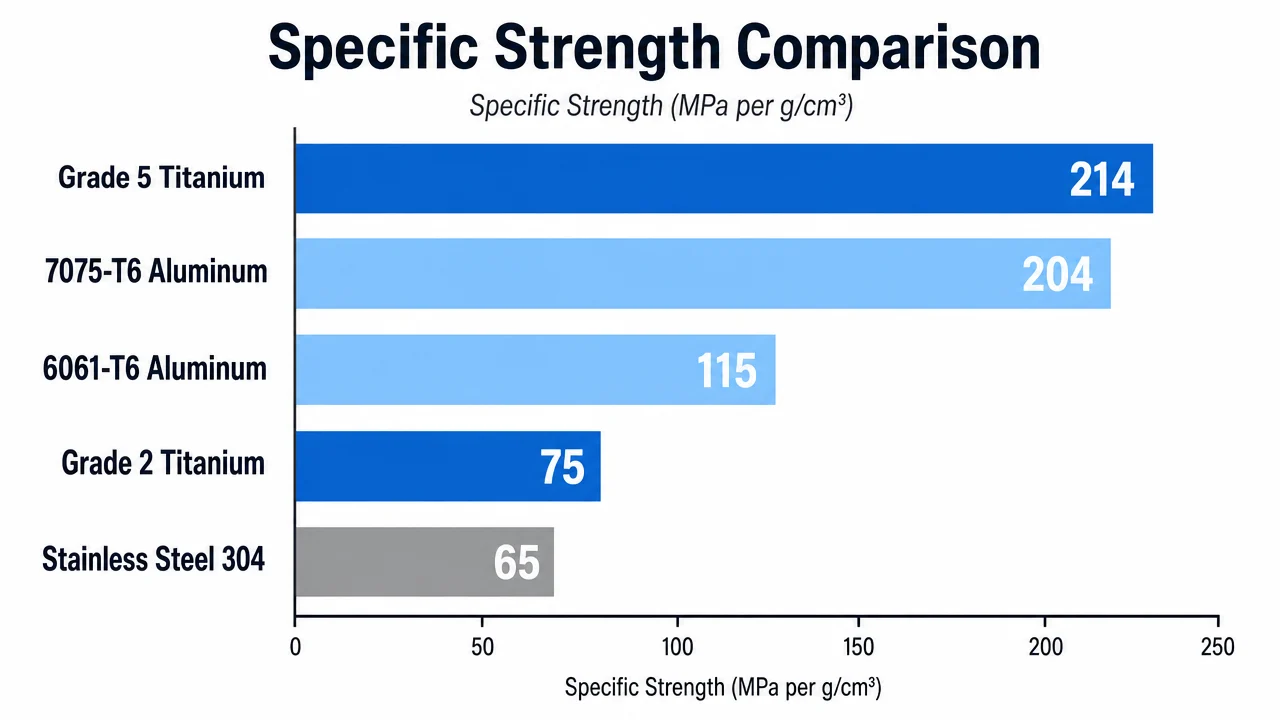
Density tells you how heavy a given volume of metal is. Specific strength tells you how much structural load that metal can carry per unit of mass. For comparing materials across an engineering design, specific strength is the relevant figure.
Specific Strength = UTS (MPa) ÷ Density (g/cm³)
Comparing Grade 5 titanium to 304 stainless: 950 ÷ 4.43 = 214 vs 515 ÷ 7.93 = 65. Grade 5 delivers more than 3× the structural performance per gram. That ratio is why the aerospace industry migrated critical fasteners and structural members from steel to titanium over several decades — not because titanium is lighter in absolute terms, but because for a given structural requirement, the titanium solution is dramatically lighter.
The aluminum-versus-titanium comparison is closer. 7075-T6 at 204 is almost equal to Grade 5 at 214. This is why the choice between them in aerospace isn’t a density argument — it’s a temperature argument. Where temperatures stay below 150°C and cost matters, 7075 wins. Where temperatures exceed 150°C or fatigue life is critical, Grade 5 wins.
For reference: carbon fiber reinforced polymer (CFRP) has a specific strength around 375 — roughly 1.75× Grade 5 titanium. The reason titanium persists alongside CFRP in aerospace is repairability, isotropy, and machinability. Titanium can be welded, machined, and repaired in field conditions. CFRP cannot.
Weight Calculation for B2B Procurement
Once you’ve settled on a grade, calculating part weight is straightforward. The core formula:
Weight = Volume × Density
For a rectangular plate (metric units):
Weight (kg) = [L (mm) × W (mm) × T (mm) × density (g/cm³)] ÷ 1,000,000
Worked example — Grade 5 plate, 500 mm × 300 mm × 6 mm:
500 × 300 × 6 × 4.43 ÷ 1,000,000 = 3.99 kg
Same plate in 304 stainless (density 7.93 g/cm³):
500 × 300 × 6 × 7.93 ÷ 1,000,000 = 7.14 kg
Same geometry: Grade 5 titanium is 44% lighter. On a production run of 500 units, that’s approximately 1,575 kg of weight removed from the final assembly — directly impacting shipping cost and, for aerospace or automotive assemblies, fuel efficiency over the product’s lifetime.
For round bar stock:
Weight (kg) = π × (D/2 in mm)² × L (mm) × density (g/cm³) ÷ 1,000,000
For imperial (lb/in³), replace the density value with 0.160 for Grade 5 or 0.163 for CP Grade 2, and input dimensions in inches. Drop the ÷ 1,000,000 adjustment — the result is in pounds directly.
When Titanium’s Density Advantage Matters — and When It Doesn’t
Titanium’s weight advantage is genuine, but it isn’t always the decision-governing factor.
Titanium density advantage is decisive when:
- Strength-to-weight is the primary design constraint: aerospace structures, performance automotive components, medical implants
- Operating temperatures exceed 150°C, ruling out high-strength aluminum alloys
- Corrosion resistance is required and stainless steel’s weight penalty is unacceptable
- Fatigue life under high-cycle loading is the limiting design criterion
Titanium density advantage is secondary — or irrelevant — when:
- Cost governs: titanium runs 5–10× the price of stainless steel per kg; the weight saving rarely pays off for static, ground-mounted structures
- Machinability matters: titanium’s low thermal conductivity and tendency to work-harden make it significantly slower and more expensive to machine than steel or aluminum
- Volume is high and tolerances are loose: aluminum remains cheaper and faster for high-volume, moderate-performance parts
- The component isn’t weight-constrained: a structural support in a fixed industrial installation doesn’t benefit from saving 4 kg per unit
When evaluating a titanium substitution in B2B manufacturing, the first question isn’t “how dense is titanium?” — it’s whether the weight saving generates measurable value. For a medical implant reducing patient load or a satellite bracket enabling a heavier payload, every gram matters. For a ground-based pump housing, the density advantage is largely academic.
자주 묻는 질문
What is the density of titanium?
Pure (commercially pure) titanium has a density of 4.506 g/cm³, or 4,506 kg/m³, or 0.163 lb/in³. The most widely used alloy, Grade 5 (Ti-6Al-4V), is 4.43 g/cm³. Beta alloys like Beta C can reach 4.81 g/cm³.
Is titanium lighter than steel?
Yes. Titanium is approximately 43% lighter than stainless steel 304 by volume. A 10 cm³ block of titanium weighs about 45 g; the same block of 304 stainless weighs approximately 79 g.
Is titanium heavier than aluminum?
Yes — by about 67% on a per-volume basis. However, Grade 5 titanium’s specific strength (214 MPa·cm³/g) is comparable to high-strength 7075-T6 aluminum (204), meaning a titanium part designed for the same structural load often ends up at similar weight to its aluminum counterpart.
Why does Grade 5 titanium have lower density than pure titanium?
Grade 5 (Ti-6Al-4V) contains 6% aluminum, which has a density of only 2.70 g/cm³ — well below titanium’s 4.506. Adding this lighter element to the alloy reduces overall density from 4.51 (CP Grade 2) to 4.43 g/cm³.
What is titanium density in kg/m³?
4,506 kg/m³ for CP titanium (Grades 1–3). Grade 5 is 4,430 kg/m³. Grade 4 is 4,540 kg/m³.
Is titanium the lightest structural metal?
No. Aluminum (~2.70 g/cm³) and magnesium (~1.74 g/cm³) are lighter. Titanium’s advantage is its superior specific strength and high-temperature performance relative to those lighter metals — not absolute lightness.
요약
Titanium sits at 4.506 g/cm³ — 43% lighter than stainless steel, 67% heavier than aluminum. The grade you specify matters: Grade 5 at 4.43 g/cm³ is the lightest commonly used structural alloy; Beta C at 4.81 is notably heavier. The density number alone rarely drives the decision. Specific strength — where Grade 5 titanium (214 MPa·cm³/g) outperforms stainless steel (65) and most aluminum alloys — is what justifies titanium’s cost premium in structural applications. For B2B procurement and component design, the weight saving calculation is straightforward: multiply volume by density, compare grades, and evaluate whether the mass reduction generates value proportional to titanium’s price premium.