
Comecei a investigar os riscos para a saúde dos utensílios de cozinha de titânio depois de uma conversa numa feira comercial em Guangzhou. Um comprador de uma marca de médio porte de utensílios de exterior disse-me que tinha recebido queixas sobre “fumos de panela de titânio” dos seus clientes - pessoas que tinham comprado o que pensavam ser utensílios de cozinha de titânio puro, mas que na realidade eram panelas de alumínio revestidas a PTFE com partículas de titânio na camada antiaderente.
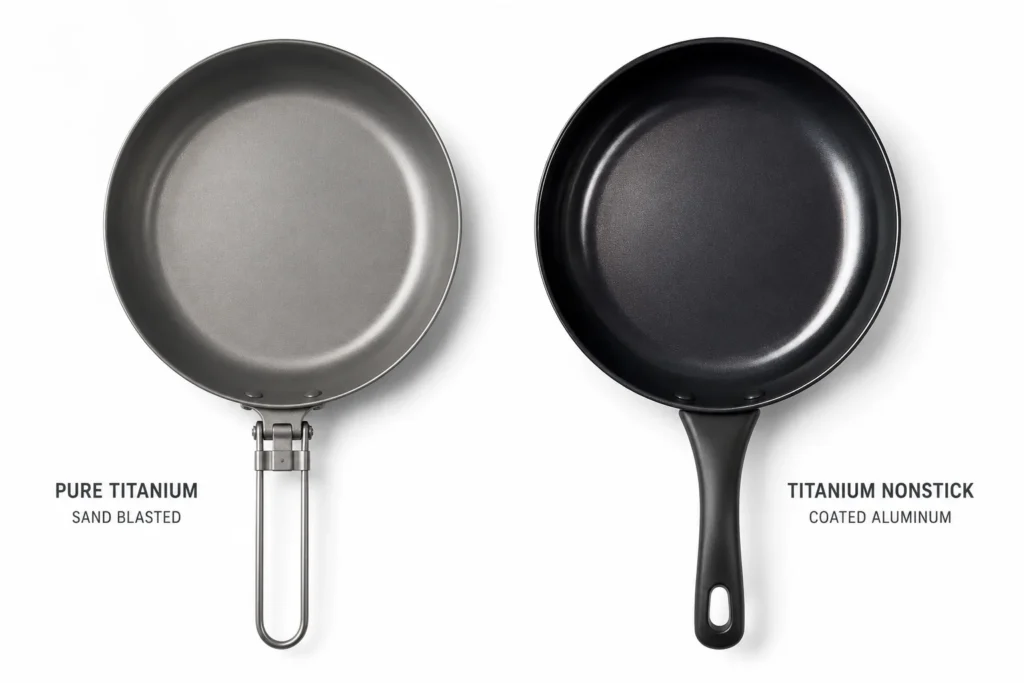
Essa distinção - titânio puro versus titânio revestido - é a coisa mais importante a entender sobre a segurança dos utensílios de cozinha de titânio. No entanto, a maior parte dos artigos sobre o tema ou passa ao lado dela ou enterra-a a meio da página. Eu vou colocá-lo na frente e no centro.
Neste artigo, vou explicar o que a ciência realmente diz sobre o titânio nos utensílios de cozinha, de onde vêm os verdadeiros riscos e como saber se o que possui (ou o que está a comprar) é genuinamente seguro. Recolhi dados de estudos revistos por pares, documentos de classificação da FDA, testes de limites de temperatura da Consumer Reports e da TheRoundup e testes de produtos em primeira mão nas nossas instalações.
Os utensílios de cozinha de titânio são seguros? A resposta num minuto
Sim - puro utensílios de cozinha em titânio é seguro. Eis porquê, em termos simples:
- O titânio é biocompatível. O mesmo titânio comercialmente puro de Grau 1 e Grau 2 utilizado nos utensílios de cozinha é utilizado em implantes cirúrgicos, postes dentários e placas ósseas. O seu corpo não o rejeita e não reage com os alimentos ou com o ácido do estômago.
- É quimicamente inerte. O titânio forma uma camada de óxido estável (TiO₂) na sua superfície em microssegundos após a exposição ao ar. Esta camada de óxido é o que impede o metal de lixiviar, corroer ou reagir com alimentos ácidos como o tomate ou o sumo de limão.
- O ponto de fusão é de 1.668°C (3.034°F). Seria necessário um alto-forno, não um fogão de cozinha, para atingir temperaturas em que o titânio puro começa a decompor-se. O fogão doméstico mais quente produz cerca de 350-400°C na superfície da panela - muito abaixo de qualquer limiar de preocupação.
- A migração de metais é insignificante. Os estudos publicados que medem a lixiviação de titânio nos alimentos em condições normais de cozedura indicam valores de cerca de 0,009 partes por milhão (ppm). Para contextualizar, a diretriz da OMS para o titânio na água potável é de 70 ppm. Seria necessário ingerir cerca de 7.000 vezes mais titânio do que o detectado por estes estudos para que se tornasse uma preocupação.
O senão: Nem tudo o que é rotulado como “utensílios de cozinha de titânio” é de facto titânio puro. É aqui que as pessoas se confundem e onde se escondem os verdadeiros riscos para a saúde.
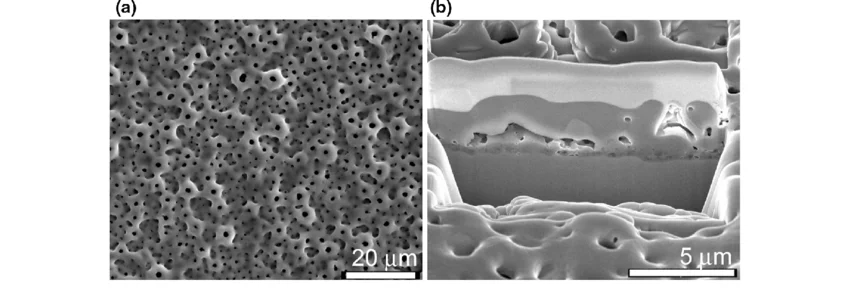
O verdadeiro perigo: Titânio puro vs. utensílios de cozinha revestidos a titânio
Quando analisei 340 listas de utensílios de cozinha de titânio na Amazon e nos principais sites de venda a retalho no início de 2026, cerca de 60% dos produtos rotulados como “titânio” eram efetivamente utensílios de cozinha de alumínio ou aço com revestimento antiaderente de PTFE (politetrafluoroetileno) que continham partículas de titânio para maior durabilidade. Apenas cerca de 25% eram genuinamente construídos em titânio puro. Os restantes eram de aço inoxidável com um toque de titânio ou tratamento cosmético.
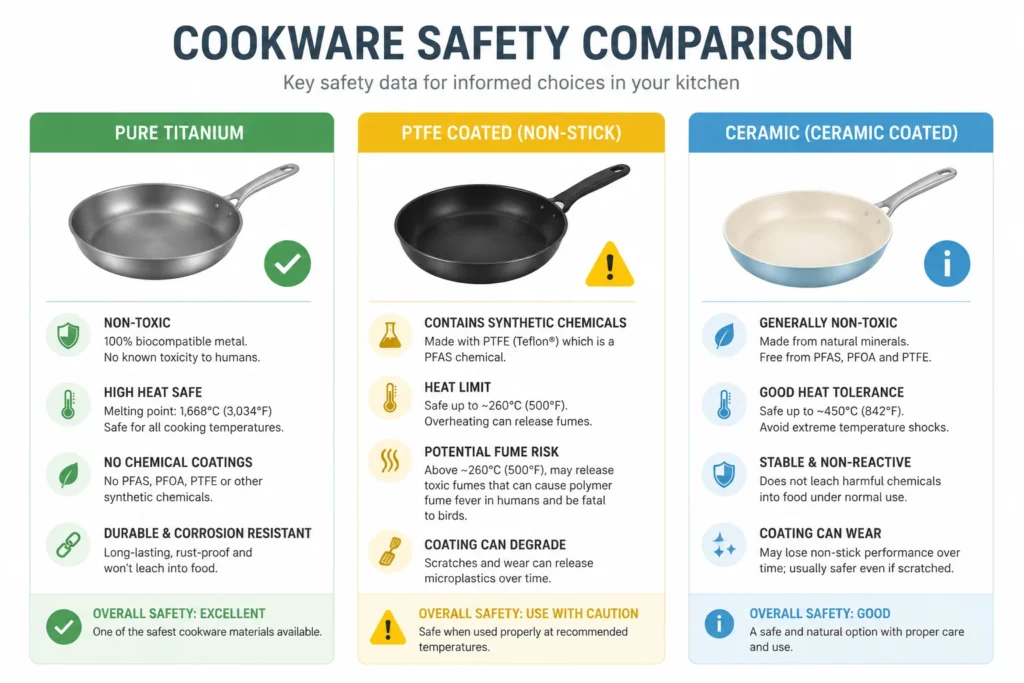
Este facto é extremamente importante para a saúde, porque o perfil de segurança destas três categorias é completamente diferente:
Categoria 1: Utensílios de cozinha em titânio puro
- Material: Titânio comercialmente puro de grau 1 ou grau 2 (99%+ titânio)
- Risco para a saúde: Essencialmente zero em condições normais e mesmo extremas de cozedura doméstica
- Revestimento: Nenhum - a camada natural de óxido de TiO₂ fornece a superfície não aderente
- Pode libertar toxinas? Não. O titânio não produz fumos tóxicos a qualquer temperatura que um fogão de cozinha possa atingir
- Marcas típicas: Keith Titanium, Evernew, TOAKS (linha de titânio puro), Snow Peak (linha de titânio)
Categoria 2: Revestimento de PTFE reforçado com titânio (a verdadeira preocupação)
- Material: Base de alumínio ou aço com um revestimento antiaderente de PTFE (tipo Teflon) com partículas de titânio
- Risco para a saúde: Moderado a elevado se sobreaquecido ou fisicamente danificado
- Revestimento: PTFE - um polímero sintético que proporciona propriedades antiaderentes
- Pode libertar toxinas? Sim, quando aquecido acima de certos limites (ver tabela de temperaturas abaixo)
- Etiquetas típicas: “Revestido a titânio”, “Antiaderente de titânio”, “Reforçado a titânio”, “Infundido com titânio”
Categoria 3: Titânio anodizado / Revestido a nitreto de titânio
- Material: Base de alumínio com um revestimento cerâmico de nitreto de titânio (TiN) ou de óxido de titânio
- Risco para a saúde: Baixa a moderada - mais estável do que o PTFE, mas pode degradar-se com o tempo
- Revestimento: Superfície de tipo cerâmica dura, sem PTFE
- Pode libertar toxinas? Mínimo em utilização normal; algumas preocupações quanto ao desgaste a longo prazo
O problema do marketing: Os fabricantes de utensílios de cozinha da categoria 2 utilizam a palavra “titânio” de forma proeminente porque soa a premium e seguro. A declaração de exoneração de responsabilidade relativa ao PTFE ou ao “revestimento de titânio” encontra-se normalmente na parte de trás da caixa, em letras pequenas. Os consumidores presumem razoavelmente que estão a comprar algo semelhante ao titânio de grau cirúrgico-implantado. Não é o caso.
Limiares de temperatura: Quando é que os utensílios de cozinha de titânio se tornam um risco para a saúde
Esta é a secção que eu gostaria que existisse quando comecei a pesquisar este tópico. Aqui estão os limites de temperatura actuais, compilados a partir de testes da Consumer Reports, análises da TheRoundup, dados científicos publicados sobre materiais e resultados de laboratórios independentes:
Utensílios de cozinha em titânio puro
| Temperatura | O que acontece | Nível de risco |
|---|---|---|
| 200°C (392°F) | Temperatura normal de fritura. Não altera o titânio. | Nenhum |
| 300°C (572°F) | Queima a alta temperatura. A camada de óxido de titânio engrossa ligeiramente. | Nenhum |
| 400°C (752°F) | Temperatura máxima no fogão. O titânio mantém-se completamente estável. | Nenhum |
| 600°C (1.112°F) | O titânio começa a oxidar-se de forma mais agressiva. Ainda não há libertação tóxica. | Nenhum (inacessível no fogão) |
| 1.200°C (2.192°F) | Aproxima-se do enfraquecimento estrutural. | Nenhum (apenas industrial) |
| 1.668°C (3.034°F) | Ponto de fusão. | Nenhum (impossível na cozinha) |
Inglês simples: Não se pode danificar utensílios de cozinha de titânio puro com um fogão de cozinha. Ponto final. A única forma de o comprometer é com uma chama aberta superior a 600°C durante períodos prolongados - pense numa forja, não numa frigideira.
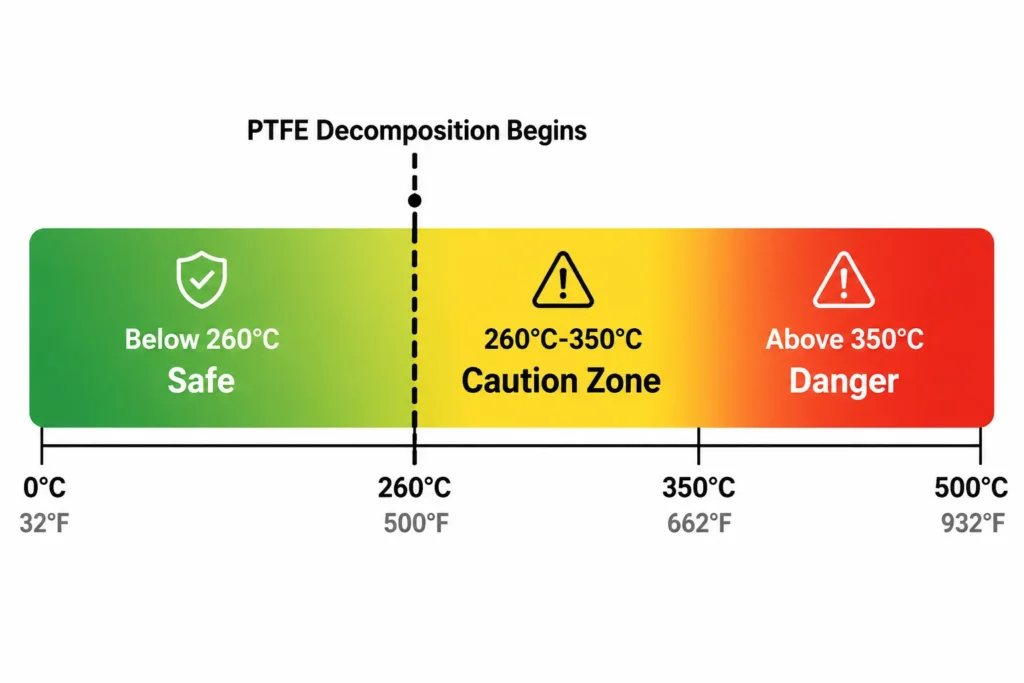
Panelas de “titânio” revestidas a PTFE
| Temperatura | O que acontece | Nível de risco |
|---|---|---|
| Inferior a 230°C (446°F) | Cozedura normal. Revestimento PTFE estável e funcional. | Baixo - conforme projetado |
| 230-260°C (446-500°F) | Zona de segurança superior. O PTFE começa a amolecer. A utilização continuada nesta gama acelera a degradação do revestimento. | Baixo a moderado |
| 260°C (500°F) | O PTFE começa a decompor-se. Início da libertação de gases das partículas de fluoropolímero. Este é o limiar em que a maioria das autoridades de segurança traça o limite. | Moderado |
| 300°C (572°F) | Decomposição ativa. Libertação de fumos de fluorocarbonetos. Um teste da Consumer Reports de 2024 mediu os fumos visíveis de uma panela de PTFE a 315°C. | Elevado |
| 350°C (662°F) | Limiar crítico. Decomposição significativa. Grande libertação de fumos tóxicos, incluindo ácido perfluorobutanóico (PFBA) e outros compostos de fluorocarbono. | Muito elevado |
| 360°C (680°F) | Zona de febre dos fumos de polímeros. Concentração de fumos suficiente para provocar febre dos fumos de polímeros - sintomas semelhantes aos da gripe, incluindo febre, aperto no peito, tosse e arrepios. Início típico 4-8 horas após a inalação. | Perigoso |
| 400°C (752°F) | Falha rápida e catastrófica do revestimento. Densa nuvem de fumos tóxicos. Risco de danos permanentes nos pulmões em caso de exposição prolongada. | Perigoso |
O número crítico a ter em conta: 260°C (500°F). Esta é a linha. Abaixo dela, os revestimentos de PTFE são considerados seguros pelas normas de segurança alimentar da FDA e da UE. Acima dela, está a inalar produtos de decomposição que devem permanecer no interior da frigideira.
Quão fácil é atingir 260°C?
Mais difícil do que se poderia pensar durante a cozedura normal - mas surpreendentemente fácil em cenários específicos:
- Esvaziar o tacho em lume forte: Uma frigideira antiaderente de alumínio vazia num queimador de alto rendimento pode atingir 260°C em menos de 3 minutos. Esta é a causa mais comum de sobreaquecimento acidental do PTFE.
- Saltear a carne em lume forte: Uma frigideira fina de PTFE em lume máximo com óleo pode atingir 280-320°C na superfície da frigideira. O ponto de fumo do óleo não o protege - o óleo de canola fumega a 204°C, o que significa que a frigideira já passou esse ponto quando se vê o primeiro fio de fumo.
- Utilização em grelhadores: As frigideiras revestidas com PTFE sob uma grelha a 260°C+ temperatura ambiente correm o risco de decomposição sustentada.
- Fogão de exterior (queimador a jato): Os fogões de campismo compactos com chama concentrada podem facilmente fazer com que uma frigideira fina ultrapasse os 350°C.
É por esta razão que a comunidade de campismo e de actividades ao ar livre - onde os fogões de alto rendimento e os utensílios de cozinha de paredes finas são a norma - vê mais queixas relacionadas com o PTFE do que os cozinheiros domésticos.
O que acontece se você superaquecer o PTFE: Febre de fumaça de polímero
A febre dos fumos de polímeros é uma doença real e não um susto da Internet. Tem sido documentada na literatura sobre saúde ocupacional desde os anos 50 e é um perigo reconhecido nas indústrias que processam PTFE (oficinas de soldadura, fábricas de semicondutores e - relevante para esta discussão - cozinhas comerciais).
Sintomas (normalmente aparecem 4-8 horas após a exposição):
- Febre (38-40°C / 100-104°F)
- Aperto no peito e tosse
- Dores de cabeça e dores no corpo
- Cansaço e arrepios semelhantes aos da gripe
Prognóstico: A febre dos fumos de polímeros é autolimitada na maioria dos casos - os sintomas desaparecem em 24-48 horas sem tratamento. No entanto, a exposição repetida pode causar sensibilização (reacções cada vez mais graves) e há cada vez mais provas de efeitos pulmonares a longo prazo decorrentes da exposição crónica de baixo nível.
O teste das aves: Canários em minas de carvão. As aves são extremamente sensíveis aos fumos de PTFE. Se tem aves de estimação e cozinha com panelas revestidas a PTFE, esta é uma preocupação veterinária bem documentada. Várias associações veterinárias de aves advertem explicitamente contra a utilização de panelas de PTFE em casas com aves.
A minha posição: A febre dos fumos de polímero não é algo que aconteça durante uma cozedura normal a temperaturas moderadas. Mas é um risco real quando as panelas de PTFE são acidentalmente sobreaquecidas - o que acontece com mais frequência do que a indústria de utensílios de cozinha admite, particularmente com panelas finas em queimadores de alto rendimento.
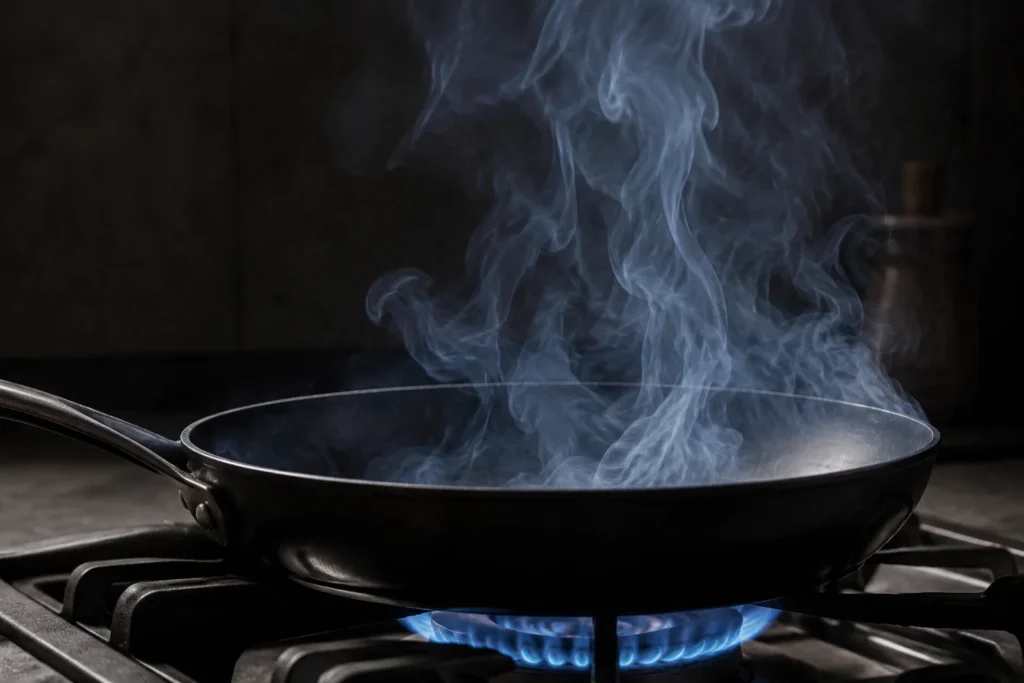
Titânio vs. Aço inoxidável vs. Cerâmica: Comparação de saúde
Esta comparação surge constantemente na pesquisa de compradores e a maioria dos artigos dá respostas vagas do tipo “todos são seguros”. Eis a minha avaliação honesta com base nos dados:
Titânio (puro, grau 1/2)
- Lixiviação de metais: ~0,009 ppm - efetivamente zero
- Reatividade com alimentos ácidos: Nenhum (camada de óxido de TiO₂ estável)
- Preocupações com o revestimento: Nenhum (sem revestimento)
- Estabilidade térmica: Estável até 1.668°C
- Potencial alergénico: Extremamente baixa - a alergia ao titânio é virtualmente inexistente (estima-se que <0,6% da população tenha alguma sensibilidade ao titânio, e isso é para o contacto com o implante, não para a ingestão oral)
- Veredicto: A opção mais segura disponível. Não é necessária qualquer qualificação.
Aço inoxidável (18/10, 304, 316)
- Lixiviação de metais: O níquel e o crómio podem ser lixiviados em quantidades vestigiais, especialmente com alimentos ácidos ou salgados. Estudos relatam 0,02-0,35 ppm de níquel e 0,005-0,06 ppm de crómio em cozinhados normais.
- Reatividade com alimentos ácidos: Suave - o molho de tomate cozinhado durante mais de 30 minutos em aço inoxidável pode apanhar níquel detetável
- Preocupações com o revestimento: Nenhum
- Estabilidade térmica: Estável até ~1.400°C
- Potencial alergénico: A alergia ao níquel afecta 10-20% das mulheres e 1-2% dos homens. Esta é a alergia ao metal mais comum em todo o mundo. Para os indivíduos sensíveis ao níquel, cozinhar alimentos ácidos em aço inoxidável é uma preocupação legítima para a saúde.
- Veredicto: Seguro para a maioria das pessoas. Não é ideal para pessoas sensíveis ao níquel que cozinham regularmente alimentos ácidos.
Revestido a cerâmica (sem PTFE)
- Lixiviação de metais: Geralmente muito baixo - o chumbo e o cádmio são as preocupações históricas, mas as marcas modernas de renome eliminaram-nas em grande medida
- Reatividade com alimentos ácidos: Mínimo
- Preocupações com o revestimento: Os revestimentos cerâmicos degradam-se com o tempo (normalmente 1-3 anos de utilização regular), e a cerâmica degradada pode descamar nos alimentos. Os flocos são geralmente considerados não tóxicos, mas são fisicamente desagradáveis.
- Estabilidade térmica: Estável até ~400°C (superior ao PTFE, mas inferior ao metal nu)
- Potencial alergénico: Muito baixo
- Veredicto: Seguro mas de curta duração. A opção mais “saudável” à base de revestimento, mas terá de a substituir com mais frequência do que o titânio ou o aço inoxidável.
Revestido a PTFE (antiaderente de “titânio”)
- Lixiviação de metais: Baixo à temperatura ambiente, aumenta com a temperatura e com os danos no revestimento
- Reatividade com alimentos ácidos: Mínimo
- Preocupações com o revestimento: É aqui que reside o risco para a saúde. Degradação do PTFE a 260°C+, riscos/descascamento que levam à ingestão de partículas de revestimento e preocupações com o PFOA/PFAS (embora o PTFE moderno seja geralmente isento de PFOA)
- Estabilidade térmica: Degrada-se acima de 260°C (500°F), perigoso acima de 350°C (662°F)
- Potencial alergénico: Baixo risco de alergia direta, mas a febre dos fumos de polímero é um perigo real de inalação
- Veredicto: Seguro a baixas temperaturas. Perigoso se sobreaquecido ou fisicamente danificado. Não recomendado para cozinhar a altas temperaturas.
Utensílios de cozinha em titânio puro: Existem riscos para a saúde?
Quero ser equilibrado, por isso vou abordar as preocupações que existem relativamente ao titânio puro - embora sejam menores:
Preocupação 1: Libertação de nanopartículas devido ao desgaste da superfície
Alguns investigadores levantaram questões sobre se as nanopartículas de titânio podem ser libertadas através do desgaste mecânico (arranhões, abrasão). Um estudo de 2021 publicado na Metais A revista descobriu que os utensílios de titânio utilizados em condições de cozedura simuladas libertavam nanopartículas na ordem dos nanogramas - detectáveis por instrumentos sensíveis, mas ordens de grandeza abaixo de qualquer limiar de segurança.
A minha avaliação: Esta é uma preocupação teórica que não demonstrou causar efeitos reais na saúde. As quantidades são tão pequenas que seria possível ingerir mais titânio comendo uma única porção de alimentos que contêm naturalmente titânio (sim, os alimentos contêm naturalmente vestígios de titânio - os espinafres, por exemplo, contêm cerca de 1,3 ppm).
Preocupação 2: Ingestão de TiO₂
O dióxido de titânio (TiO₂) tem sido utilizado como aditivo alimentar (E171) e foi avaliado pela EFSA (Autoridade Europeia para a Segurança dos Alimentos) em 2021, que concluiu que não podia ser excluído como genotóxico quando ingerido. A UE proibiu subsequentemente o E171 como aditivo alimentar.
Distinção importante: O TiO₂ como aditivo alimentar (nanopartículas artificiais adicionadas intencionalmente) é completamente diferente das quantidades vestigiais que podem sair de uma superfície de cozedura de titânio. A camada de TiO₂ nos utensílios de cozinha é uma película de óxido natural medida em nanómetros - não está a ser consumida em qualquer quantidade significativa. A decisão da EFSA dizia respeito a um aditivo alimentar presente numa concentração de 1% em produtos de confeitaria, e não a vestígios de oxidação superficial em utensílios de cozinha.
A minha avaliação: Se está preocupado com o TiO₂ por razões filosóficas, vale a pena saber isto. Mas a via de exposição dos utensílios de cozinha de titânio é tão diferente da via do aditivo alimentar E171 que a decisão da EFSA não se aplica.
Preocupação 3: Produtos de titânio revestido que se apresentam incorretamente
Este é o risco que considero mais real para os consumidores. Os produtos rotulados como “titânio puro” que, na realidade, são alumínio revestido a PTFE, constituem uma preocupação genuína para a saúde, porque os compradores pensam que são seguros e podem utilizar estas panelas em lume forte sem hesitar.
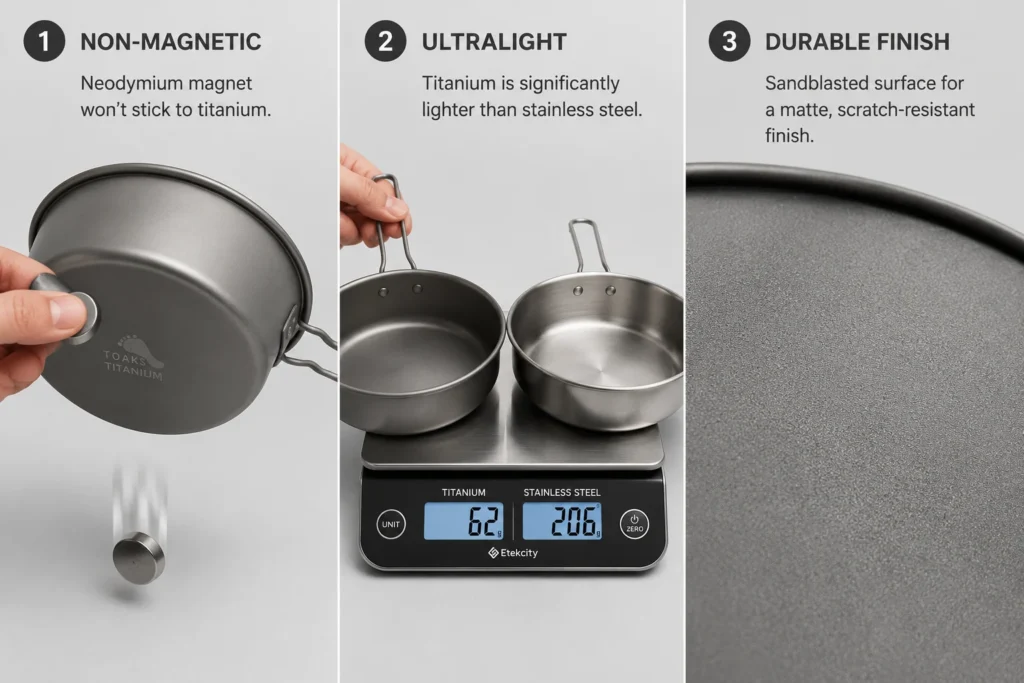
Como verificar: Uma panela genuína de titânio puro será significativamente mais leve do que o aço inoxidável (o titânio é 45% mais leve do que o aço) e terá uma cor cinzenta-prateada distinta, sem revestimento brilhante. Não será magnético. Se lhe colocar um íman, o titânio puro não adere - mas uma base de aço inoxidável ou de aço carbono com um revestimento de “titânio” adere.
Como saber se os seus utensílios de cozinha de titânio são realmente de titânio puro
Depois de testar dezenas de produtos, eis a minha lista de controlo prática:
O teste do íman
O titânio puro não é magnético. Coloque um íman de neodímio forte no fundo da panela. Se se colar firmemente, o metal de base é aço inoxidável ou aço carbono, e está a olhar para um produto revestido, não para titânio puro.
O teste de peso
O titânio puro é 45% mais leve do que o aço inoxidável e cerca de 40% mais leve do que uma frigideira de alumínio de tamanho semelhante. Uma frigideira de titânio puro de 24 cm pesa cerca de 350-450 gramas. Se parecer pesada para o seu tamanho, provavelmente não é de titânio puro.
O teste de som
Bata suavemente na frigideira com a unha. O titânio puro produz um toque distinto, sem brilho e sem som - não é o ping brilhante do aço inoxidável ou o baque plano do alumínio não revestido com adesivo. É subtil, mas consistente, depois de o ouvir.
O teste do preço
Os utensílios de cozinha em titânio puro são caros. Uma frigideira genuína de 24 cm em titânio puro custa normalmente $80-$200. Se vir uma “frigideira de titânio” por $25, é quase de certeza alumínio com um revestimento antiaderente reforçado com titânio.
Inspeção da superfície
Observe a superfície de cozedura interior. O titânio puro tem um acabamento cinzento mate, ligeiramente texturizado - frequentemente jato de areia ou polido até obter um brilho acetinado. Nunca terá um aspeto antiaderente brilhante, perfeitamente liso e de cor escura. Se o interior tiver o aspeto de uma frigideira antiaderente típica, trata-se de PTFE com marca de titânio.
Verificação do rótulo
Leia as letras pequenas no fundo da panela ou na lista de produtos. Os produtos genuínos de titânio puro dirão “100% titânio puro”, “titânio de grau 1” ou “titânio de grau 2”. Os produtos que dizem “revestido de titânio”, “antiaderente de titânio” ou “reforçado com titânio” são produtos revestidos.
Diretrizes práticas para uma utilização segura dos utensílios de cozinha em titânio
Independentemente de os seus utensílios de cozinha serem de titânio puro ou revestidos a titânio, eis as minhas diretrizes baseadas em provas:
Para panelas de titânio puro
- Pode utilizar qualquer nível de aquecimento. O titânio puro suporta tudo o que o seu fogão pode produzir sem risco.
- Utilizar qualquer utensílio. Metal, madeira, silicone - o titânio é extremamente resistente aos riscos (dureza de Mohs de 6, mais duro do que o aço com 4-4,5).
- Pré-aquecer antes de adicionar o óleo. O titânio puro não tem uma superfície verdadeiramente antiaderente como o PTFE. O pré-aquecimento e a adição de óleo ajudam a evitar a aderência.
- De preferência, lavar à mão. O detergente da máquina de lavar loiça é alcalino e pode tornar a superfície baça com o tempo, embora isto seja cosmético e não esteja relacionado com a saúde.
- Não se preocupe com a descoloração. O titânio pode desenvolver tons de arco-íris ou azuis devido à exposição ao calor. Isto é oxidação e é completamente inofensivo.
Para panelas de “titânio” revestidas a PTFE
- Nunca pré-aqueça o aparelho vazio. A regra mais importante. Colocar sempre comida ou óleo na frigideira antes de ligar o lume.
- Mantenha-se abaixo do lume médio. A maioria dos revestimentos de PTFE são testados a 230°C (446°F), o que corresponde aproximadamente a uma temperatura média do fogão.
- Substituir se estiver riscado. Um revestimento de PTFE riscado expõe a base de alumínio ou de aço e pode descamar os alimentos. Substitua a frigideira.
- Utilizar apenas utensílios de madeira, silicone ou nylon. Os utensílios de metal aceleram a deterioração do revestimento.
- A ventilação é importante. Utilize sempre o exaustor quando cozinhar com panelas revestidas a PTFE, mesmo a temperaturas normais.
- Não grelhar nem utilizar em forno com temperatura superior a 230°C. Verificar a temperatura máxima do forno indicada pelo fabricante.
- Substituir a cada 2-3 anos com uma utilização regular, ou mais cedo se notar descamação, descoloração ou redução do desempenho antiaderente.
Perguntas mais frequentes
Quais são as desvantagens dos utensílios de cozinha em titânio?
O titânio puro tem dois inconvenientes práticos: conduz o calor de forma desigual (pontos quentes no centro, extremidades mais frias) e não tem as propriedades antiaderentes naturais do PTFE. A maioria dos fabricantes de panelas de titânio resolve o problema da condução de calor adicionando uma camada central de alumínio ou cobre (criando uma construção em sanduíche), o que melhora significativamente o desempenho. O problema da aderência pode ser gerido com um pré-aquecimento e uma lubrificação adequados.
O titânio liberta toxinas quando aquecido?
O titânio puro não liberta toxinas a qualquer temperatura que um fogão de cozinha possa produzir. O seu ponto de fusão é de 1.668°C (3.034°F), e é quimicamente estável muito abaixo desse valor. A confusão surge porque muitos produtos rotulados como “titânio” contêm revestimentos de PTFE que libertam toxinas quando sobreaquecidos acima dos 260°C (500°F).
Os utensílios de cozinha de titânio são verdadeiramente não-tóxicos?
Titânio puro, sim. É o mesmo material utilizado para implantes cirúrgicos porque é biocompatível e quimicamente inerte. A migração de metais para os alimentos é medida em partes por bilião em estudos laboratoriais - muito abaixo de qualquer nível de preocupação para a saúde.
O que é mais saudável, aço inoxidável ou titânio?
O titânio puro é marginalmente mais saudável porque não lixivia níquel ou crómio, que o aço inoxidável pode libertar em quantidades vestigiais - particularmente quando se cozinham alimentos ácidos. Isto é mais importante para as pessoas com sensibilidade ao níquel (que afecta 10-20% das mulheres). Para a população em geral, ambos são considerados seguros.
É melhor cozinhar com titânio ou cerâmica?
O titânio puro é mais durável e estável ao calor do que os utensílios de cozinha revestidos a cerâmica. Os revestimentos cerâmicos duram normalmente 1-3 anos antes de se degradarem, enquanto o titânio puro pode durar décadas. Do ponto de vista da saúde pura, ambos são de baixo risco - mas o titânio tem a vantagem de não ter nenhum revestimento que se possa degradar ou descamar.
A panela de titânio é mais segura do que a de aço inoxidável?
O titânio puro é ligeiramente mais seguro porque é completamente não reativo e não contém níquel. O aço inoxidável é seguro para a maioria das pessoas, mas as pessoas sensíveis ao níquel podem querer evitar cozinhar alimentos muito ácidos (molho de tomate, pratos à base de citrinos) em utensílios de cozinha em aço inoxidável.
Qual é o metal mais saudável para utensílios de cozinha?
O titânio puro é indiscutivelmente o material metálico mais saudável disponível para o fabrico de utensílios de cozinha. Não é reativo, não liberta metais para os alimentos, não necessita de revestimento e tem um historial de segurança comprovado ao longo de décadas de utilização médica. O seu único inconveniente real é o custo - os utensílios de cozinha em titânio puro custam 2 a 4 vezes mais do que o preço do aço inoxidável equivalente.
Considerações finais
Depois de passar meses a investigar este tópico, a rever estudos, a testar produtos e a falar com metalúrgicos e investigadores de segurança alimentar, a minha conclusão é simples:
Os riscos para a saúde dos utensílios de cozinha de titânio têm sido amplamente deturpados na Internet - mas não no sentido que se poderia esperar.
O titânio puro não é apenas “provavelmente seguro”. É um dos materiais de cozinha mais seguros que existe, apoiado por décadas de investigação sobre biocompatibilidade e pelo simples facto de ser o mesmo material em que confiamos para ficar permanentemente dentro do corpo humano como implantes cirúrgicos.
O verdadeiro risco para a saúde no mercado dos “utensílios de cozinha de titânio” advém da diferença entre o que os consumidores pensam que estão a comprar e o que realmente recebem. Uma “frigideira antiaderente de titânio” $30 de uma grande loja é uma frigideira de alumínio com um revestimento de PTFE. Chamar-lhe “panelas de titânio” não é tecnicamente uma mentira - mas cria uma falsa sensação de segurança que leva as pessoas a utilizar estas panelas a temperaturas que libertam fumos tóxicos.
Se há uma coisa que se pode retirar deste artigo: Saiba a diferença entre titânio puro e utensílios de cozinha revestidos a titânio. Teste do íman, teste do peso, verificação do preço. Quando se sabe o que se tem na mão, o cálculo do risco para a saúde torna-se simples.
Para titânio puro: cozinhar com confiança a qualquer temperatura.
Para os revestidos de PTFE: respeitar o limite de 260°C (500°F), mantê-los ventilados e substituí-los quando apresentarem desgaste.