
A titanium double wall mug uses an air gap between two titanium shells to slow heat loss — lighter than vacuum-insulated stainless steel bottles, but less thermally efficient. Most products marketed as “titanium vacuum mugs” are actually air-gap double wall, not true vacuum. For camping and backpacking, the choice between single wall, double wall, and vacuum insulation comes down to one trade-off: flame compatibility versus heat retention. This guide covers the key types, material grade, honest performance data, and four products worth considering — including exact gram weights, not just marketing copy.
Three Types of Titanium Mug — and the Naming Confusion That Trips Everyone Up
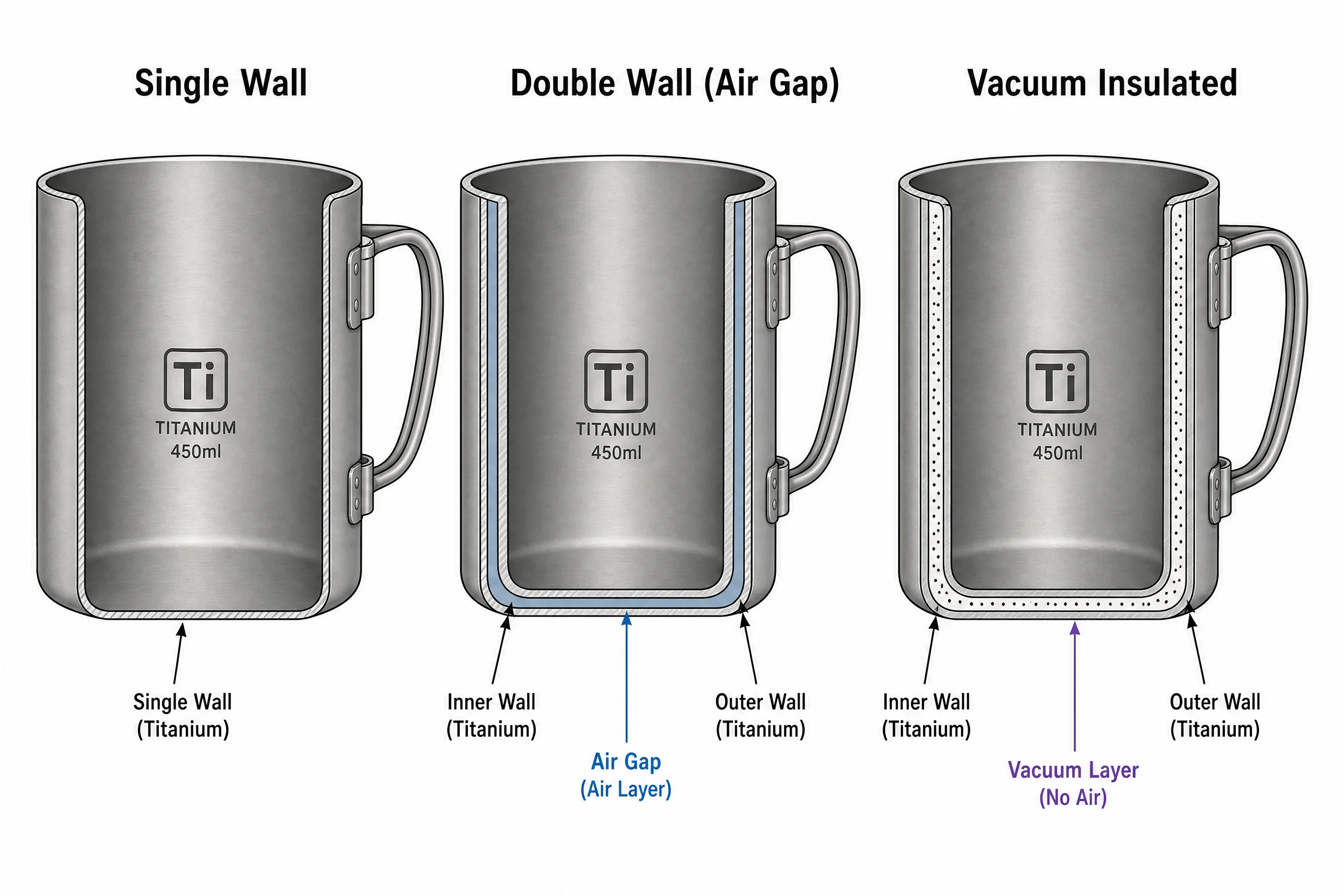
The term “titanium vacuum mug” appears in search results and product titles constantly. It’s mostly inaccurate. Here’s what the three actual categories mean:
Single wall titanium: One titanium shell, no insulation. The lightest option — the TOAKS 450ml single wall weighs 48g at 0.3mm wall thickness. Drinks cool quickly, but the mug can go directly on a camp stove or open flame. This is what the ultralight crowd uses.
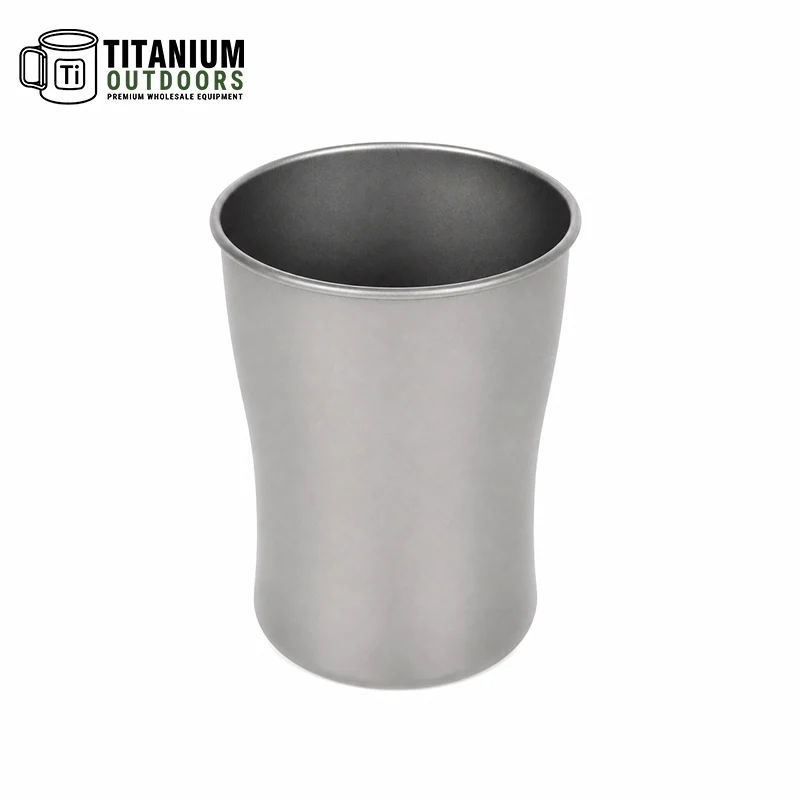
Double wall titanium (air gap): Two titanium shells with a sealed air gap between them. The air slows heat transfer by convection, so drinks stay warm longer — roughly 45 minutes without a lid, or up to 2 hours with a lid, based on independent field testing. The outer wall stays cool enough to hold without burning your hands. The TOAKS CUP-450-DW weighs 120g; the Snow Peak Ti-Double 450 weighs 104g (mug without lid). These cannot go over direct flame — heat warps the air gap and destroys the insulation structure.
Vacuum insulated titanium: Two titanium shells with the space between them pumped to near-vacuum. This is genuine vacuum insulation — similar in principle to a Hydro Flask or Yeti, but made from titanium. The SilverAnt Thermos Flask 400ml (vacuum) weighs 240g, more than twice a comparable air-gap double wall mug. Heat retention is significantly better: 4–8 hours for hot drinks. Also cannot go over direct flame.
| Type | Weight (450ml equiv.) | Heat Retention | Direct Flame | Price Range |
|---|---|---|---|---|
| Single wall titanium | ~48–68g | ~20–30 min | Yes | $30–60 |
| Double wall titanium (air gap) | ~104–145g | ~45 min (no lid) / ~2 hrs (with lid) | No | $45–90 |
| Vacuum insulated titanium | ~200–280g | ~4–8 hours | No | $60–130 |
| Vacuum insulated stainless steel | ~280–450g | ~6–12 hours | No | $30–60 |
The last row matters for context: a vacuum stainless mug keeps drinks hotter longer and costs less. The reason to buy titanium double wall is weight, not heat performance.
Why Grade 1 Titanium Is What You Want in a Drinkware Product
Titanium comes in over 30 grades. The one used for food-contact drinkware is commercially pure Grade 1 (CP1), the softest and most chemically inert form of titanium. Its density is 4.51 g/cm³ — roughly 43% lighter than 304 stainless steel by volume (7.93 g/cm³).
Grade 1 has no added alloying elements, which means nothing to leach into your coffee. It’s the standard used by TOAKS, Snow Peak, SilverAnt, and virtually every reputable titanium drinkware brand. The higher-strength alloys (like Grade 5 / Ti-6Al-4V, used in aerospace) contain aluminum and vanadium — fine for structural parts, but not ideal for repeated contact with acidic beverages.
When a brand says “pure titanium” or “commercially pure titanium,” they mean Grade 1. If a product listing doesn’t specify the grade, that’s a yellow flag — though most established outdoor brands use CP1 by default.
One practical implication of Grade 1: it scratches and dents more easily than alloys. That’s acceptable for a mug you’re actually using in the field. The trade-off is durability for purity.
Double Wall Titanium vs Vacuum Insulated Stainless: The Real Trade-Off
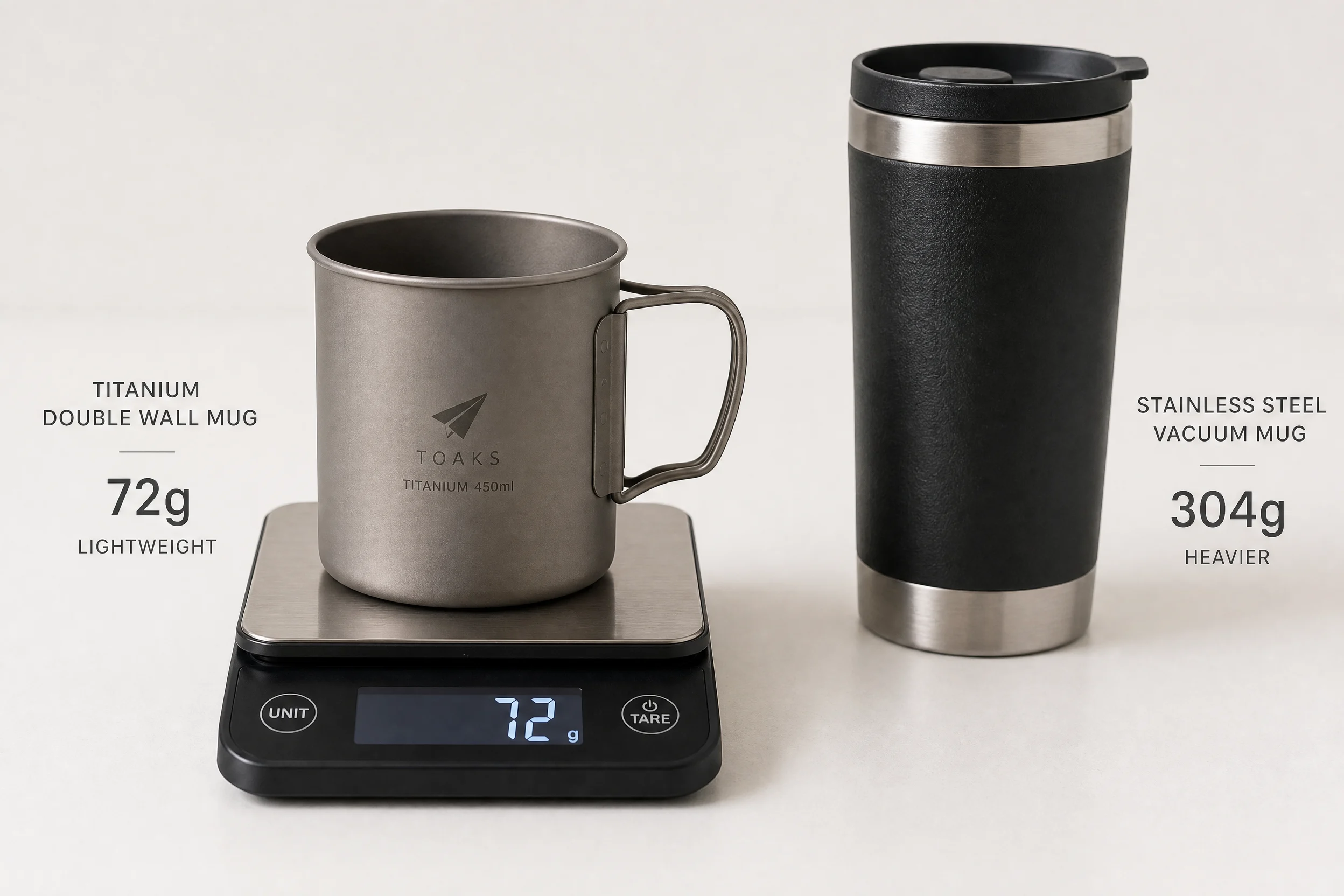
This is the comparison most buyers are actually making, even if they don’t phrase it that way.
Weight: A titanium double wall mug (air gap) at 450ml capacity weighs roughly 104–120g. A comparable vacuum insulated stainless mug — a Hydro Flask or Stanley 16 oz travel mug — typically weighs 300–450g. That’s a 180–340g difference, which matters when you’re counting grams on a multi-day trail.
Heat retention: Vacuum insulated stainless wins, clearly. Air-gap insulation keeps a hot drink warm for roughly 45 minutes without a lid; with a lid, independent testing puts that closer to 2 hours. Vacuum stainless holds heat for 5–12 hours. If you want your morning coffee warm at noon, you want vacuum stainless — or a titanium vacuum thermos (heavier, but made from titanium).
Taste and reactivity: Both Grade 1 titanium and 304 stainless steel are essentially taste-neutral. Titanium is slightly more inert and has no nickel content, which matters for people with nickel sensitivity. Stainless steel with a damaged interior coating can impart metallic taste — but most quality stainless drinkware has no interior coating to begin with.
Price: Titanium double wall mugs run $45–90. A Hydro Flask 16 oz is about $35–45. You’re paying a real premium for the weight savings.
The honest verdict: If weight is a hard constraint — ultralight backpacking, long-distance hiking — titanium double wall is the right call. If you’re car camping or just want your coffee to stay hot, a vacuum stainless mug at half the price keeps drinks hotter longer and doesn’t require you to justify the cost.
What to Look For Before You Buy
Capacity: 300ml is a standard espresso/tea size; 450ml fits a standard cup of coffee with room for cream. 450ml is the sweet spot for most camp use. If you want to eat from the mug (instant oatmeal, ramen), go 500–700ml.
Lid fit: Double wall mugs lose a significant amount of heat through an open top. A lid that seals properly — not just a loose cover — makes a measurable difference in retention. The Snow Peak Ti-Double 450 ships without a lid; the Ti-300 (sold separately) nests inside it and can serve as one.
Handle type: Folding wire handles are standard on most titanium camp mugs. They get hot on single wall mugs over a flame (not relevant for double wall since flame use is prohibited). For double wall mugs, the handle is mostly a grip preference — some people use the mug without one.
Stackability: Many titanium camp mugs nest inside each other or inside a pot. The Snow Peak Ti-Double 300 nests inside the Ti-Double 450. If you’re building a compact kit, check whether two mugs stack before buying both separately.
Wall thickness: Thicker walls add weight but increase durability. The TOAKS ultralight single wall uses 0.3mm — impressively thin, and it shows after a few drops. Double wall mugs are inherently more rigid due to their construction, so wall thickness is less of a concern.
Four Titanium Double Wall Mugs Worth Considering
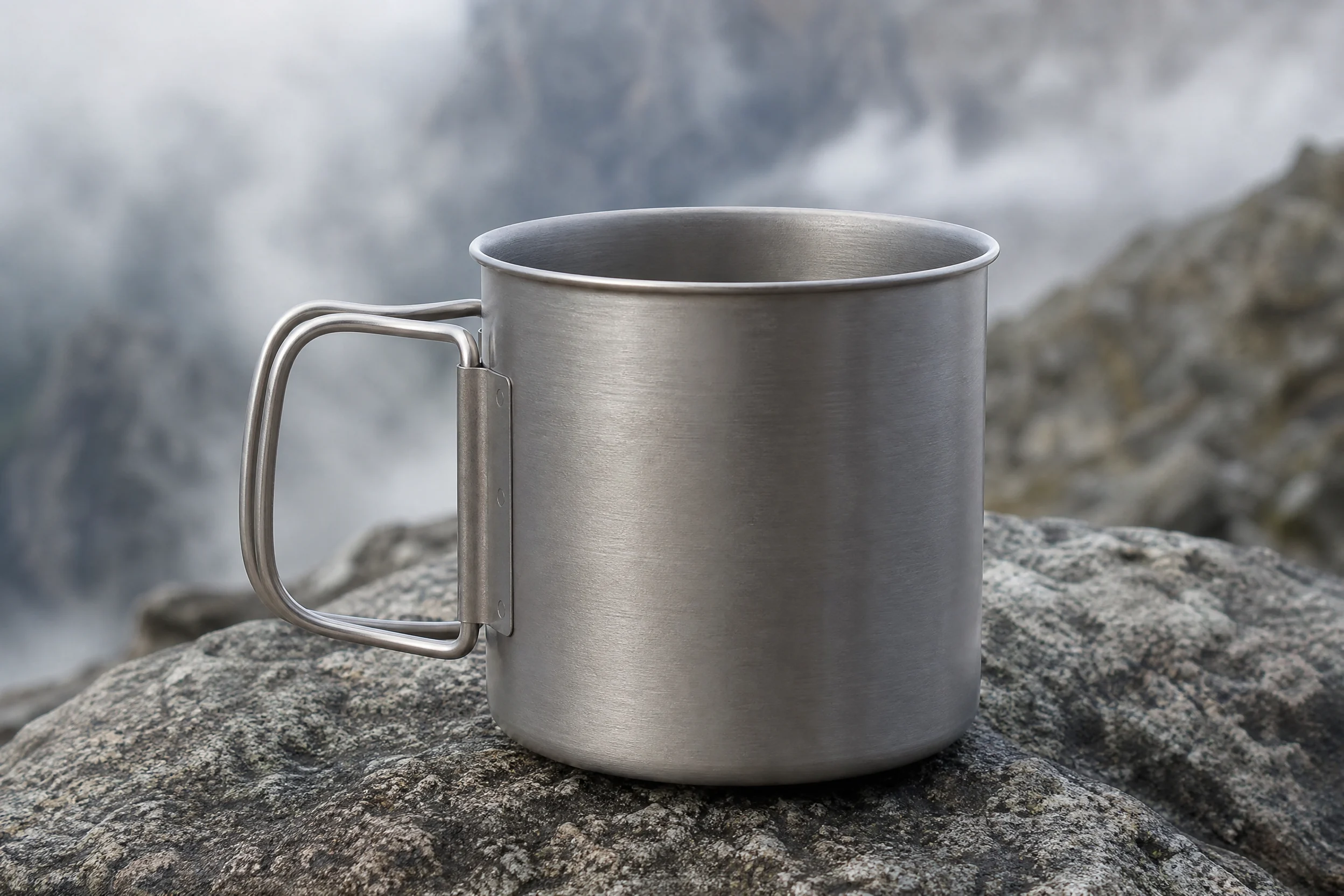
These are the products that appear consistently in ultralight gear recommendations and have verifiable specs from brand or major retailer sources.
| Product | Capacity | Weight | Lid Included | Direct Flame | Price (approx.) |
|---|---|---|---|---|---|
| TOAKS CUP-450-DW | 450ml | 120g | No | No | ~$55 |
| Snow Peak Ti-Double 450 (MG-153) | 450ml | 104g | Sold separately | No | ~$50 |
| SilverAnt Double Wall Mug | 300ml | 145g | Yes (with filter) | No | ~$60 |
| SilverAnt Double-Wall Coffee Cup | 400ml | 187g | Yes | No | ~$75 |
TOAKS CUP-450-DW is the most straightforward option: no frills, no coating, 120g. The double wall design keeps the exterior cool with a hot drink inside. It does not ship with a lid, which is worth factoring into the cost if you want one. The internal diameter of 79mm fits a standard camp stove fuel canister for compact packing.
Snow Peak Ti-Double 450 (MG-153) is the lightest of this group at 104g and benefits from Snow Peak’s manufacturing in Tsubame-Sanjo, Niigata — a metalworking region with a known reputation for quality. Snow Peak’s titanium products are made in Japan, which is worth noting for buyers who care about country of origin. The mug without a lid is essentially a wide camp cup; pairing it with the Ti-Double 300 (which nests inside) gives you a tidy two-mug system for two people.
SilverAnt’s offerings skew heavier for their capacity — the 300ml mug weighs 145g, which is heavier per ml than TOAKS’s 450ml at 120g. The advantage is the included lid with integrated tea/coffee filter, which is genuinely useful if you’re a tea drinker who wants to steep directly in the mug. SilverAnt’s double wall vacuum thermos (400ml, 240g) is the closest thing to a true titanium vacuum mug at a reasonable price, though that weight edges into stainless vacuum territory.
On the “titanium vacuum mug” label: If a product is listed as a titanium vacuum mug but weighs under 150g at 400ml capacity, it’s almost certainly an air-gap double wall, not a true vacuum. Vacuum construction requires a more complex manufacturing process and adds weight. A true titanium vacuum vessel at 400ml capacity should weigh 200g or more.
Single Wall vs Double Wall vs Vacuum Stainless: Which One for Your Trip?
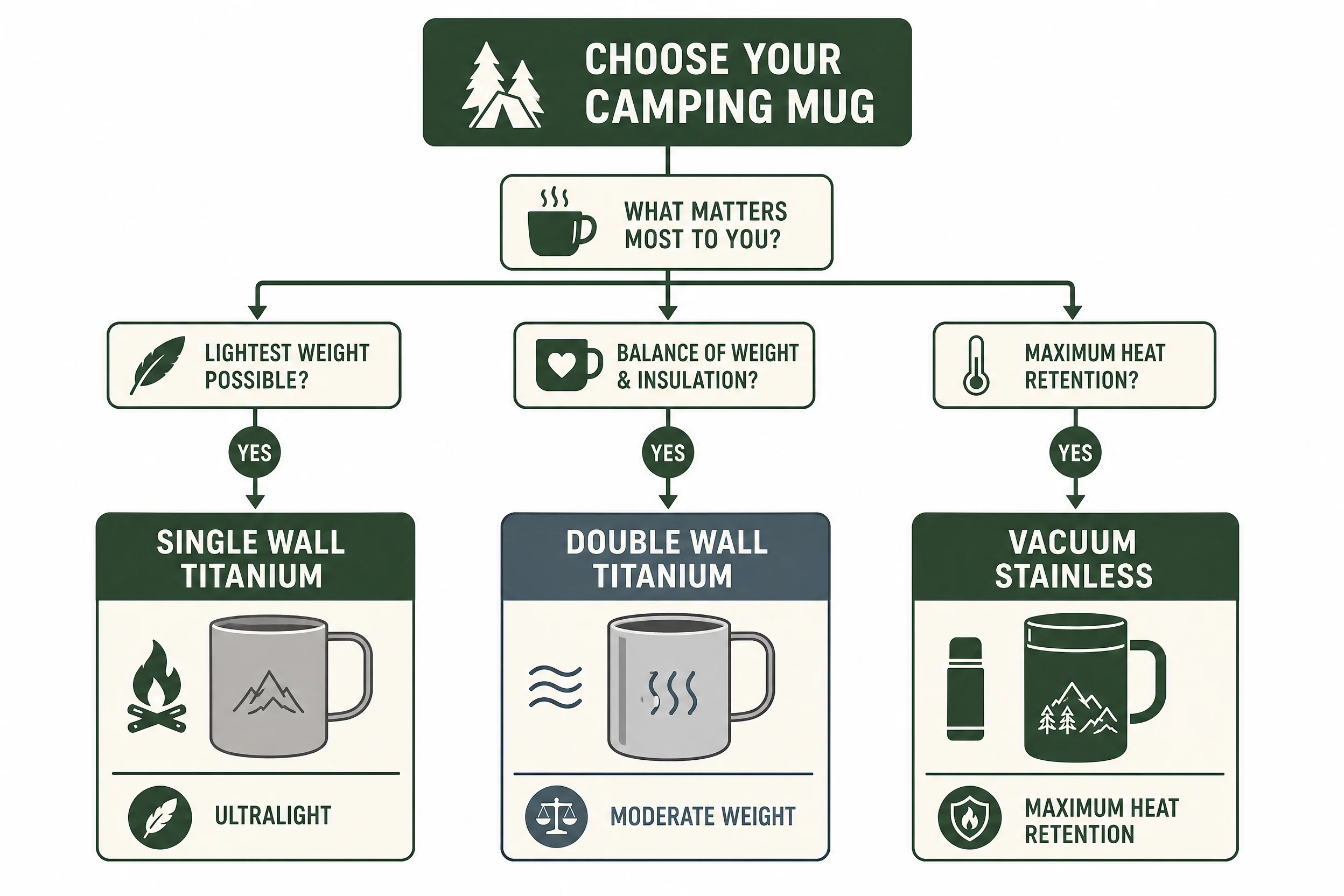
The answer depends on what you’re actually doing.
Choose single wall titanium if:
- You need to boil water or heat food directly in the mug over a stove or fire
- Every gram counts — you’re deep into ultralight territory (sub-10 lb base weight)
- You’re solo and using the mug as a cook pot/cup combo
- You’re okay wrapping a bandana around it to hold a hot drink
Choose double wall titanium if:
- You want to hold a hot coffee without burning your hands
- Weight still matters, but you can accept 100–120g instead of 48g
- You’re in a group where you won’t be cooking in the mug
- You want a clean, no-coating, taste-neutral camp coffee experience
Choose vacuum insulated stainless steel if:
- You want coffee to stay hot for several hours, not 90 minutes
- Weight is not a constraint (car camping, base camp, day hikes)
- You’re watching a budget — stainless vacuum mugs cost significantly less
Choose vacuum insulated titanium if:
- You want maximum heat retention AND the absolute lightest possible option
- You’re willing to pay the premium (expect $60–130+ for a quality titanium vacuum vessel)
- Note: at this price point, some ultralight backpackers buy a quality stainless vacuum mug and accept the weight penalty instead
There’s no wrong answer here — just different constraints. The ultralight backpacker and the car camper are solving different problems with the same product category.
How to Care for a Titanium Double Wall Mug
Titanium doesn’t rust and doesn’t require seasoning or special treatments. That said, double wall construction has one vulnerability that single wall mugs don’t: the sealed air gap.
Avoid dishwashers. High-temperature dishwasher cycles and harsh detergents can compromise the seal between the two walls over time. Most brands recommend hand washing. Warm water and mild soap is all you need.
Don’t use steel wool or abrasive scrubbers. Grade 1 titanium scratches more easily than alloys. A soft brush or sponge keeps the surface intact — though scratches don’t affect performance, just aesthetics.
Don’t heat from the bottom. This applies specifically to double wall mugs: placing a double wall mug over a flame or stove burner will damage the air gap seal and potentially warp the inner wall. This is not a theoretical concern — it ends the insulation properties of the mug permanently. Use single wall if you need to heat food or drink directly.
Dealing with stains: Coffee and tea tannins stain titanium over time. A paste of baking soda and water, left for 20–30 minutes, removes most stains without damaging the surface. Avoid bleach or chlorine-based cleaners.
One thing that’s not a concern: off-flavors from the material. Grade 1 titanium is genuinely taste-neutral, unlike some stainless steel vessels that develop a metallic taste when the interior finish shows wear. A well-maintained titanium mug should taste like water — nothing else.
Frequently Asked Questions
Can you boil water in a titanium double wall mug?
No. Double wall mugs — both air-gap and vacuum — cannot be used over direct heat sources. The heat damages the sealed gap between the walls. If you need to boil water in your mug, buy a single wall titanium mug instead.
How long does a titanium double wall mug keep drinks hot?
Based on independent field testing (99boulders), expect roughly 45 minutes without a lid before a hot drink drops below comfortable drinking temperature. With a lid, that extends to approximately 2 hours. That estimate assumes an air-gap double wall mug, not a vacuum titanium vessel.
Is “titanium vacuum mug” the same as “titanium double wall mug”?
Usually not. Most products with “vacuum” in the name are actually air-gap double wall mugs. A true vacuum insulated titanium mug is heavier — typically 200g or more at 400ml capacity — and more expensive. Check the product weight: if a 400ml “titanium vacuum mug” weighs under 150g, it’s an air-gap double wall.
Why does a titanium mug cost more than stainless?
Titanium is harder to machine and weld than steel. The manufacturing process requires more precise tooling, which drives up cost. Grade 1 titanium sheet is also more expensive as a raw material. The weight savings come at a real premium — expect to pay $45–90 for a quality titanium double wall mug vs $30–50 for a comparable stainless option.
Is titanium safe for hot beverages?
Grade 1 (commercially pure) titanium is considered one of the most inert metals for food contact. It has no nickel content (relevant for nickel-sensitive users), no leaching concerns at food-contact temperatures, and does not react with acidic beverages like coffee or citrus drinks. It’s used in medical implants partly for this reason. No special certification is required for food contact use in most markets.
Does titanium affect the taste of coffee or tea?
No. Grade 1 titanium is taste-neutral. This is one of the genuine advantages over some stainless steel products, particularly cheaper models with interior coatings that can wear and contribute a metallic taste. A bare titanium mug won’t impart any flavor to your drink.
The Bottom Line
A titanium double wall mug makes the most sense for weight-conscious backpackers who want to hold a hot coffee without burning their hands and aren’t willing to carry a heavier vacuum stainless mug. The TOAKS CUP-450-DW at 120g and the Snow Peak Ti-Double 450 at 104g are the most established options with verifiable specs. If you need direct flame use, switch to single wall. If you need all-day heat retention, switch to vacuum stainless. And if someone’s selling you a “titanium vacuum mug” that weighs 90g, check the product description — it’s almost certainly an air-gap double wall under a more marketable name.