
Pure titanium cookware is one of the safest materials you can cook on. It’s chemically inert, biocompatible, and does not leach metals or chemicals into food — even when cooking acidic dishes at high heat. However, most cookware marketed as “titanium” is actually an aluminum or steel pan with a PTFE-based nonstick coating reinforced with titanium particles. The safety of those pans depends entirely on the coating, not the titanium. This article explains the science, the distinction, and how to tell the difference before you buy.
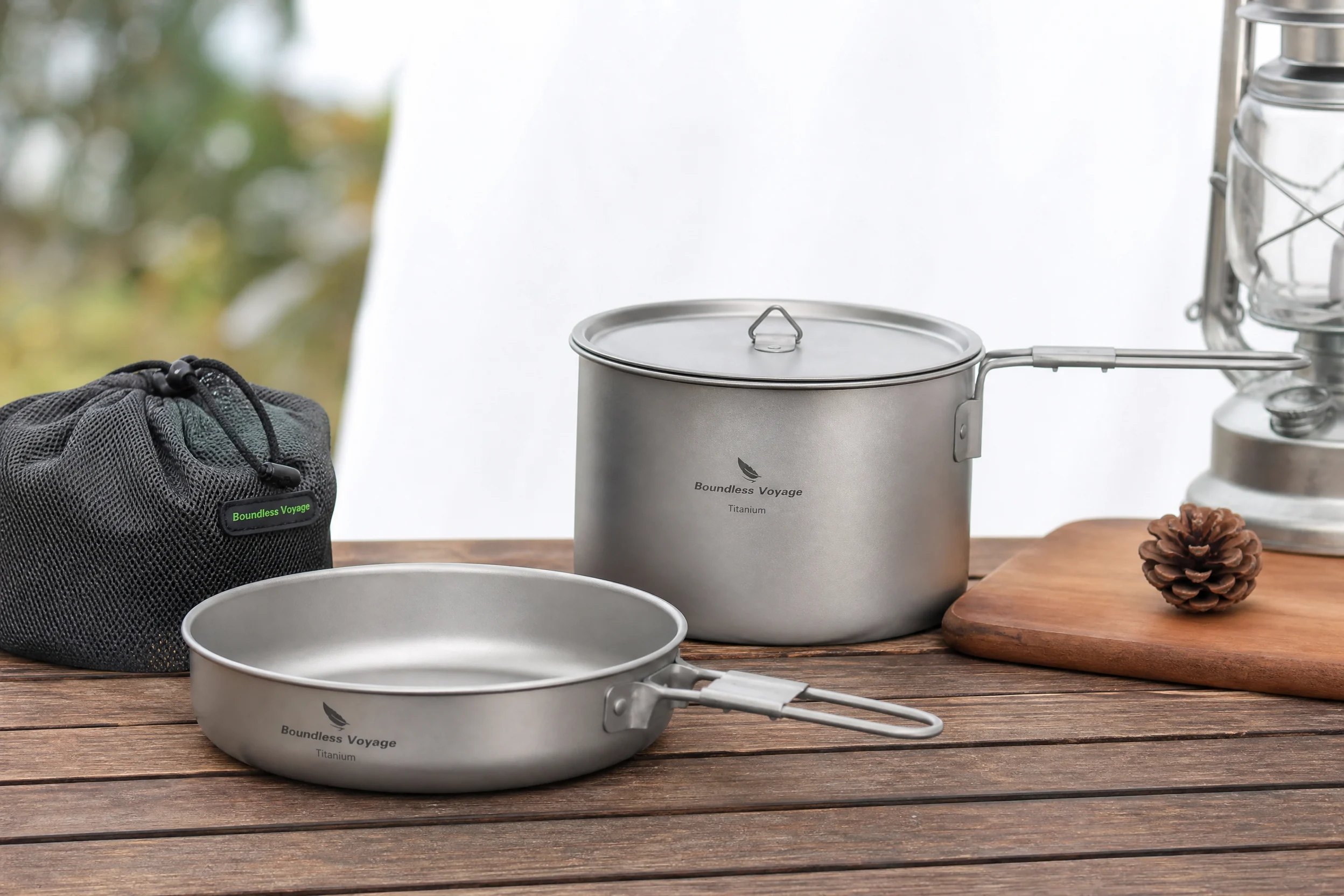
Titanium is trusted inside the human body for decades — surgical implants, dental fixtures, bone plates — and yet people still ask whether a titanium pan is safe to cook in. The question is understandable. After the PFOA and PFAS scandals that burned trust in nonstick cookware, people are right to scrutinize what they’re cooking on.
The problem is that “titanium cookware” means at least three completely different things, and most safety articles on the topic never make that clear. You could be reading about a pure-titanium camping pot, a premium bonded titanium-stainless cookware line, or an aluminum pan with a PTFE nonstick coating that happens to contain titanium particles for scratch resistance. Those are not the same product. They don’t have the same safety profile.
This guide works through the actual science — the chemistry of why titanium behaves the way it does, what the medical implant research tells us, and where the real risks in “titanium” cookware actually sit.
What “Titanium Cookware” Actually Means
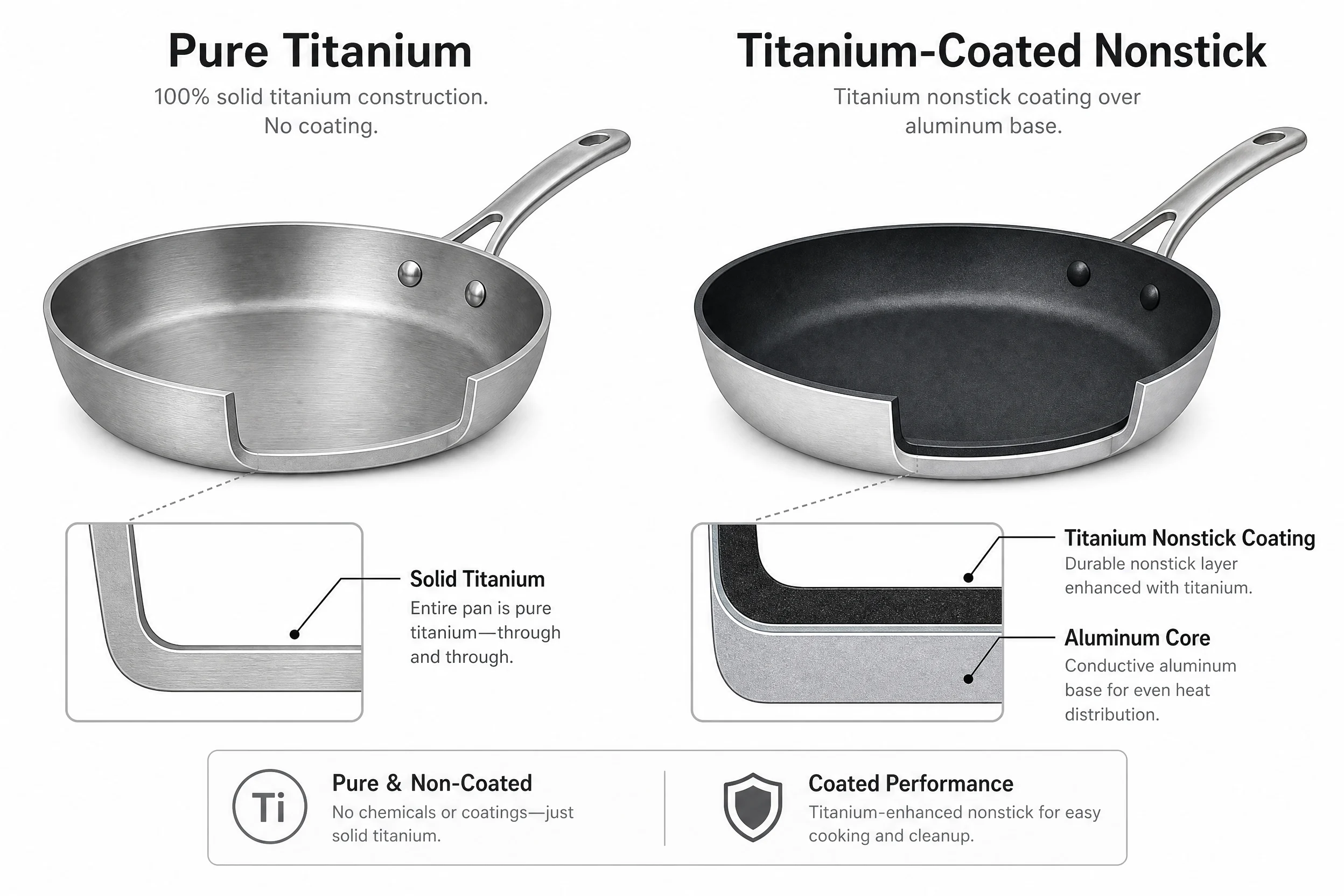
Most people are surprised to learn there are at least three distinct product categories sold under the “titanium cookware” label.
1. Pure (commercially pure) titanium cookware
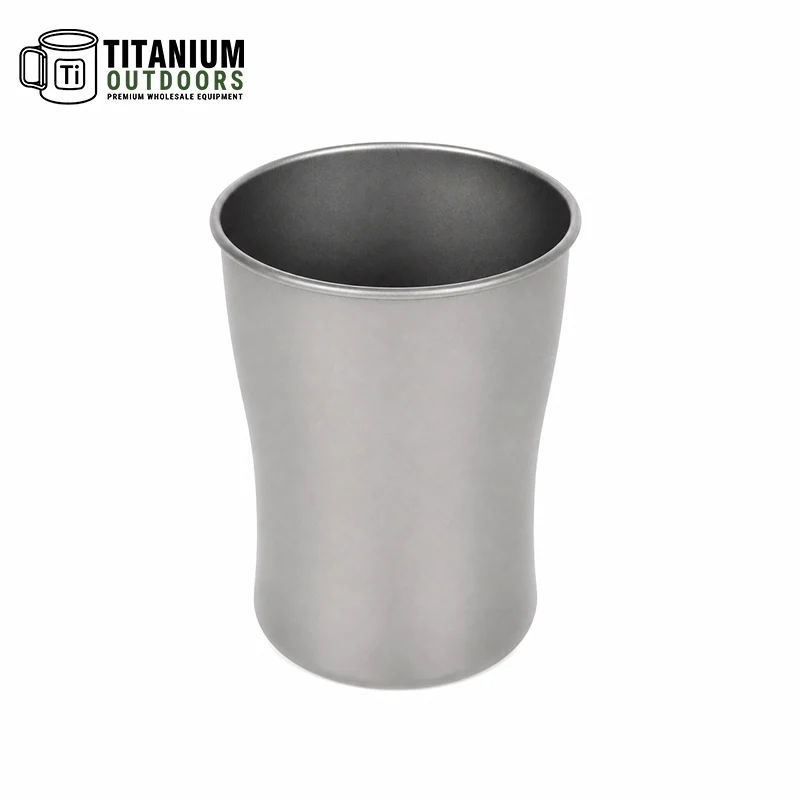
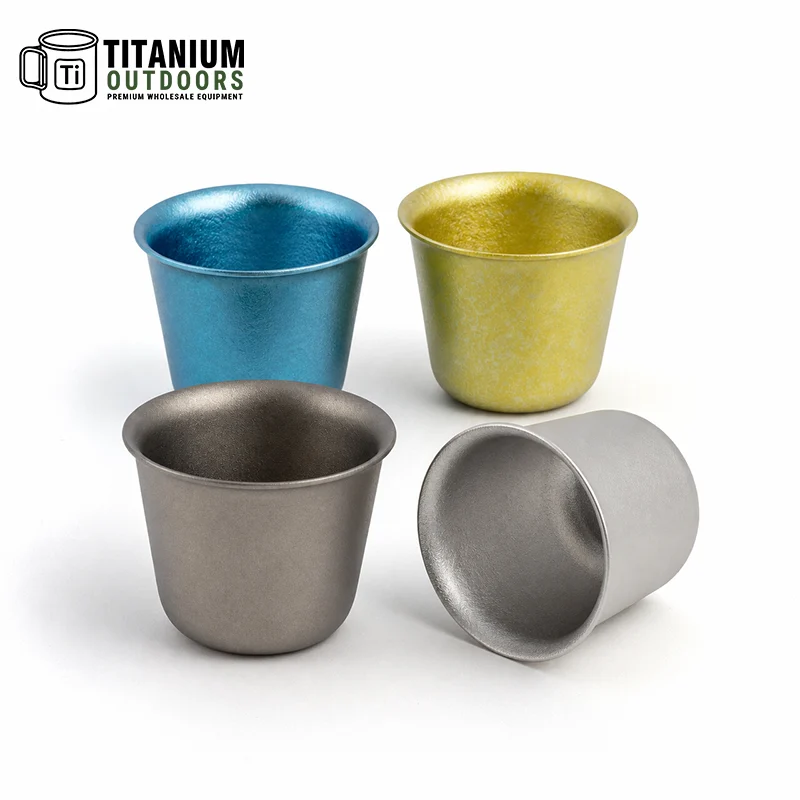
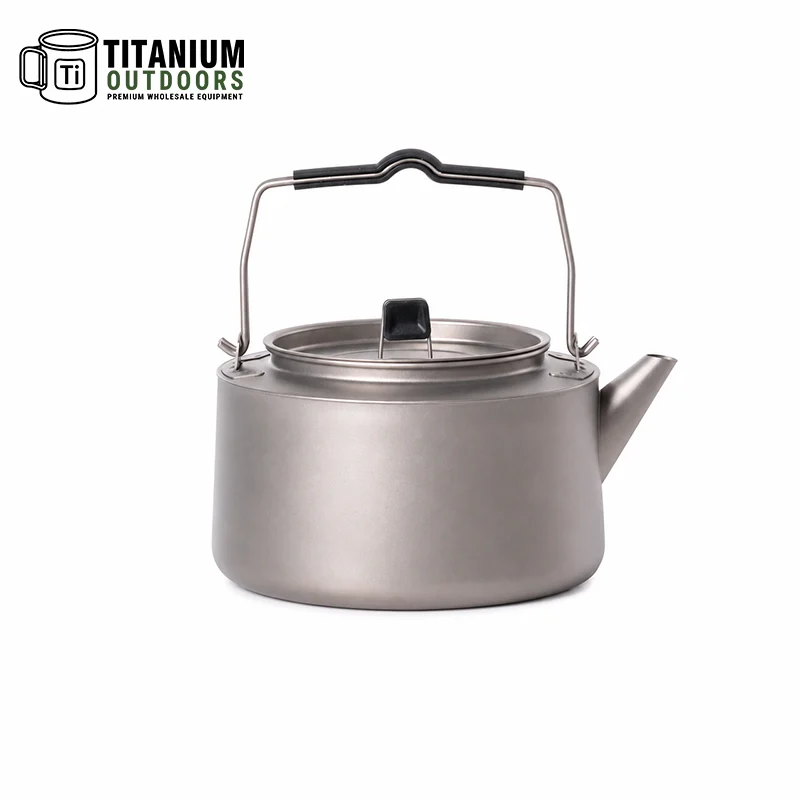
This is what serious campers and outdoor cooks use — pots and pans made entirely from Grade 1 or Grade 2 commercially pure titanium (99.2–99.5%+ Ti). Brands like Valtcan, Snow Peak, and Toaks make this type. The cooking surface is bare titanium metal. No coating, no nonstick layer, nothing.
2. Titanium-bonded premium cookware
High-end kitchen brands like Hestan (NanoBond) fuse thousands of molecular titanium layers directly onto a stainless steel body via a chemical-free vacuum process. The result is a titanium-surfaced pan that’s also good at conducting heat (because of the stainless and aluminum core beneath). This is the category where titanium genuinely upgrades the cooking surface.
3. “Titanium-coated” or “titanium-reinforced” nonstick cookware
This is what most supermarket and mid-range “titanium” pans actually are. The base is aluminum or stainless steel. On top is a PTFE-based (or sometimes ceramic) nonstick coating that has titanium particles mixed in to increase hardness and scratch resistance. You are not cooking on titanium. You’re cooking on PTFE. The titanium is in the coating, not on the surface you eat from.
Understanding which category your pan falls into is the foundation of every safety question. When someone asks “is titanium cookware safe?” the answer is completely different depending on which of these three products they’re holding.
Why Pure Titanium Doesn’t Leach: The TiO₂ Passivation Layer
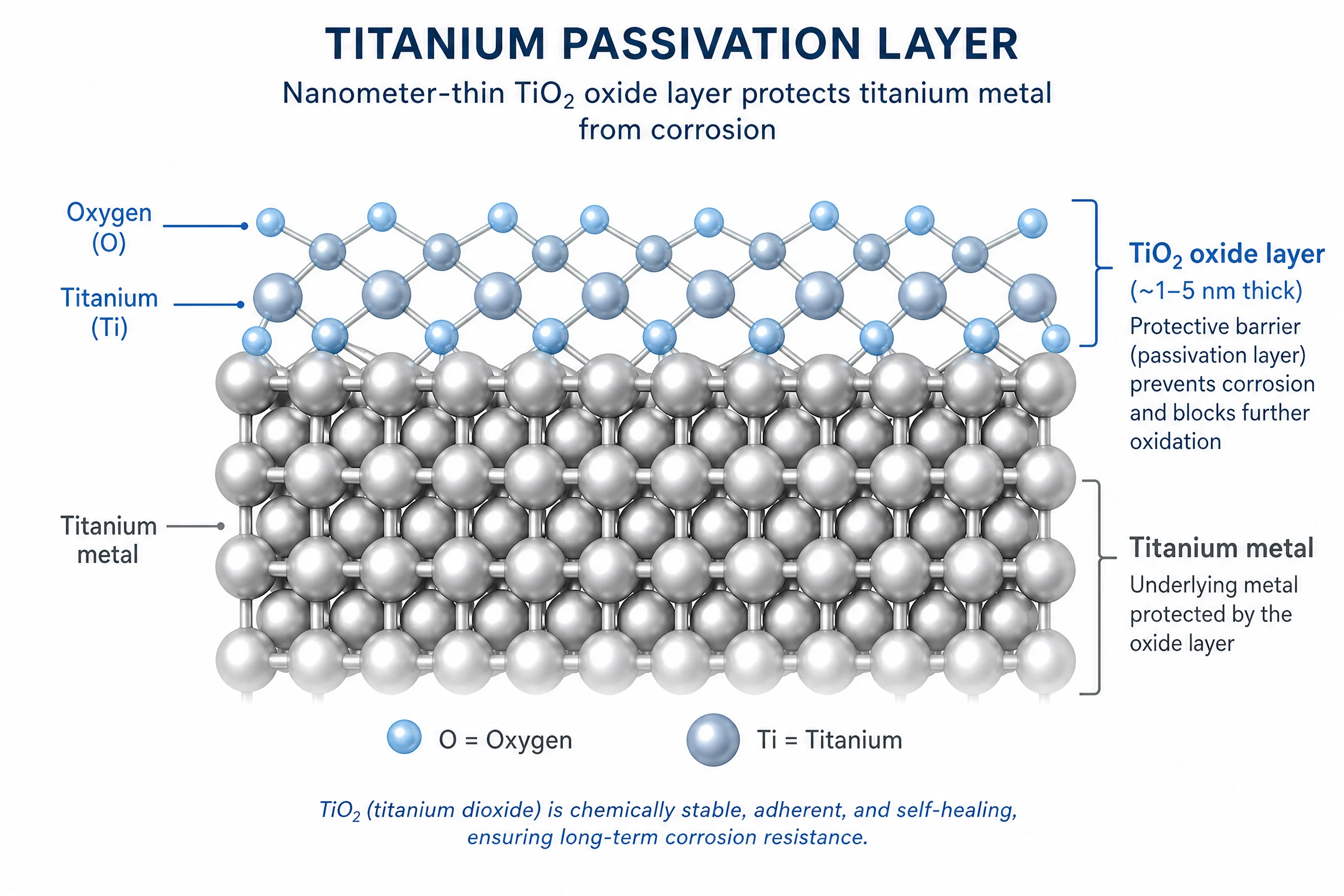
This is the part that most cookware articles skip, and it’s the most important piece of chemistry to understand.
When titanium is exposed to air or water, its surface instantly reacts with oxygen to form an extremely thin, stable layer of titanium dioxide (TiO₂) — measured in nanometers. This happens spontaneously and is self-repairing: scratch the surface, and the oxide layer reforms within seconds.
That TiO₂ layer is what makes titanium behave like an inert ceramic rather than a reactive metal. It acts as a physical and chemical barrier between the metal underneath and whatever it touches — food, acid, salt, heat. The underlying titanium atoms never come into contact with your pasta sauce.
Does any titanium get into food at all? Research cited in the food-grade titanium literature puts it at less than 0.01 ppm (parts per million) under normal cooking conditions. To put that in perspective: WHO/JECFA has not set a numeric acceptable daily intake for metallic titanium — its safety designation is “not specified,” meaning no upper limit has been deemed necessary. Estimated dietary exposure from all food sources is typically 0.2–2 mg/kg/day by age group. The trace migration from a titanium pan falls well below any level of toxicological concern.
This is precisely why the medical field uses titanium for permanent implants — hip replacements, dental posts, spinal hardware — that sit inside the human body for 20 to 30 years. The biocompatibility research is extensive. A 2014 review published in Materials (Basel) by Sidambe — cited over 1,000 times in the scientific literature — confirmed that commercially pure titanium forms no cytotoxic products, triggers no immune response, and does not degrade in biological environments.
If that’s the standard titanium meets when placed inside a body, it’s a very strong indicator of what happens when it briefly contacts your food.
One clarification worth making: titanium dioxide (TiO₂) has been in the news as a food additive (E171) with some safety questions attached. That is a completely different substance than the metallic titanium used in cookware. Metallic titanium is an elemental metal with an atomic structure; TiO₂ nanoparticles used as a food colorant are a manufactured compound. The passivation layer on a titanium pan is stable and inert — it is not shedding TiO₂ nanoparticles into your food.
The Real Health Risks: When “Titanium” Cookware Isn’t Safe
Here’s the honest part that most brand-funded articles on this topic avoid.
The risk in most “titanium” cookware has nothing to do with titanium.
When a $30 pan from a kitchen store markets itself as “titanium-reinforced nonstick,” the cooking surface is PTFE — the same polymer family as Teflon. Titanium is in the coating for scratch resistance, not as a safety feature. The health questions that apply to PTFE-based nonstick surfaces apply here too:
- Overheating above 500°F (260°C): PTFE starts to degrade and can release fumes that cause “polymer fume fever” — flu-like symptoms in humans and, at higher temperatures, are fatal to pet birds. Normal stovetop cooking rarely hits these temperatures, but an empty pan left on high heat can reach them in minutes.
- Scratched coating: Once a nonstick coating is visibly scratched or flaking, small particles can transfer to food. While PTFE itself is considered biologically inert (it passes through the body), the concern is about other substances in the coating — adhesion layers, primers, or undisclosed PFAS compounds.
- PFOA-free ≠ PFAS-free: Many “titanium nonstick” pans advertise “PFOA-free,” which is accurate — PFOA was phased out. But PFOA is just one member of the PFAS family. Other PFAS compounds may still be present in the coating process. A 2022 Consumer Reports investigation found PFAS in at least one pan marketed as non-toxic — a finding that illustrates why “titanium-reinforced” labeling is not a safety guarantee.
The bottom line for coated “titanium” pans: treat them like any PTFE nonstick pan. Use medium heat, avoid preheating empty, replace when the coating shows visible damage, and keep them away from birds. The titanium in the coating doesn’t eliminate those considerations.
What about ceramic-coated “titanium” pans? Some pans use a sol-gel ceramic coating reinforced with titanium. Ceramic coatings are PFAS-free, which addresses one concern. But they tend to degrade faster than PTFE — once the surface is no longer smooth, food sticks and the pan is usually due for replacement.
Titanium vs. Other Cookware: Safety Comparison
How does titanium stack up against the other materials in your kitchen?
| Material | Leaching Risk | PFAS/Coating Risk | Heat Safety | Allergy Risk | Overall Safety |
|---|---|---|---|---|---|
| Pure Titanium | Negligible (<0.01 ppm) | None (no coating) | Excellent (stable to 1,650°C) | Hypoallergenic | ⭐⭐⭐⭐⭐ |
| Titanium-bonded (e.g. NanoBond) | Negligible | None | Excellent | Very low | ⭐⭐⭐⭐⭐ |
| Stainless Steel (18/8 or 18/10) | Low (nickel, chromium in trace amounts with acidic food) | None | Excellent | Nickel allergy possible | ⭐⭐⭐⭐ |
| Cast Iron / Enameled Cast Iron | Low (iron, can be beneficial) | None | Very Good | Minimal | ⭐⭐⭐⭐ |
| Ceramic-coated | Very Low | None (PFAS-free) | Good (coating degrades over time) | Minimal | ⭐⭐⭐½ |
| PTFE nonstick (“titanium-reinforced”) | Very Low (PTFE inert) | Possible (PFAS in manufacturing) | Acceptable below 500°F | Minimal | ⭐⭐⭐ |
| Aluminum (uncoated) | Moderate (especially with acidic food) | None | Good | Minimal | ⭐⭐½ |
A few things worth noting from this table:
- Stainless steel is excellent overall, but people with nickel sensitivity can react to trace nickel that migrates from stainless steel when cooking acidic foods for long periods. 18/8 grade contains 8% nickel; 18/10 grade contains 10% nickel. Pure titanium cookware has no nickel — which is why some allergy-prone cooks seek it out.
- Cast iron is often seen as the safest option, but iron does migrate into food — measurably so. That’s actually a benefit for people with iron deficiency, but it’s not “zero leaching.”
- Ceramic coatings degrading over time is a real concern: once the surface develops micro-cracks, the aluminum substrate underneath can start contributing to the cooking environment.
How to Tell If Your “Titanium” Pan Is Actually Titanium
The marketing around titanium cookware is aggressive and often misleading. Here’s a practical three-question checklist to evaluate any pan before buying.
Question 1: What does the product description say the cooking surface is made of?
Look for explicit language: “pure titanium,” “commercially pure titanium,” “Grade 1 titanium body,” or “molecular titanium bonded to stainless steel.” If the description says “titanium-reinforced nonstick,” “titanium ceramic coating,” or “titanium-infused coating,” you are buying a coated pan, not a titanium pan.
Question 2: Is there a nonstick layer?
Pure titanium cookware is not nonstick. It behaves more like a stainless steel pan — food can stick, especially eggs and fish, and you need oil and proper heat management. If a pan is marketed as both “pure titanium” and “nonstick,” that’s a contradiction. Nonstick + titanium almost always means PTFE or ceramic coating with titanium particles.
Question 3: What’s the price range?
Pure titanium cookware is expensive. A single pure-titanium frying pan from a reputable brand runs $80–$200+. A premium titanium-bonded stainless line (like Hestan NanoBond) is $200–$600+ per piece. If you’re seeing a full “titanium cookware set” for $60–$80, it’s coated aluminum. That’s not necessarily dangerous, but it’s not what the marketing implies.
Bonus check: Country of origin + material certification
Premium pure titanium cookware manufacturers (Snow Peak, Valtcan, Toaks) specify the titanium grade (Grade 1, Grade 2) and country of origin. Mass-market “titanium nonstick” sets rarely list a titanium grade because there’s no substantial titanium in the cooking surface to grade.
Cooking on Titanium: What Changes and What to Expect
Pure titanium has one well-known limitation: it conducts heat poorly compared to copper, aluminum, and even stainless steel. This affects how you cook on it — and understanding this prevents both bad cooking results and unnecessary safety concerns.
The hot-spot problem
Titanium’s thermal conductivity is roughly 21 W/m·K, compared to 235 W/m·K for aluminum and 400 W/m·K for copper. In practical terms, heat from a burner concentrates at the point of contact rather than spreading evenly across the pan. This leads to hot spots — zones that are significantly hotter than the rest of the cooking surface.
For safety, this means a titanium pan on high heat can reach scorching temperatures at its center while the edges remain relatively cool. This is fine for boiling water (where camp cooks love titanium for speed and weight) but requires attention when sautéing or searing proteins.
How to cook well on pure titanium:
- Preheat at medium, not high. Let the pan warm up gradually to minimize hot-spot severity before adding food.
- Use fat. Pure titanium is not nonstick. A thin layer of oil or butter prevents most sticking.
- Don’t walk away from a dry pan. An empty titanium pan on high heat can reach temperatures that affect oil-coating seasoning and discolor the surface (though this is aesthetic, not a safety issue).
- For camping: titanium’s poor conductivity is actually an advantage for boiling water quickly in thin-walled cups — the heat goes straight into the water rather than distributing through the pan walls.
Metal utensils? Yes. One genuine advantage of pure titanium is that it’s extremely hard and scratch-resistant. Metal spatulas, spoons, and whisks won’t damage the surface or expose a hidden coating. This is a real daily-use benefit over ceramic and PTFE nonstick surfaces.
Induction cooktops: Pure titanium is not magnetic and will not work on induction. Some titanium cookware is manufactured with a magnetic stainless steel base layer specifically for induction compatibility — check the product specs before purchasing.
People Also Ask: Titanium Cookware Safety FAQ
Is titanium cookware 100% non-toxic?
Pure titanium cookware has no known toxicity. It is biocompatible, chemically inert, and does not leach metals or synthetic chemicals into food. Titanium-coated nonstick pans are a different category — their safety profile depends on the coating, not the titanium component.
Does titanium cookware leach into food?
At negligible levels only. Research puts titanium migration from pure titanium cookware at less than 0.01 ppm under cooking conditions. For comparison, titanium is naturally present in many foods at similar or higher concentrations (soil and water contribute trace amounts). There is no evidence this trace level poses any health risk.
Does titanium release toxins when heated?
Pure titanium: no. Its TiO₂ passivation layer is stable at all normal cooking temperatures and does not decompose or off-gas at stovetop or oven heat. Titanium-coated nonstick pans: the PTFE coating can degrade above 500°F (260°C) and release fumes. The titanium particles in those coatings don’t cause that — the PTFE does.
Is titanium cookware safe for people with nickel allergies?
Yes. Pure titanium contains no nickel. People who react to stainless steel cookware — which contains 8–10% nickel in 18/8 grades — often report zero issues with pure titanium. It is considered hypoallergenic and is the material of choice for medical implants in nickel-sensitive patients.
Can titanium cookware cause cancer?
No scientific evidence links titanium cookware to cancer. Titanium is not a carcinogen. The cancer-related concerns in cookware research are primarily directed at PFOA (now largely phased out), other PFAS compounds, and cadmium/lead found in some ceramic glazes. None of those concerns apply to metallic titanium.
What is the difference between titanium dioxide and titanium cookware?
Titanium dioxide (TiO₂) is a chemical compound used as a food colorant and sunscreen ingredient that has faced regulatory scrutiny in the EU. Metallic titanium is an elemental metal. The passivation layer on a titanium pan is a stable, adherent oxide film — it is not shedding nano-particulate TiO₂ into food. These are fundamentally different substances.
Which is safer: titanium or ceramic cookware?
Both are PFAS-free and have low leaching profiles when new. Pure titanium has a durability advantage: its surface doesn’t degrade or develop micro-cracks over time the way ceramic coatings do. An old, chipped ceramic pan exposes the aluminum substrate; an old titanium pan is still just titanium. For long-term safety, pure titanium holds its properties better.
Summary: What the Science Actually Says
Titanium’s safety story is straightforward once you separate the metal from the marketing.
Pure titanium is among the most biologically inert materials used in any kitchen. Its TiO₂ passivation layer prevents any meaningful interaction with food. The medical implant track record — titanium sitting inside the human body for decades without causing reactions — is the most compelling real-world safety data any cookware material can point to. Less than 0.01 ppm migration rate, no PFAS, no PTFE, no nickel, no cadmium. The safety case is strong.
The risk in the “titanium cookware” category sits almost entirely in coated pans. Titanium-reinforced nonstick pans are PTFE nonstick pans with added durability. They’re not dangerous when used correctly at moderate temperatures, but they carry the same considerations as any PTFE surface: avoid overheating, replace when visibly damaged, and don’t treat the “titanium” label as a magic safety guarantee.
The practical buying conclusion: If your priority is the safest, most chemically inert cooking surface with no coatings to worry about, pure titanium cookware delivers that — at a price premium and with the trade-off of lower heat conductivity and a non-nonstick surface. If budget is the constraint and you’re looking at mid-range “titanium nonstick” sets, treat them as you would any quality nonstick pan: moderate heat, no preheating empty, replace when the surface degrades.
The question “is titanium cookware safe?” has a clear answer: yes, when the cookware is actually titanium. The harder question is whether what you’re buying is actually titanium — and now you have the tools to find out.