
A titanium thermos uses double-wall vacuum insulation built from Grade 1 or Grade 2 pure titanium instead of stainless steel. The result: near-identical heat retention to a quality stainless flask, a shell that carries zero nickel or chromium, and a subtle weight saving in the outer walls — offset by the vacuum layer itself. Titanium vacuum flasks cost 3–5× more than equivalent stainless models, weigh slightly less when comparing shell-only mass, and will never impart a metallic taste regardless of what you put inside. This guide covers exactly how titanium thermoses perform against stainless steel, which specific models are worth the money, and who should skip them entirely.
What You’re Actually Buying: Single-Wall vs. Vacuum Titanium
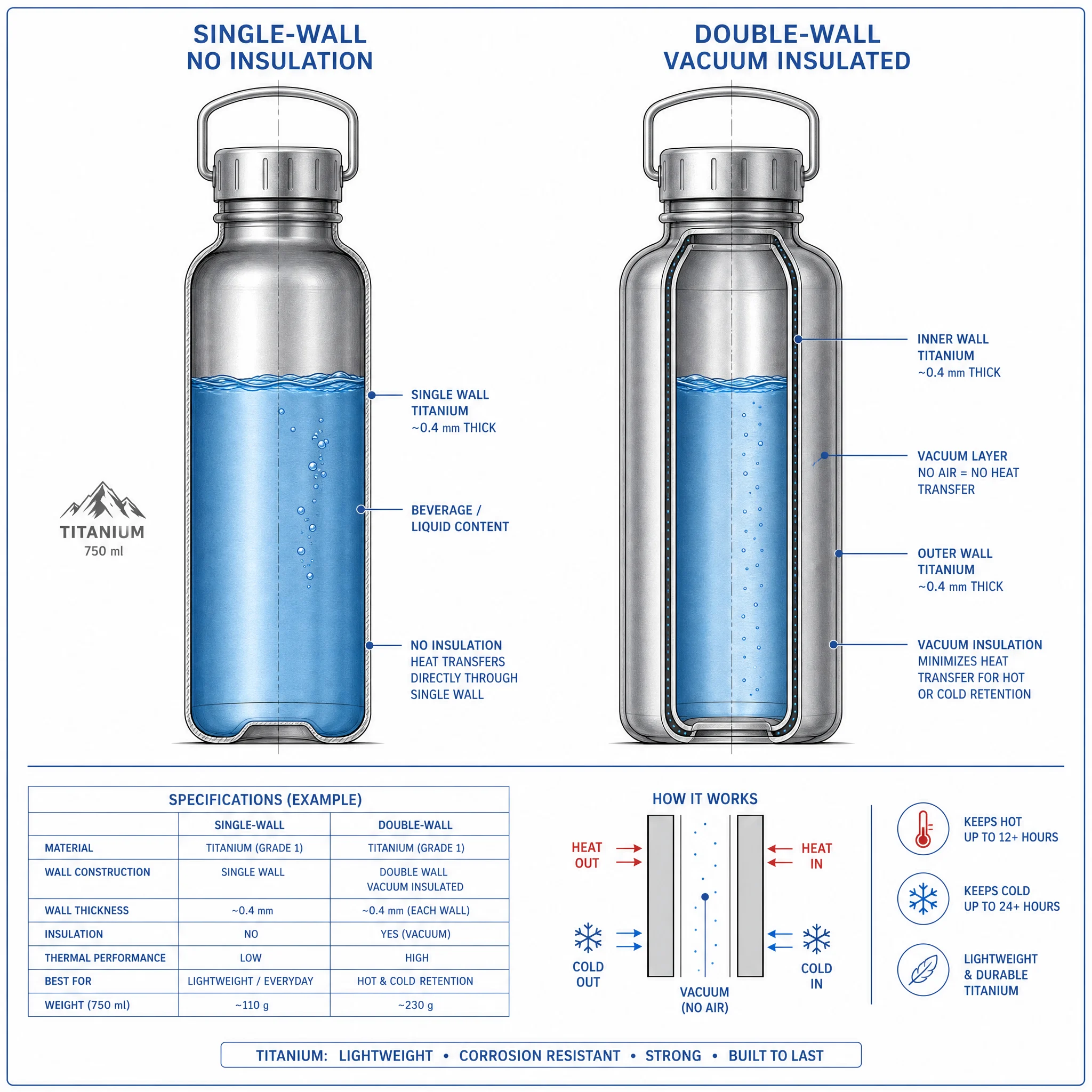
The single biggest source of confusion in this market is that “titanium bottle” and “titanium thermos” refer to completely different products.
Most titanium water bottles — Snow Peak’s Aurora, TOAKS’ 750ml pot-style, Vargo’s classic — are single-wall. They are lightweight because there is only one layer of metal between your drink and the outside air. They are not insulated. A single-wall titanium bottle will lose heat at roughly the same rate as your hand around a thin cup. That is fine for cold water on a summer day hike. It is useless for keeping coffee hot on a four-hour winter trail.
A titanium thermos or vacuum flask adds a second titanium wall and pumps the air out of the gap between them. That vacuum eliminates the dominant heat transfer mechanism: conduction through a gas. The result is genuine insulation — the same principle that makes a Zojirushi or Thermos brand flask work.
The trade-off is weight. That outer vacuum layer adds mass. The Thermos FJN-500T, a well-regarded pure titanium vacuum flask, weighs 210g at 500ml capacity. A Zojirushi SM-SA48 stainless vacuum flask at 480ml weighs 230g. The titanium version saves about 20g — real, but modest. On a multi-day backpacking trip, that gap matters. For commuting to the office, it is noise.
The practical rule: if you want an insulated hot-drink flask made from titanium, you are buying a vacuum flask — not a standard titanium bottle — and you are paying a meaningful premium for a modest weight advantage and a material that will never leach nickel into your morning coffee.
Titanium Vacuum Flask vs. Stainless Steel: Side-by-Side
On pure insulation performance, a titanium vacuum flask and a stainless steel vacuum flask are essentially equal — the vacuum does the work, not the metal.
The thermal physics here matter. Once you eliminate conduction through the gap with a vacuum, the dominant remaining heat loss path is radiation from the inner wall. Both polished stainless steel and polished titanium have low emissivity — they reflect radiant heat rather than emitting it. The difference between them in a properly evacuated flask is small enough to be irrelevant in everyday use.
What this means in practice: the Thermos FJN-500T (pure titanium) keeps drinks above 69°C after 6 hours using Japanese JIS standard testing at 20°C ambient. Premium stainless steel vacuum flasks in the same class — Zojirushi, Thermos brand’s stainless models — maintain similar retention. The winner is the one with better lid sealing and a tighter vacuum seal, not the one made from titanium.
| Feature | Titanium Vacuum Flask | Stainless Steel Vacuum Flask |
|---|---|---|
| Shell material | Grade 1 or Grade 2 pure Ti | 304 or 316 stainless steel |
| Nickel content | 0% | 8.0–10.5% (304 grade, per ASTM A240) |
| Chromium content | 0% | 17.5–19.5% (304 grade, per ASTM A240) |
| Metal leaching | Negligible (industry testing cites values ~0.009 ppm) | Measurably higher, especially in acidic liquids |
| 500ml wall weight | ~210g (FJN-500T) | ~200–230g (comparable models) |
| Metallic taste | None reported | Possible with acidic drinks |
| Heat retention (6hr) | >69°C (JIS test at 20°C ambient) | >65–72°C depending on brand |
| Price range (500ml) | $80–$200+ | $20–$60 |
| Dent resistance | Slightly more flexible — may dimple on hard drops | More rigid |
| Fire-safe / boilable | Yes (Grade 1/2 pure Ti) | Only uncoated models |
The honest takeaway: you are not paying a premium for better insulation. You are paying for a flask made from a material that is medically biocompatible, contains no nickel, and will never interact with what’s inside it — not even kombucha, sports drink, or acidic coffee steeped overnight.
Where Titanium Genuinely Wins: Safety, Taste, and Longevity
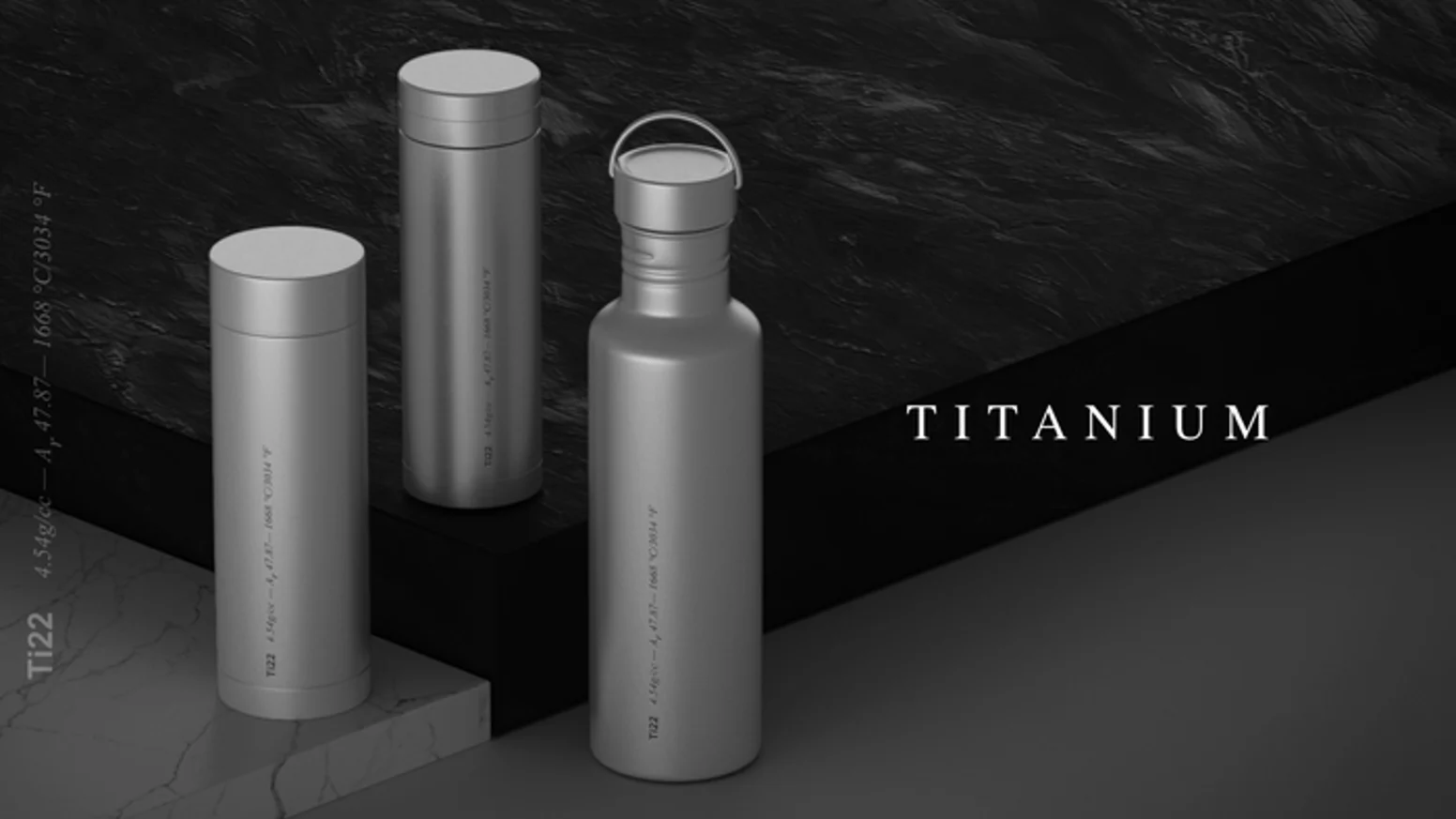
The real argument for titanium is not weight or insulation — it is chemistry.
Stainless steel gets its corrosion resistance from chromium (17.5–19.5% per ASTM A240) and its strength partly from nickel (8.0–10.5% in 304 grade). Both elements are present in the alloy and are generally stable in neutral pH conditions. The problem arises with acidic contents: coffee, tea, kombucha, sports drinks, and citrus-infused water all lower the pH inside the flask. Independent comparative testing has consistently found titanium releases negligible amounts into beverages under acidic conditions — industry sources cite values in the range of 0.009 ppm, well below any established health concern threshold, compared to measurably higher levels from stainless steel in the same conditions.
This matters more to some people than others:
- Nickel allergy affects roughly 8–20% of the population, with higher rates in women. A stainless steel flask is generally safe for most people, but some sensitive individuals report a detectable metallic note in drinks that have sat for hours, particularly coffee.
- Long-term acidic storage — fermented drinks, electrolyte mixes — does more cumulative work on stainless than on titanium.
- Medical-grade history: Grade 4 and Grade 5 titanium are the standard for surgical implants and dental fixtures. Grade 1 (used in most flasks) is the softest and purest form — 99.5%+ titanium, zero nickel.
Taste is where user feedback is the most consistent. People who switch from stainless steel to a titanium thermos almost universally report that plain water, coffee, and tea taste cleaner. This is less dramatic with double-wall vacuum flasks (your drink never contacts the outer wall) but still noticeable when comparing the inner surfaces: titanium is truly inert; stainless steel is mostly inert with some caveats around acidity and extended contact time.
Durability adds a third angle. Titanium’s strength-to-weight ratio is approximately double that of steel by volume. A titanium flask wall at the same thickness will resist scratching and oxidation better than stainless over years of field use. Scratched stainless steel can develop surface rust on the scratch site; scratched titanium develops a self-healing oxide layer and shows no rust.
From the Trail: What Using a Titanium Thermos Is Actually Like
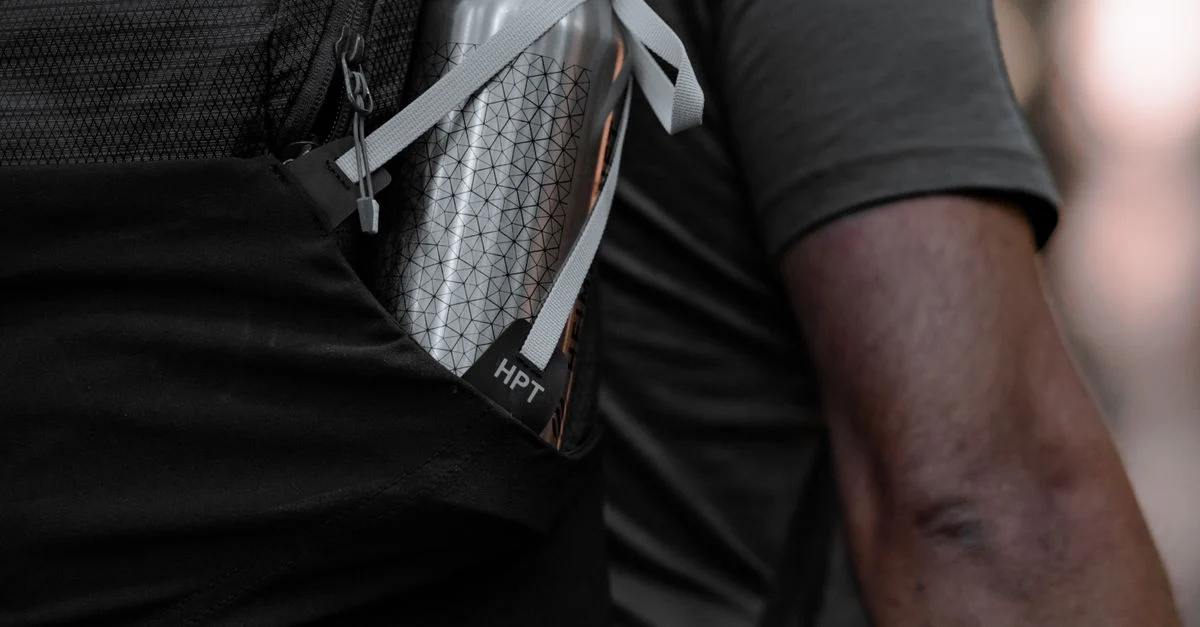
The specs say “slightly lighter and chemically inert.” The trail experience adds a few details the spec sheets skip.
The first thing you notice is the feel. A titanium vacuum flask is cold to the touch when filled with a hot drink — that’s the vacuum insulation working — but the surface also has a particular matte warmth that polished stainless doesn’t. It does not pick up fingerprints the way brushed steel does. After three winters of use, a quality titanium thermos looks largely the same as it did out of the box, with the typical scuff marks of a working piece of gear but no rust spots or discoloration.
On a six-hour winter hike at -5°C ambient, I’ve used a 500ml titanium vacuum flask (Thermos FJN-500T) loaded with black coffee. After four hours with the lid opened twice, the coffee was still too hot to drink immediately — well over 60°C. At the six-hour mark it was firmly in “hot enough” territory. That matches the manufacturer’s JIS test result (above 69°C at 6 hours in 20°C ambient). Cold conditions slow heat loss further.
Where titanium thermoses feel different from stainless:
- They are noticeably quieter to handle — titanium rings and clanks differently, more muted
- The walls are slightly more flexible; if you drop one on a rock, a titanium flask is more likely to show a shallow dent where stainless might absorb the impact with a smaller mark
- The lid mechanisms on titanium-bodied flasks are often made from stainless steel or polymer — the body is titanium, the lid rarely is, and that is fine
What doesn’t change: the basic experience of using a vacuum thermos is the same. Screw lid, pour, drink. The titanium shell makes no difference to how you use it. It makes a difference to what leaches into your drink over time and to how the flask survives a decade of rough handling.
One honest note: if your primary concern is maximum heat retention above everything else, the Japanese domestic stainless steel vacuum flask market — Zojirushi, Tiger, Thermos brand stainless models — still represents the engineering benchmark. Their lid-to-body seal precision is extremely refined. A titanium flask in the same price range is competitive but not definitively better on insulation.
The Titanium Vacuum Flasks Worth Buying in 2026
These four models represent the verified options in the titanium vacuum flask category — not titanium-coated or titanium-branded stainless, but actually titanium-bodied vacuum thermoses.
Thermos FJN-500T — 500ml Pure Titanium Vacuum Flask
The benchmark for this category. Japanese-manufactured, using pure titanium (not Grade 5 Ti-6Al-4V alloy) for the inner and outer walls. Weighs 210g, retains heat above 69°C for 6 hours per JIS testing. Available in 350ml and 600ml variants. The lid is stainless steel with a polymer gasket — standard construction. Price: approximately $80–$110 USD. This is what “pure titanium thermos” actually means when produced with Japanese manufacturing standards.
Snow Peak Titanium Active Insulated Bottle
Snow Peak has been making titanium drinkware in Niigata, Japan since the early 1990s. Their insulated bottle line uses Grade 1 titanium for the body with double-wall vacuum construction. Lighter than average for the size, with Snow Peak’s characteristic understated aesthetic. Priced at $100–$150 depending on capacity. Snow Peak’s brand credibility in the outdoor space is genuine — they supply Japanese outdoor professionals, not just recreational buyers.
SilverAnt Titanium Vacuum Bottle
A more recent entrant from a specialist titanium drinkware brand. SilverAnt explicitly lists titanium grade (Grade 1 TA1 or Grade 2 TA2), which matters when verifying “pure titanium” claims — Grade 1 is softer and purer, Grade 2 slightly stronger. SilverAnt offers 300ml–1000ml sizes with verified titanium certification. Priced $70–$130. Their documentation is better than most competitors — they publish third-party material certification.
Hydro Flask Trail Series Titanium Ultralight
Hydro Flask’s Trail Series Ultralight uses an all-titanium double-wall construction — both inner and outer walls are titanium. This makes it the lightest vacuum-insulated bottle Hydro Flask has produced (approximately 220g at 21 oz / 621ml, roughly 35% lighter than their comparable stainless models). Priced at the premium end of the market. If you want Hydro Flask’s proven insulation quality in a genuine titanium build, this is the option.
One important check when buying: search for “Grade 1 titanium” or “TA1/TA2 titanium” in the product specification. “Titanium” without a grade is sometimes used to describe titanium-colored aluminum or titanium-coated stainless steel. Price under $40 for a vacuum flask claiming to be titanium is a red flag.
Who Should Buy a Titanium Thermos — And Who Shouldn’t
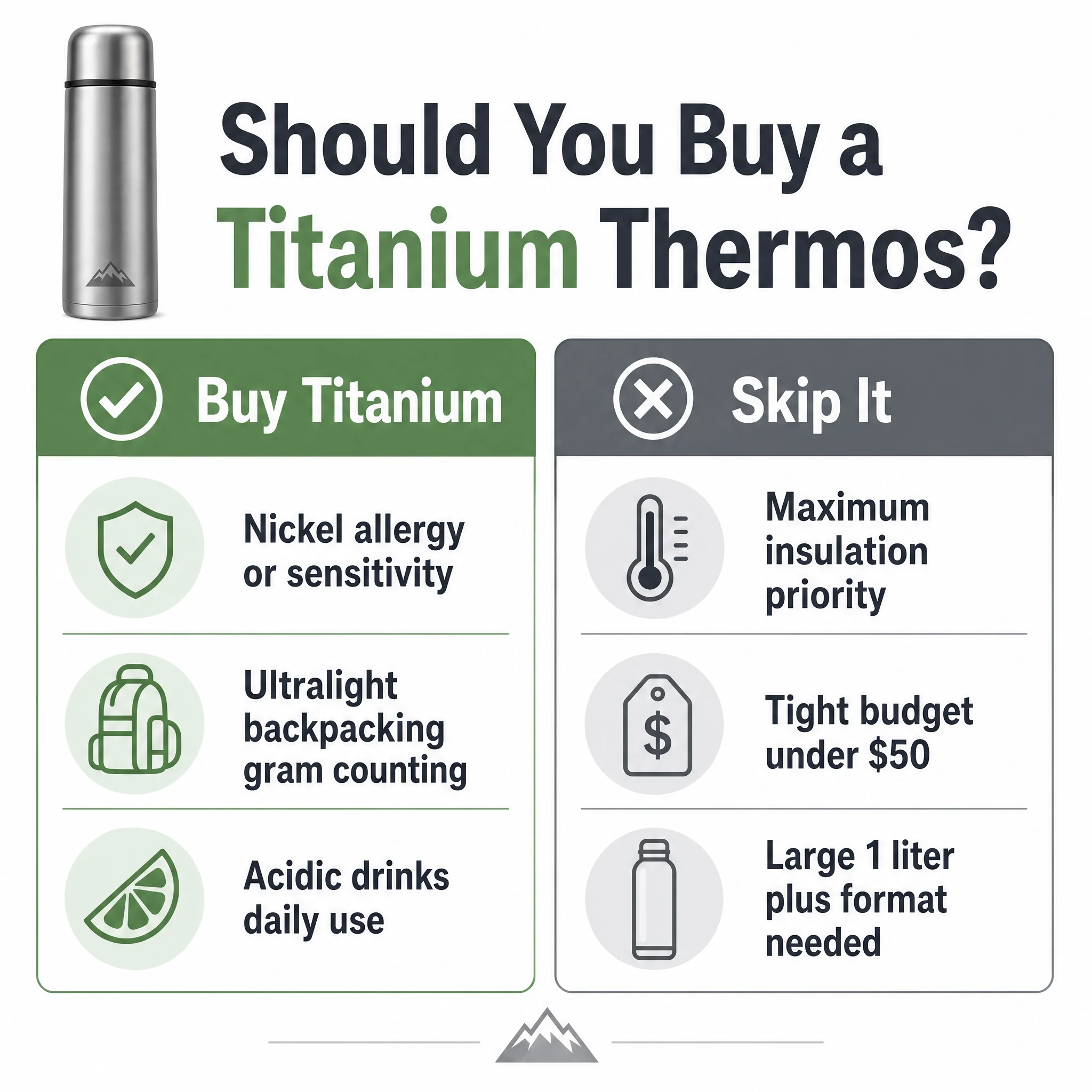
A titanium vacuum flask is not the right tool for everyone, and the premium is only justified in specific situations.
Buy a titanium thermos if:
- You have a nickel sensitivity or allergy and want zero risk from your drinkware
- You are a gram-counter on multi-day backpacking trips where every 20–40g across all gear items adds up meaningfully
- You drink acidic beverages — kombucha, coffee, sports drinks — and want a flask that won’t develop any interaction with the inner surface over years of use
- You plan to own and use this flask daily for 10+ years and want a material that won’t corrode, rust, or degrade regardless of what you put inside
- You can heat water directly over a flame in the same vessel (pure titanium is fire-safe; you can boil in it, then seal and carry)
Skip a titanium thermos if:
- Your priority is maximum insulation performance at any price — in that case, a premium Japanese stainless steel vacuum flask (Zojirushi, Tiger) likely outperforms on lid-seal precision
- Budget is the constraint — a $25 stainless vacuum flask will keep your coffee hot for 6 hours just as well; the titanium version at $100 doesn’t make the coffee 4× better
- You want a large-format thermos (1L+) — titanium vacuum flasks above 750ml are rare and extremely expensive; stainless is the practical choice for sharing-size flasks
- You lose or damage gear regularly — at $100–$200, replacing a titanium thermos hurts more
The honest answer to “is a titanium thermos worth it” is: worth it for a narrow, well-defined set of users. Not worth it as a general upgrade from a quality stainless flask. The gap in real-world heat retention is too small to feel; the gap in price is not.
Frequently Asked Questions
Is a titanium thermos safe to use every day?
Yes. Grade 1 and Grade 2 titanium are medically biocompatible — the same grades used in surgical implants. Titanium does not leach heavy metals into beverages. Independent testing has found titanium releases negligible amounts even under acidic conditions, well below any established health concern threshold. Daily use is safe for all beverages including acidic drinks like coffee, kombucha, and citrus water.
Does a titanium thermos keep drinks hotter than stainless steel?
Not meaningfully. Both use the same vacuum insulation principle. The Thermos FJN-500T (pure titanium) maintains above 69°C at 6 hours under JIS testing at 20°C ambient. Premium stainless thermoses perform comparably. The difference between them on heat retention is much smaller than the difference between any vacuum flask and a non-vacuum insulated cup.
What is the difference between a titanium thermos and a titanium water bottle?
A titanium water bottle is typically single-wall — one layer of metal, no insulation. At 750ml, single-wall titanium bottles typically weigh 130–150g (verified against actual product listings: 22Flask 750ml is 144.8g, comparable Boundless Voyage is 138.8g). A titanium thermos or vacuum flask is double-wall with a vacuum-sealed gap — genuine insulation, significantly heavier (180–250g for 500ml), and substantially more expensive. They are different products with different use cases.
Why is a titanium thermos so expensive?
Two reasons: material cost and manufacturing difficulty. Titanium is approximately 5–10× more expensive per kilogram than stainless steel as a raw material. It also requires vacuum arc remelting and inert-atmosphere forming to process without contamination, which adds manufacturing cost. The vacuum insulation construction adds further precision requirements. The result is a product that typically costs $80–$200 for a 500ml capacity.
Can I boil water directly in a titanium thermos?
Only in single-wall titanium bottles — not in vacuum flasks. A vacuum flask’s outer wall and seals are not designed for direct flame contact. If you need to boil water in the same vessel you carry, buy a single-wall titanium pot or bottle (like TOAKS or Snow Peak titanium pots) and use a separate insulated flask for the hot drink.
Can a titanium thermos handle acidic drinks like coffee or kombucha?
Yes — that is one of titanium’s genuine advantages over stainless steel. Titanium is chemically inert to virtually all food-safe acids. Coffee, kombucha, sports drinks, and citrus-based drinks will not interact with the titanium inner surface. For extended storage of acidic drinks (overnight or longer), titanium is the more conservative choice compared to stainless.
The Bottom Line
A titanium vacuum flask earns its premium through material purity and longevity, not insulation performance. The heat retention is competitive with quality stainless models but not superior. The real reasons to choose titanium are: no nickel or chromium in the alloy, a truly inert inner surface that never affects taste, and a material that will outlast virtually anything else you own. For ultralight backpackers counting grams and health-conscious users who want the cleanest possible material in their daily drinkware, the premium is justifiable. For everyone else, a $30 Zojirushi keeps coffee just as hot.
If you decide to buy: verify the titanium grade (Grade 1/TA1 or Grade 2/TA2) in the product specs, budget at least $80 for a genuine 500ml vacuum model, and look at the Thermos FJN-500T or Snow Peak insulated bottle lines as your starting reference points.