
Titanium camping cookware is the lightest cookware material available for backpacking — commercially pure Grade 1/2 titanium pots typically weigh 3–5 oz for 550–900 ml capacity, versus 5–10 oz for equivalent stainless steel. The tradeoff is poor heat distribution: titanium’s thermal conductivity (~16 W/m·K) is roughly 10× lower than aluminum’s (~167 W/m·K), making hot spots unavoidable. Titanium wins for ultralight boil-only backpacking. It loses for actual cooking. This guide explains exactly when the premium is worth it — and when aluminum or stainless steel is the smarter call.
Titanium camping cookware has been popular with ultralight backpackers since MSR introduced the Titan kettle around 2000 with the tagline “You want light? You want strong? You want Titanium.” That pitch still holds — but there are real tradeoffs that most buyer guides skim past.
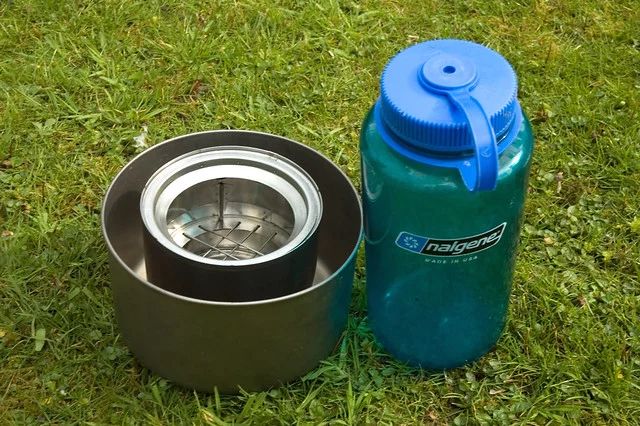
After testing multiple titanium pots across long-distance trail systems — including trips where I ate freeze-dried oatmeal out of a TOAKS 750 ml for five consecutive mornings — the honest answer is this: titanium is an exceptional tool for a specific job, and a frustrating one for everything outside that job.
This guide covers the material science behind the weight savings, the heat distribution limitation in plain numbers, the campfire soot issue nobody puts in their headline, and a volume guide to help you pick the right capacity for your trip. It also covers the one question that shows up in every comment section: is titanium cookware actually safe to use?
What Makes Titanium Different from Other Camp Cookware Materials
Titanium’s defining property for cookware is its strength-to-weight ratio: density of 4.51 g/cc, roughly 43% lighter than steel (7.9 g/cc) at the same volume, yet stronger than aluminum (2.70 g/cc) at the same wall thickness.
That gap translates directly to finished pot weight. A titanium pot can use thinner walls than aluminum to achieve the same structural rigidity, which is how a TOAKS 750 ml titanium pot reaches 3.6 oz (103g with lid) while an aluminum pot of similar capacity typically weighs 5–7 oz. Stainless steel at the same capacity hits 8–10 oz.
Most cookware-grade titanium is commercially pure (CP) Grade 1 or Grade 2 — the same grades used in medical implants and aerospace fasteners. Both Grade 1 and Grade 2 have a thermal conductivity of approximately 16–16.4 W/m·K. Both are far below aluminum 6061-T6 (~167–170 W/m·K) and roughly comparable to stainless steel 304 (~16 W/m·K).
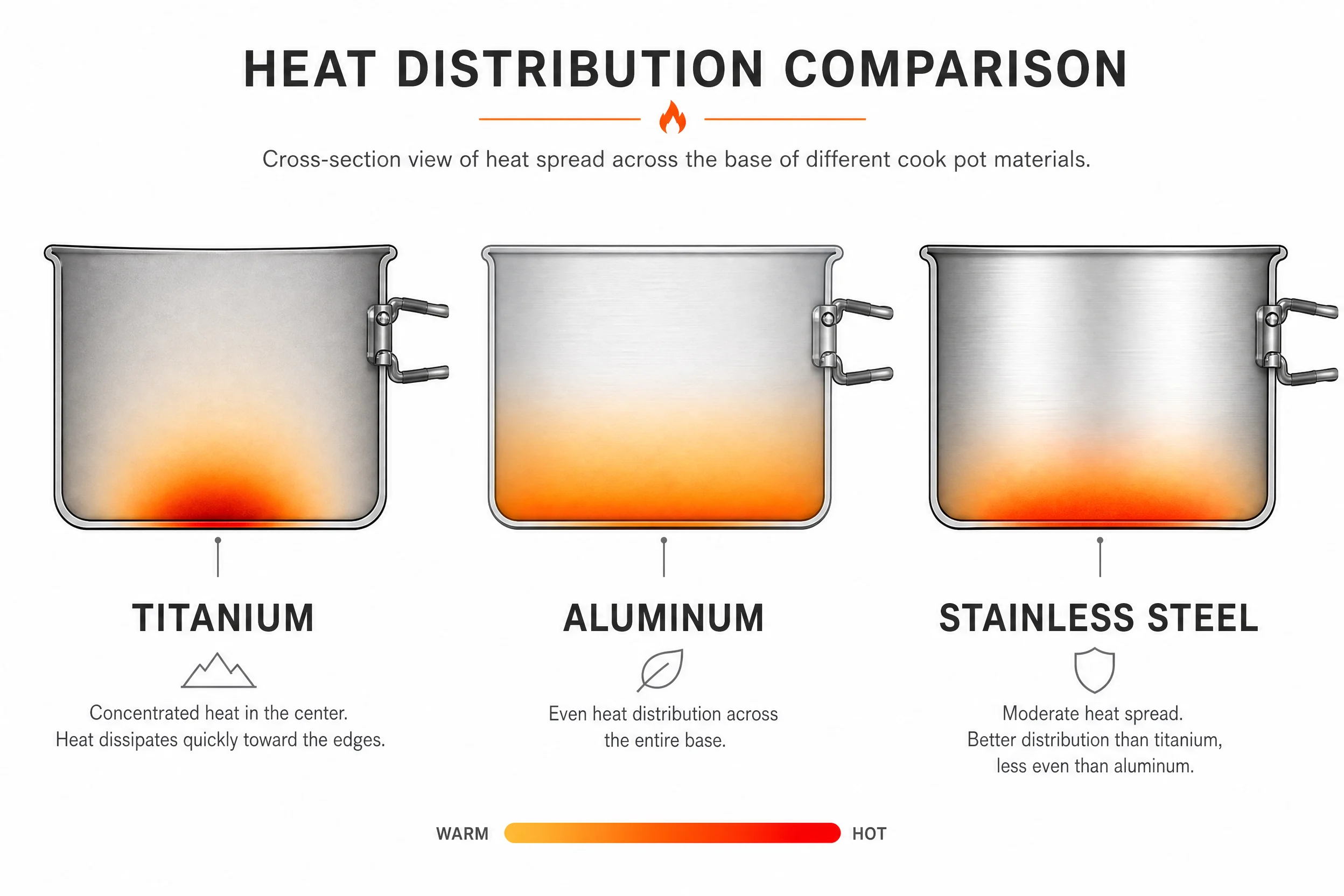
The practical result: titanium transfers heat quickly through thin walls — so water boils fast — but does not spread that heat laterally. The flame point underneath the pot becomes a hot zone, while the surrounding base stays cooler. That’s the origin of titanium’s infamous hot spots.
Titanium is also fully corrosion-resistant, non-reactive with food acids, and does not require coatings or anodizing to be food-safe. It’s the lowest-maintenance option of the three materials.
Titanium vs Aluminum vs Stainless Steel: Side-by-Side
The right material depends on how you cook and what heat source you use — not just which is lightest.
| Feature | Titanium | Aluminum (hard-anodized) | Stainless Steel |
|---|---|---|---|
| Typical pot weight (750–900 ml) | 3.5–5 oz (99–142g) | 5–7 oz (142–198g) | 8–11 oz (227–312g) |
| Thermal conductivity | 16–16.4 W/m·K | ~167–170 W/m·K | ~16 W/m·K |
| Heat distribution | Poor — hot spots | Excellent — even spread | Moderate |
| Best heat source | Canister stove | Canister stove | Campfire / any |
| Campfire use | Possible, but soots heavily | Not recommended | Recommended |
| Cooking real food | Poor for simmering | Good | Good |
| Boiling water | Excellent | Excellent | Good |
| Durability | Very high — no coating to chip | High (coating can wear) | Very high |
| Maintenance | Minimal — no coating | Mild soap, no abrasives | Straightforward |
| Price range (single pot) | $40–$100+ | $20–$60 | $15–$50 |
| E-E-A-T data source | MSR / TOAKS specs; Aerospace Metals Grade 1 datasheet | Fire Maple / MSR product data | Rolled Alloys Grade 2 datasheet |
One number from that table is worth pausing on: aluminum’s thermal conductivity (~167–170 W/m·K) is roughly 10× higher than titanium’s (~16 W/m·K). That single fact explains most of the “titanium burned my food” complaints online. It also explains why titanium is perfectly fine for boiling water — spread doesn’t matter when your goal is just getting the whole pot hot.
The Hot Spot Problem — and How to Cook Around It
Titanium concentrates heat directly over the flame point, which means the center of the pot base gets far hotter than the edges. For boiling water, this is irrelevant. For cooking anything that can scorch — rice, oats, tomato sauce — it’s a real problem.
The physics are straightforward: low thermal conductivity means heat stays where it’s applied instead of spreading laterally. The burner flame hits a 2–3 cm diameter spot at the base center, and that spot becomes significantly hotter than the surrounding area. Titanium’s thin walls (typically 0.4–0.8 mm on quality pots) amplify this effect because there’s less material mass to absorb and redistribute the heat.
Practical workarounds that actually help:
- Use the lowest flame possible. Simmering rather than full-blast significantly reduces the temperature differential across the base.
- Stir frequently. Moving food away from the hot zone continuously is the most effective mitigation for porridge, instant meals, and soups.
- Use a heat diffuser or simmer ring on alcohol or canister stoves if you regularly cook actual food and refuse to switch materials.
- Go wide, not tall. Wider-diameter pots distribute the same flame over a larger base area, reducing the severity of the central hot spot. A 700 ml wide-mouth pot will cook more evenly than a tall 750 ml narrow pot.
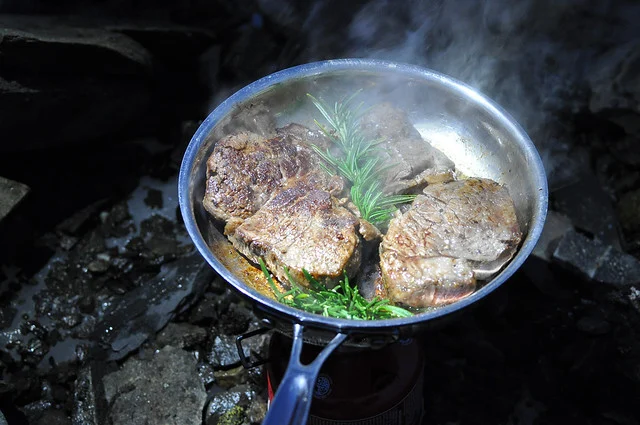
For pure boil-and-pour meals — freeze-dried packets, instant noodles, coffee — none of this matters. You boil the water, pour it in the bag or cup, wait. No stirring, no simmering, no scorching risk.
The honest conclusion: if 80% of your camp meals are rehydrated freeze-dried food, titanium’s hot spot weakness is a non-issue. If you’re sautéing, simmering sauces, or cooking eggs, use an aluminum or stainless pan instead.
Campfire Use: What Nobody Warns You About
Titanium can technically go over a campfire — it won’t warp, melt, or degrade from direct flame. But there’s a practical consequence that most buyer guides skip: campfire use coats the exterior in thick carbon soot that is extremely difficult to remove.
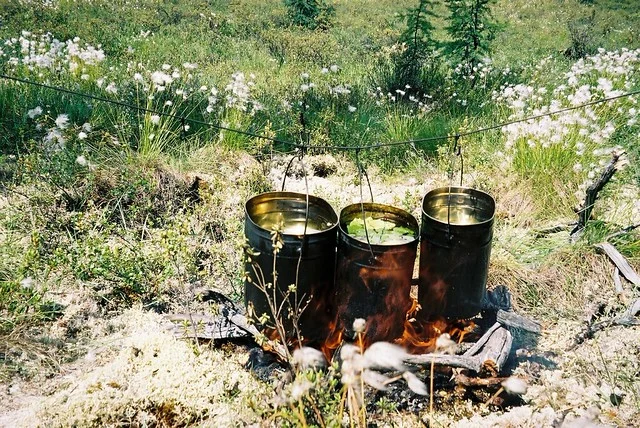
Wood fires produce carbon-rich smoke. That carbon bonds to titanium’s surface at high temperature, creating a black coating that doesn’t scrub off with normal trail cleaning. The pot still works fine — soot doesn’t affect performance — but it blackens permanently and transfers carbon residue onto anything it touches in your pack.
A few things to know before using titanium over a campfire:
- Soot buildup is cosmetic, not a safety issue. The exterior blackens; the interior stays clean if you’re boiling water or rehydrating food.
- Prevention is easier than removal. Some backpackers apply a light layer of dish soap to the exterior before campfire use — the soot bonds to the soap layer instead of the titanium, and rinses off more cleanly afterward.
- For regular campfire cooking, stainless steel is the better call. It handles open flame without warping and the soot situation is more manageable due to thicker walls and better heat distribution.
- Quality matters for campfire use. Single-wall titanium with handles that have plastic components is not campfire-safe. Look for all-metal construction if you want fire flexibility.
The stainless steel comparison is relevant here: 304 stainless has thermal conductivity of ~16 W/m·K — similar to titanium — but significantly higher wall thickness in budget pots, which makes it more forgiving over variable campfire heat. Titanium’s thin-wall construction that earns its weight savings also makes it less tolerant of the uneven, high-intensity heat of an open fire.
How to Choose the Right Volume
Most people underestimate how much volume they need when cooking for two, and overestimate what they need solo. Getting this wrong negates the weight savings.
Volume selection for titanium pots by trip type:
| Use Case | Recommended Capacity | Reasoning |
|---|---|---|
| Solo ultralight (boil-only, freeze-dried) | 550–750 ml | Fits a standard 110g fuel canister inside for pack efficiency |
| Solo with occasional real cooking | 750–900 ml | Extra headroom prevents boilovers; fits stove and canister |
| 2-person boil-only | 900–1300 ml | Minimum 900 ml for two pouches + hot drinks |
| 2-person cooking actual meals | 1300–1600 ml | Need room to stir without spilling |
| Group (3+) | Multiple smaller pots | One large titanium pot loses weight advantage vs two lightweight pots |
The TOAKS 750 ml is the benchmark solo pot — it weighs 3.6 oz (102g), the lid doubles as a fry pan, and a 110g canister fits inside for pack-out. The Snow Peak Trek 700 (4.8 oz, 136g) is slightly heavier but has a wider mouth that’s easier to eat from directly.
One geometry note: wider pots boil faster per BTU of fuel than narrow, tall pots. More base surface area means more heat transfer per unit of flame. If boil speed matters more than pack height, go wide over tall.
For solo snow camping, aluminum may still be preferable despite the extra weight — aluminum’s superior heat spread makes snow melt more efficient and reduces fuel consumption in cold conditions where every fuel canister gram matters more.
Is Titanium Cookware Safe?
Yes. Commercially pure (CP) Grade 1 and Grade 2 titanium are among the most inert materials used in food contact applications. There is no evidence that titanium leaches into food or releases toxins at any temperature achievable in camping cookware.
The safety profile comes from titanium’s chemistry: it forms a stable, self-renewing titanium dioxide (TiO₂) oxide layer that prevents the metal beneath from reacting with food acids, water, or heat. This same property is why CP titanium is used for surgical implants, dental fixtures, and bone plates — applications where biological inertness is the primary requirement.
Key points for the safety question:
- No leaching at cooking temperatures. Titanium’s oxide layer is stable up to well above any achievable flame temperature on a camping stove or campfire.
- No PFOA, PTFE, or coating concerns. Bare titanium pots have no nonstick coatings. The food safety question is simpler than with aluminum (which uses anodizing or nonstick finishes) or nonstick-coated stainless.
- Grade 1/2 is the relevant standard. Most quality camping cookware (TOAKS, Snow Peak, MSR Titan) uses commercially pure Grade 1 or 2 titanium. Be cautious of unbranded pots that may use titanium alloys with other metal additives.
- The “metallic taste” issue some users report is typically from manufacturing residue on new pots, not from the titanium itself. Boiling water and discarding it twice before first use resolves this in almost all cases.
For sourcing teams: look for CP Grade 1 or Grade 2 titanium on product specs. Avoid Ti-6Al-4V (the aerospace structural alloy) for cookware — while safe, it’s overkill and harder to form into thin-wall pot shapes.
Top Titanium Cookware Picks by Use Case
Three pots stand out in field testing as representative benchmarks for different use cases — not because they’re the only options, but because they illustrate the real-world tradeoffs clearly.
Solo ultralight thru-hiking — TOAKS Titanium 750 ml Pot
Weight: 3.6 oz (103g with lid). Lid included. Fits a 110g fuel canister inside. At around $26–30, it’s the best value-to-weight ratio in titanium. The narrow tall shape suits stoves with compact canister supports. It’s been the most field-tested titanium pot in the ultralight community for over a decade, and the reason its name appears in nearly every thru-hiking pack list is simply that it works exactly as advertised with no maintenance surprises. For boil-only ultralight use, it’s the reference standard.
Solo with eating comfort — Snow Peak Trek 700
Weight: 4.8 oz (136g). Wider mouth makes eating directly from the pot significantly easier. Slightly heavier than the TOAKS, but the ergonomics are noticeably better for multi-day trips. Snow Peak’s manufacturing quality is audited to Japanese industrial standards, which shows in lid fit and handle durability. Price is around $45–55, but the product is built to last many years rather than seasons.
2-person ultralight — TOAKS Titanium 1100 ml Pot
Weight: 4.8 oz (136g). Adds capacity for two without dramatic weight penalty. The volume is sufficient for two freeze-dried pouches and a pair of drinks without boilover risk. Handles fold flat; the pot stacks into most backpacks without wasted space.
Note: Brand-specific pricing varies. Verify current specs and weights on manufacturer pages before purchasing.
When to Skip Titanium (and Choose Aluminum Instead)
Titanium earns its price premium in one specific context: gram-counting ultralight backpacking where boiling water is the primary cooking task. Outside that context, it’s usually the wrong choice.
Skip titanium if:
- You cook real food at camp. Scrambled eggs, rice, pasta sauce, sautéed vegetables — titanium’s hot spots will burn the contact surface before the interior is fully heated. Aluminum distributes heat evenly and is the right material for anything beyond rehydration.
- You’re car camping or base camping. Weight is irrelevant; durability and even cooking performance matter. A good stainless steel pot or hard-anodized aluminum set is cheaper, more functional, and handles the gear abuse of car camping better.
- Budget is a real constraint. The same 750 ml capacity in anodized aluminum costs $20–35 vs $45–65 for titanium. For casual weekend camping, there’s no performance difference that justifies the price gap.
- You’re melting snow. Multiple field guides note that aluminum’s superior heat distribution makes snow melt more efficient than titanium. The energy cost difference adds up over days.
- You want a frying pan for actual frying. No titanium pan does this well. The physics of low lateral heat conductivity make a flat titanium surface a hot spot machine. Ceramic-coated aluminum is the only lightweight option that produces consistent results for frying.
The honest version of the titanium pitch: it’s the best tool for ultralight boil-only backpacking, and a mediocre tool for almost everything else. Buy it for that specific job, and don’t expect it to replace a versatile camp kitchen.
The Bottom Line
Titanium camping cookware delivers a real, measurable weight advantage — typically 2–5 oz saved over equivalent stainless steel — with zero coating maintenance, lifetime durability, and complete food safety. The tradeoff is equally real: thermal conductivity of 16–22 W/m·K compared to aluminum’s 155 W/m·K means hot spots are a physical inevitability, not a manufacturing defect.
The backpackers who get the most value from titanium are the ones who accept that tradeoff deliberately: they’ve decided that shaving 3 oz over 500 miles is worth eating rehydrated meals instead of camp-cooked ones. That’s a completely legitimate trade on a long trail. It’s also a trade that makes no sense for a weekend car camper who wants to cook a real dinner.
Buy aluminum if you want to cook food. Buy titanium if you want to carry less weight and don’t mind eating from packets. Buy stainless if you’re cooking over a fire and care about durability over grams. None of these is the wrong answer — the wrong answer is buying the lightest option and expecting it to do everything.
FAQ
What brand of titanium cookware is best for backpacking?
TOAKS is the most field-validated value option — the 750 ml pot at 3.6 oz is the benchmark solo backpacking pot. Snow Peak is the premium option with noticeably better ergonomics and lid fit. MSR’s Titan line is reliable but heavier than TOAKS at comparable capacities. For most ultralight backpackers, TOAKS 750 ml is the default starting point.
Is a titanium pot worth the price premium over aluminum?
Yes, if weight is your primary constraint and your cooking style is boil-only. No, if you cook real food at camp. The weight savings are real (typically 2–4 oz per pot vs aluminum), but aluminum distributes heat roughly 10× more evenly, which makes it significantly better for actual cooking. The $20–40 price difference per pot is easier to justify on a multi-week thru-hike than on weekend car camping trips.
Is titanium or stainless steel cookware better for camping?
Titanium for ultralight backpacking with canister stoves — it’s significantly lighter and equally durable. Stainless steel for campfire cooking or basecamp use — it handles direct flame without the soot buildup issues, and the extra weight is irrelevant when you’re not carrying everything on your back.
What are the cons of titanium cookware?
Three main ones: hot spots (low thermal conductivity creates uneven heat across the base), campfire soot (carbon deposits are very hard to remove from titanium surfaces), and price (typically 2–3× the cost of comparable aluminum pots). None of these are dealbreakers for boil-only backpacking use, but all three become significant if you cook actual food or use open fires regularly.
Does titanium cookware release toxins when heated?
No. Commercially pure Grade 1/2 titanium is biologically inert — it’s the same material used for surgical implants. It forms a stable titanium dioxide oxide layer that prevents any reaction with food, acids, or heat at camping temperatures. There are no known leaching risks from CP titanium cookware. The metallic taste some new users report is from manufacturing residue, not the titanium itself, and disappears after boiling water and discarding it two or three times.
Can you use a titanium pot over a campfire?
Technically yes — titanium won’t warp or melt from campfire heat. The practical issue is carbon soot from wood fires bonds strongly to the titanium surface and is very difficult to remove. For regular campfire use, stainless steel is more practical. If you do use titanium over a fire, coat the exterior in dish soap before use to make cleanup easier.
What size titanium pot do I need?
Solo backpackers with boil-only meals: 550–750 ml. Solo with occasional real cooking: 750–900 ml. Two-person trips: 900–1100 ml minimum. The TOAKS 750 ml is the most common solo choice because it fits a 110g fuel canister inside for pack efficiency and covers most one-pot meal volumes with headroom.