
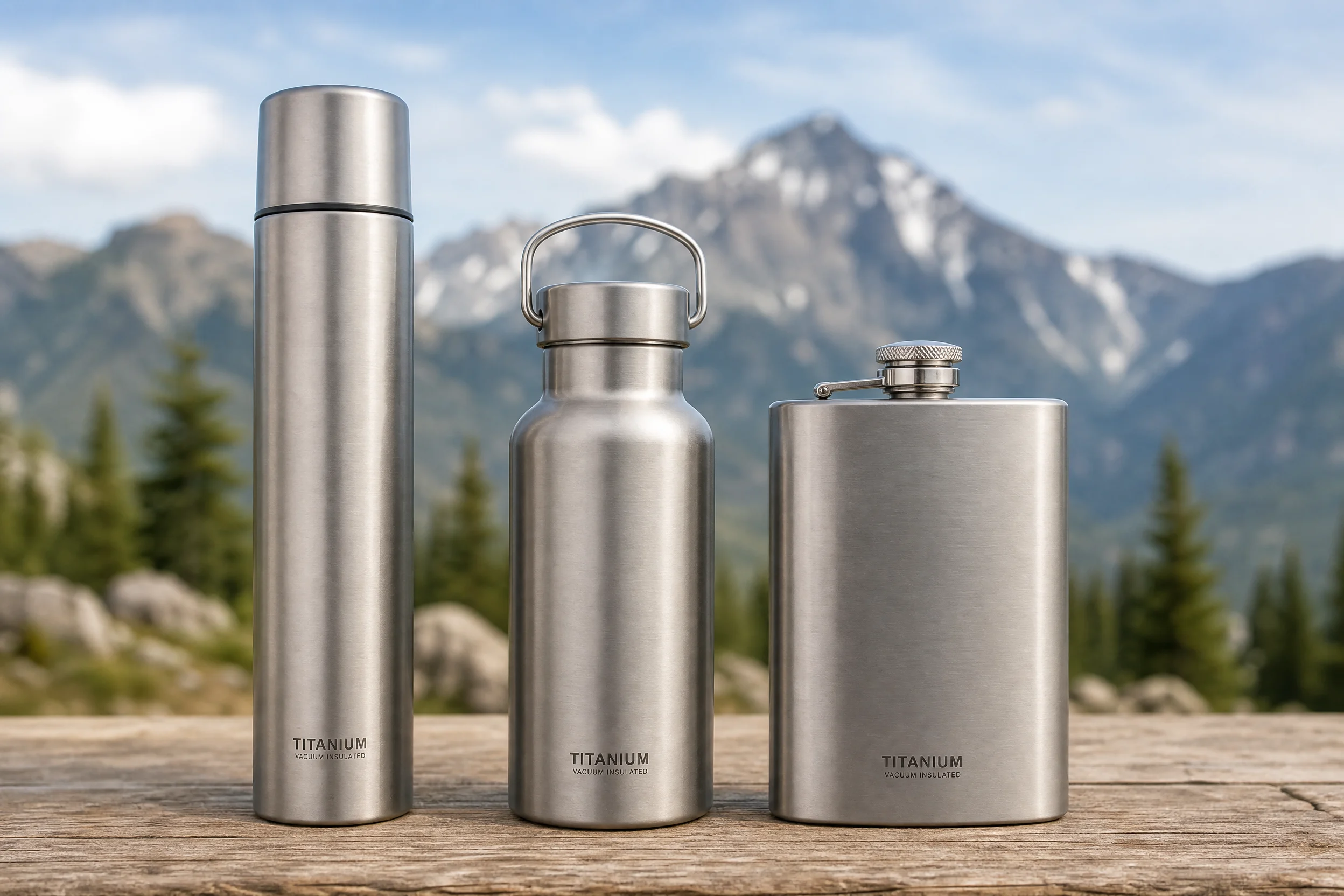
“Titanium thermos,” “titanium vacuum flask,” “titanium insulated bottle,” and “titanium thermos flask” are largely used to describe the same product family — a double-wall titanium drinkware container designed to slow heat transfer. The differences are mainly in construction quality (true vacuum seal vs. double-wall with air), regional naming conventions (UK vs. US English), and marketing positioning. This guide maps out each term, explains what to look for in the product description, and tells you where titanium genuinely beats stainless steel — and where it doesn’t.
Four Names, One Product Family — and Why It Matters
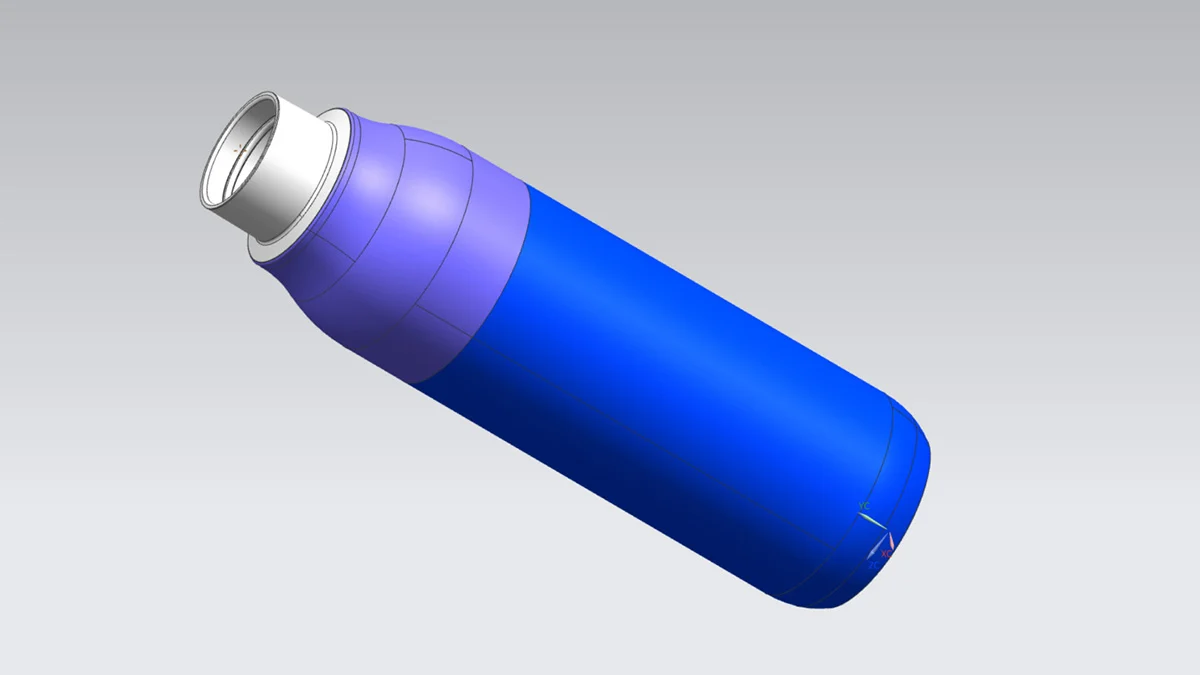
If you’ve searched for a titanium insulated container recently, you’ve probably hit the same wall: four different terms, dozens of products, and no clear explanation of whether they’re all the same thing.
The short answer: mostly yes, but the details matter.
“Thermos” started life as a brand name — Thermos LLC registered it in the early 1900s — but it’s become a genericized trademark in many markets, the way “Band-Aid” describes any adhesive bandage. In everyday US English, “thermos” means any vacuum-insulated container that keeps drinks hot or cold.
“Vacuum flask” is the British English and technical term for the same device. It describes the engineering principle: a double-walled vessel with the air evacuated from the space between walls, creating a vacuum that dramatically slows heat transfer. In physics and manufacturing contexts, this is the precise term.
“Insulated bottle” is the broadest category. It includes vacuum-insulated designs, but also double-wall bottles that still have air in the gap (no vacuum), and even foam-insulated designs. When you see “insulated bottle” without further specification, you don’t automatically know whether it has a true vacuum or not.
“Thermos flask” is a British-English hybrid that combines both common terms. You’ll see it used in UK retail, on European manufacturer product pages, and widely among Chinese OEM exporters who supply both markets.
For titanium drinkware specifically, this terminology gets even more important — because a true full vacuum seal is harder to achieve in titanium manufacturing than in stainless steel. More on that below.
Quick Comparison: What Each Term Tells You
| Term | Primary Market | Engineering Precision | Insulation Guarantee? | Titanium Context |
|---|---|---|---|---|
| Titanium thermos | US / Global | Low | Implied but not specified | Most common consumer search term |
| Titanium vacuum flask | UK / Technical | High | Yes — vacuum insulation specified | Precise term; fewer results, clearer products |
| Titanium insulated bottle | Global / Retail | Low | No — depends on construction | Widest catch-all; check specs carefully |
| Titanium thermos flask | UK / EU / Export | Medium | Usually implied | Common on B2B export listings |
Bottom line: If you’re sourcing or shopping, “titanium vacuum flask” gives you the most precise filter. Products listed under that term are more likely to specify vacuum construction. “Titanium insulated bottle” is the least specific — read the product description.
Titanium Thermos: The American Default
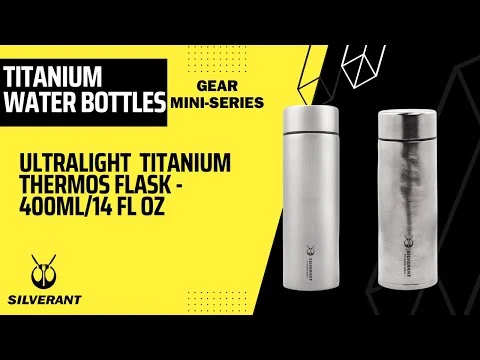
A titanium thermos is what most North American buyers picture: a slim, cylindrical titanium container with a screw-top lid, designed to keep coffee hot on a morning hike or a hot meal warm on a winter summit.
In practice, most products sold as “titanium thermoses” use double-wall construction — two layers of Grade 1 or Grade 2 pure titanium with a gap between them. The better ones pull a partial vacuum from that gap. Some, like the SilverAnt 400ml titanium thermos flask, achieve enough vacuum to keep drinks warm for 8 hours and cold for up to 24 hours at a weight of just 240g.
That weight figure is the titanium thermos’s strongest selling point. A comparable stainless steel double-wall thermos of the same capacity typically weighs 300–380g. For ultralight backpackers, that 60–140g difference is meaningful.
One thing worth knowing: the word “thermos” in the product name tells you nothing about insulation performance. A $25 single-wall titanium “thermos” and a $120 double-wall vacuum titanium thermos both get that label. The construction detail lives in the product spec sheet, not the name.
What to look for: “Double-wall” + “vacuum insulated” (or “vacuum sealed”) in the spec. If you only see “double-wall” without vacuum, expect performance closer to 3–5 hours for hot liquids.
Titanium Vacuum Flask: The Precise Term
“Titanium vacuum flask” is the most technically honest label. A true vacuum flask — whether made from stainless steel or titanium — has had the air evacuated from the space between its inner and outer walls, reducing heat transfer to near-zero via conduction and convection. What remains is only radiant heat loss, which is why quality vacuum flasks include a metallic inner surface to reflect radiation.
The catch with titanium: manufacturing a true vacuum seal is significantly harder than with stainless steel. Titanium reacts with oxygen at high temperatures. Welding requires inert gas protection (typically argon shielding), and the vacuum evacuation step must be done with great precision to avoid micro-leaks that degrade performance over time.
SilverAnt Outdoors, a manufacturer with years of titanium production experience, states plainly: “Stainless steel thermos flasks can be completely vacuum sealed in the manufacturing process. Titanium can only ever be double-wall. In the titanium manufacturing process, creating a vacuum seal is very hard.”
This is the single most important fact most comparison articles skip.
What it means practically: a premium titanium vacuum flask from a manufacturer who invests in the production process (argon welding, proper evacuation, tight quality control) will approach stainless steel performance, but rarely match it. A budget titanium “vacuum flask” may have minimal vacuum and perform like a simple double-wall design.
What to look for: Named titanium grade (Grade 1/TA1 or Grade 2/TA2 — these are commercially pure titanium, appropriate for food contact), argon-welded seams in the spec, and documented insulation test hours from the brand.
Titanium Insulated Bottle: The Retail Catch-All
“Titanium insulated bottle” is the most marketing-friendly term and the least informative one. It covers:
- True vacuum-insulated titanium containers (the premium tier)
- Double-wall titanium bottles with air in the gap (mid-tier performance)
- Single-wall titanium bottles with add-on insulation sleeves (mostly marketing)
On Amazon and general retail, you’ll find all three grouped under this term. The price range runs from around $35 for basic double-wall designs to $150+ for premium full-vacuum titanium bottles.
The titanium material itself doesn’t provide insulation — that’s a common misconception. Titanium’s thermal conductivity (Grade 2: ~16.4 W/m-K, per MatWeb/ASTM data) is nearly identical to 304 stainless steel’s (~16.2 W/m-K). The wall material makes virtually no practical difference to heat transfer. The insulation performance difference between titanium and stainless steel thermoses comes entirely from construction quality — specifically, the depth of vacuum achieved in the gap between walls.
For outdoor use where weight is a priority and you don’t need maximum heat retention, a titanium insulated bottle is a solid choice. For commuters or anyone who needs coffee genuinely hot at hour six, stainless steel vacuum insulation typically delivers better results.
Titanium Thermos Flask: The British-European Hybrid
“Titanium thermos flask” is the term you’ll encounter most often on UK retail sites, European outdoor gear shops, and Chinese B2B export platforms (Alibaba, Made-in-China, 7titanium.com). It combines both common terms and signals a double-wall, insulated, screw-top container — essentially what Americans call a titanium thermos.
If you’re sourcing from a Chinese manufacturer or OEM supplier, “thermos flask” is often the standard description across all materials. Context matters: when a supplier lists a “titanium thermos flask,” they typically mean a double-wall titanium container. Whether it achieves true vacuum insulation or just traps air depends on their production process — something to verify before placing an order.
For B2B buyers, this term is practical shorthand, but always request the product spec sheet with insulation performance data (usually expressed as “keeps hot X hours / keeps cold X hours at ambient 25°C”).
The Insulation Truth: Where Titanium Thermoses Actually Stand
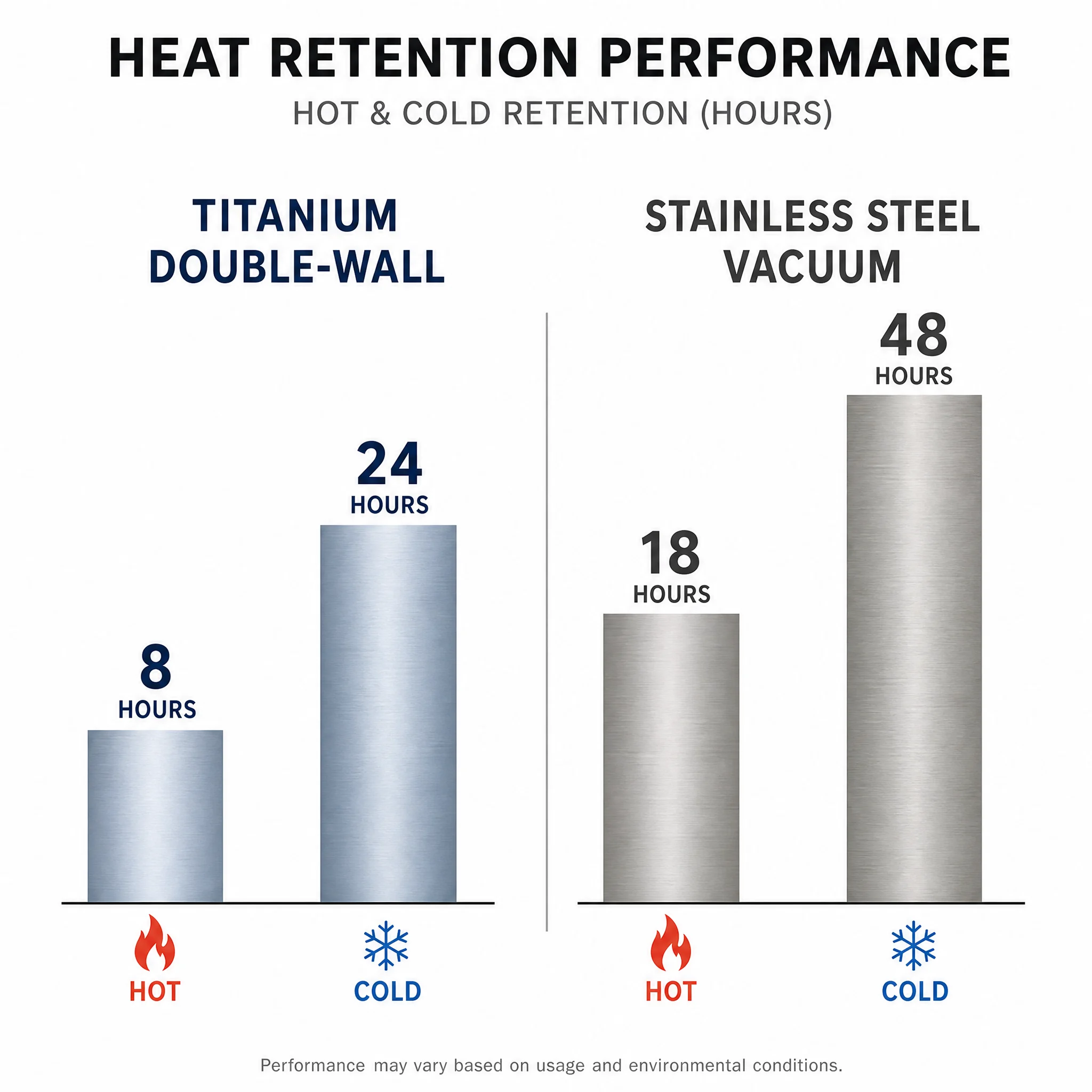
Here’s the honest performance comparison, drawn from manufacturer-published specs and community testing data:
| Construction Type | Hot Retention | Cold Retention | Typical Weight (400ml) |
|---|---|---|---|
| Stainless steel full vacuum | 12–24 hours | 24–48 hours | 300–380g |
| Titanium double-wall (partial vacuum) | 6–8 hours | 18–24 hours | 220–260g |
| Titanium double-wall (air gap) | 2–4 hours | 8–12 hours | 200–240g |
| Titanium single-wall | 30–90 min | 1–3 hours | 90–130g |
The titanium double-wall with partial vacuum — which most premium products like the Titaner 380ml (228g) and SilverAnt 400ml (240g) represent — gives you roughly two-thirds of stainless steel’s heat retention at roughly 60–65% of the weight. That tradeoff is genuine and worth calculating against your actual use.
For a three-hour mountain hike where you want hot coffee at the summit, a titanium thermos works perfectly. For an eight-hour workday where you need your lunch hot at noon, a stainless steel vacuum thermos is the more reliable choice.
The health argument does favor titanium regardless of insulation: titanium is fully biocompatible, forms a stable titanium oxide passivation layer, and does not leach nickel or chromium the way stainless steel can over prolonged acidic beverage contact. For people with nickel sensitivities, titanium is genuinely the cleaner material.
Which Should You Buy?
| Use Case | Best Choice | Why |
|---|---|---|
| Ultralight hiking / thru-hiking | Titanium double-wall vacuum | Weight savings (60–140g) outweigh modest insulation gap |
| Daily commute / long workday | Stainless steel vacuum flask | Superior heat retention (12–24h vs. 6–8h) |
| Backpacking + camp cooking | Titanium single-wall bottle | Can be used directly on stove; lightweight |
| Nickel allergy / chemical sensitivity | Titanium (any construction) | No nickel, no chromium, fully inert surface |
| B2B/OEM sourcing at scale | Stainless steel | Higher production volumes, lower unit cost, more factory options |
| Premium outdoor gift | Titanium vacuum flask | Premium positioning, lifetime durability, conversation piece |
One practical note on terminology when shopping or sourcing: use “titanium vacuum flask” in your search if you want to filter for products that specifically claim vacuum insulation. Use “titanium insulated bottle” for broader results. If you’re on a Chinese B2B platform, “titanium thermos flask” is the working term.
Frequently Asked Questions
Is a vacuum flask the same as a thermos?
Yes, in everyday use they refer to the same product — a double-wall insulated container with a vacuum between walls. “Thermos” is the Americanized generic term (originally a brand name); “vacuum flask” is the British English and technical term.
Why can’t titanium thermoses achieve full vacuum seal like stainless steel?
Titanium oxidizes rapidly at high welding temperatures, making the precision vacuum-sealing step more difficult to execute consistently. This requires inert gas protection and specialized equipment, which limits production output and increases cost. Most titanium double-wall containers achieve a partial vacuum rather than the full vacuum of premium stainless steel flasks.
What grade titanium is used in titanium thermoses?
Grade 1 (TA1) or Grade 2 (TA2) commercially pure titanium is the standard for food-contact drinkware. Grade 5 titanium (Ti-6Al-4V), which is an aerospace alloy containing aluminum and vanadium, should not be used in drinkware that holds hot liquids.
How long does a titanium vacuum flask keep drinks hot?
Premium titanium double-wall models with partial vacuum (e.g., SilverAnt, Titaner) typically keep drinks hot for 6–8 hours. Lower-end double-wall titanium bottles without vacuum keep heat for 2–4 hours. Neither matches the 12–24 hours achieved by quality stainless steel vacuum flasks.
Are titanium insulated bottles worth the premium price?
For weight-critical use cases — ultralight backpacking, trail running, long-distance hiking — yes. You’re paying for material purity (biocompatible, no leaching), a significant weight reduction, and extreme durability. For everyday desk use or commuting, the insulation performance of stainless steel delivers better value.
What does “double-wall” mean vs. “vacuum insulated”?
Double-wall means two walls with a gap between them. Vacuum insulated specifically means the air has been evacuated from that gap, creating a near-vacuum that dramatically slows heat conduction. Double-wall without vacuum still insulates somewhat, but much less effectively.
Summary
The four terms — titanium thermos, titanium vacuum flask, titanium insulated bottle, titanium thermos flask — point to the same product category but with important construction and regional nuances. “Vacuum flask” is the most technically precise; “insulated bottle” is the broadest. For titanium specifically, no product fully matches stainless steel’s vacuum seal performance due to manufacturing constraints, but premium titanium double-wall options cut significant weight while delivering practical insulation for most outdoor scenarios.
The titanium premium is justified by biocompatibility, weight, and lifetime durability — not by insulation numbers. Know what you’re buying.