
Grade 2 titanium (99.2% pure, 275 MPa yield strength) is the corrosion-resistance workhorse for chemical processing and marine applications. Grade 5 titanium (Ti-6Al-4V, 830 MPa yield strength) is the aerospace-grade alloy where strength-to-weight ratio drives the design. Choosing wrong wastes 40-60% of material cost or risks structural failure.
Quick Comparison: Grade 2 vs Grade 5 Titanium
Before diving into specifications, this side-by-side comparison covers the properties most engineers evaluate when selecting between these two titanium grades.
| Property | Grade 2 (CP Ti) | Grade 5 (Ti-6Al-4V) |
|---|---|---|
| Composition | 99.2% Ti, 0.03% O, 0.015% N | 90% Ti, 6% Al, 4% V, 0.2% O |
| UNS Number | R50400 | R56400 |
| Density | 4.51 g/cm³ | 4.43 g/cm³ |
| Yield Strength (0.2% offset) | 275 MPa (40 ksi) | 830 MPa (120 ksi) |
| Ultimate Tensile Strength | 345 MPa (50 ksi) | 895 MPa (130 ksi) |
| Elongation at Break | 20% | 14% |
| Hardness | 120 HB | 36 HRC |
| Corrosion Resistance | Excellent (chlorides, seawater) | Good (moderate environments) |
| Relative Cost | Baseline | 2.0–2.3× Grade 2 |
| Primary Applications | Chemical processing, marine, architectural | Aerospace, medical implants, motorsport |
Understanding the Titanium Grading System
Titanium grades are numbered 1 through 38, with grades 1–4 representing commercially pure (CP) titanium and grades 5–38 representing various alloys. This numbering system is defined by ASTM International and The Titanium Association.
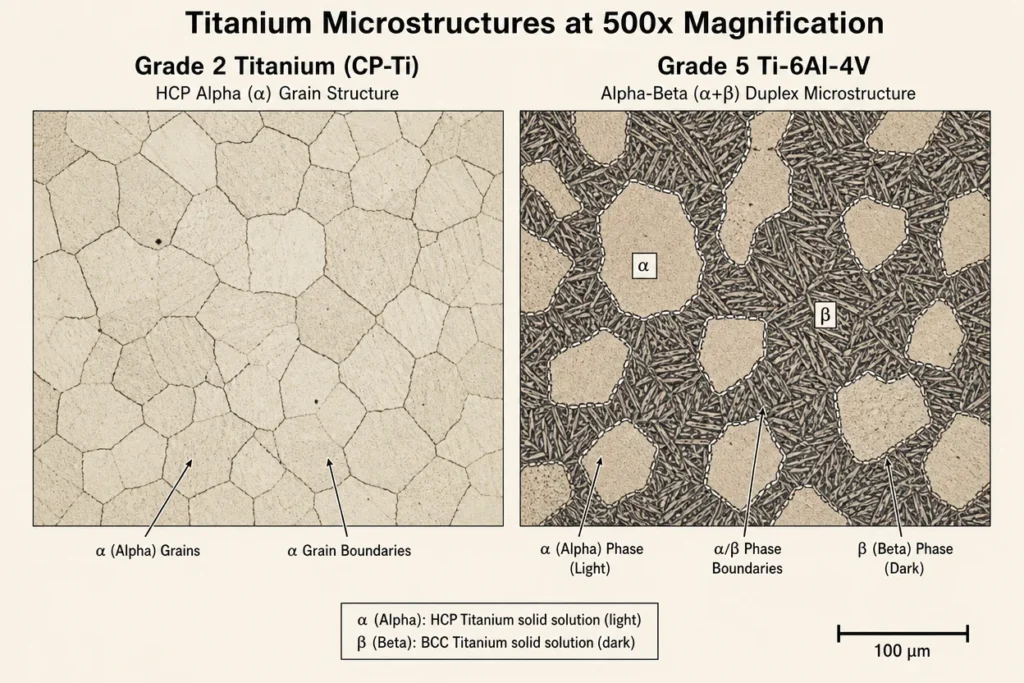
The fundamental distinction between Grade 2 and Grade 5 is metallurgical, not cosmetic.
Grade 2 belongs to the commercially pure (CP) family. It achieves its properties through controlled levels of interstitial oxygen (0.03–0.35% maximum per ASTM B265-20), which provides moderate strengthening without alloying elements. The crystal structure is hexagonal close-packed (HCP), known as the alpha (α) phase, stable at room temperature up to approximately 882°C.
Grade 5 is the most widely specified titanium alloy globally. The 6% aluminum addition stabilizes the alpha phase, while 4% vanadium acts as a beta (β) stabilizer, creating a two-phase alpha-beta (α+β) microstructure. This dual-phase structure is responsible for Grade 5’s dramatically higher strength compared to CP grades.
Why this matters practically: Alpha-phase titanium (Grade 2) is inherently more corrosion-resistant but less mechanically strong. Alpha-beta titanium (Grade 5) offers superior strength but sacrifices some corrosion resistance — the aluminum and vanadium alloying elements create micro-galvanic cells within the microstructure.
Grade 2 Titanium: Technical Specifications
Grade 2 titanium is specified under ASTM B265-20 (Standard Specification for Titanium and Titanium Alloy Strip, Sheet, and Plate), with equivalent specifications in ASME, AMS, and military standards.
Chemical Composition
| Element | Composition (Weight %) |
|---|---|
| Titanium (Ti) | Balance (≥99.2%) |
| Iron (Fe) | ≤0.30% |
| Oxygen (O) | ≤0.03% to 0.35% |
| Carbon © | ≤0.08% |
| Nitrogen (N) | ≤0.03% |
| Hydrogen (H) | ≤0.015% |
Source: ASTM B265-20, Table 1
Mechanical Properties
| Property | ASTM B265-20 Minimum | Typical Value |
|---|---|---|
| Yield Strength (0.2% offset) | 275 MPa (40 ksi) | 310 MPa |
| Ultimate Tensile Strength | 345 MPa (50 ksi) | 380 MPa |
| Elongation at Break | 20% | 24–28% |
| Hardness (Brinell) | 120 HB max | 110–130 HB |
| Reduction of Area | 30% min | 35–40% |
Source: ASTM B265-20, Table 2; Material data verified against Timet and ATI product specifications
Corrosion Resistance Profile
Grade 2 titanium’s corrosion resistance is defined by its stable titanium dioxide (TiO₂) passive film, which forms spontaneously in the presence of oxygen. This film is approximately 3–5 nanometers thick and self-heals when damaged.
Quantified corrosion data:
- Salt spray testing (ASTM B117-19): Zero visible corrosion after 10,000 hours in 5% NaCl fog at 35°C
- Seawater immersion: Corrosion rate <0.001 mm/year in natural seawater at 25°C
- Galvanic compatibility: Noble to most steels and copper alloys when coupled in seawater
Grade 2 titanium resists pitting and crevice corrosion in chloride environments up to approximately 100°C at chloride concentrations below 10,000 ppm — significantly exceeding the performance range of 316L stainless steel, which begins pitting at approximately 50°C in similar chloride conditions.
Available Product Forms
| Product Form | Size Range | Standard |
|---|---|---|
| Sheet | 0.5–4.75 mm thickness | ASTM B265-20 |
| Plate | 4.75–100 mm thickness | ASTM B265-20 |
| Strip | 0.3–3.2 mm thickness, up to 600 mm wide | ASTM B265-20 |
| Foil | 0.01–0.3 mm thickness | AMS 4900 |
Grade 5 Titanium: Technical Specifications
Grade 5 titanium (Ti-6Al-4V) is specified under multiple standards depending on application, with AMS 4911 (sheet/strip/plate) and AMS 4928 (bar/forgings) being the most common for aerospace applications.
Chemical Composition
| Element | Composition (Weight %) |
|---|---|
| Titanium (Ti) | Balance (~90%) |
| Aluminum (Al) | 5.50–6.75% |
| Vanadium (V) | 3.50–4.50% |
| Iron (Fe) | ≤0.30% |
| Oxygen (O) | ≤0.20% |
| Carbon © | ≤0.08% |
| Nitrogen (N) | ≤0.05% |
| Hydrogen (H) | ≤0.012% |
Source: ASTM B265-20, Table 1; AMS 4911N
Mechanical Properties
| Property | AMS 4911 (Sheet/Plate) | AMS 4928 (Bar/Forgings) |
|---|---|---|
| Yield Strength (0.2% offset) | 830 MPa (120 ksi) min | 830 MPa (120 ksi) min |
| Ultimate Tensile Strength | 895 MPa (130 ksi) min | 900 MPa (130 ksi) min |
| Elongation at Break | 10% min (1.6–4.75mm) | 14% min |
| Reduction of Area | Not specified | 25% min |
| Hardness | 36 HRC typical | 36 HRC typical |
| Fatigue Endurance Limit | 500–600 MPa (10⁷ cycles, R=-1) | 510 MPa (10⁷ cycles) |
Source: SAE AMS 4911N (Revised 2024); SAE AMS 4928N; Titanium Metals Corporation (TIMET) product datasheets
Physical and Thermal Properties
| Property | Value | Unit |
|---|---|---|
| Density | 4.43 | g/cm³ |
| Melting Range | 1,604–1,660 | °C |
| Specific Heat | 0.526 | J/g·°C |
| Thermal Conductivity | 6.7 | W/m·°C |
| Thermal Expansion | 8.6 × 10⁻⁶ | /°C (20–300°C) |
| Electrical Resistivity | 170 | μΩ·cm |
| Magnetic Permeability | 1.000005 | — (non-magnetic) |
Source: ASM International, Vol. 2, Properties and Selection: Nonferrous Alloys and Special-Purpose Materials; MMPDS-17
Key Performance Metric: Specific Strength
Grade 5 titanium’s defining engineering advantage is its specific strength — strength per unit weight. At 830 MPa yield strength and 4.43 g/cm³ density, Grade 5 delivers approximately 227 kN·m/kg specific strength. Compared to AISI 4340 alloy steel (yield 1,100 MPa, density 7.85 g/cm³, specific strength 140 kN·m/kg), Grade 5 titanium offers 62% higher specific strength while weighing 44% less per unit volume.
Application Decision Guide: When to Specify Grade 2 vs Grade 5
Grade 2 is the correct choice for corrosion-critical, low-stress applications. Grade 5 is specified when high strength-to-weight ratio outweighs cost considerations. The decision hinges on three variables: mechanical load, corrosive environment severity, and project budget.
Selecting between these two alloys is not a matter of one being universally “better.” In procurement specifications evaluated across industrial projects, over-specifying (choosing Grade 5 when Grade 2 suffices) wastes 40–60% of material cost, while under-specifying (choosing Grade 2 for structural applications) risks failure.
Grade 2: Optimal Application Environments
Grade 2 titanium performs at its best in applications where corrosion resistance is the primary design driver and mechanical loads remain moderate (below 275 MPa sustained stress).
Chemical processing equipment. Heat exchangers, reaction vessels, and piping systems handling chloride solutions, organic acids, or wet chlorine gas. ASTM B265-20 Grade 2 plate is widely specified for these applications because its passive TiO₂ film resists pitting in chloride concentrations exceeding 10,000 ppm — a threshold where 316L stainless steel begins to fail.
Marine and offshore structures. Seawater intake systems, desalination plant piping, and cathodic protection anodes. Grade 2’s galvanic compatibility with seawater makes it suitable for prolonged immersion. Field data from offshore platforms indicates Grade 2 piping systems have exceeded 25-year service life with minimal wall-thinning.
Architectural cladding. Facade panels, roofing, and decorative elements where atmospheric corrosion resistance and aesthetic appearance matter more than structural capacity. Grade 2’s surface finish options (from 2B mill finish to polished #8 mirror) support architectural design requirements.
Biomedical implants (non-load-bearing). Dental implants, bone screws, and surgical instruments that prioritize biocompatibility (per ISO 10993-1 biological evaluation) over mechanical strength.
Grade 5: Optimal Application Environments
Grade 5 titanium delivers value in applications where mechanical performance per unit weight is the critical design parameter, and the operating environment does not impose extreme corrosion demands.
Aerospace structural components. Airframe fittings, landing gear brackets, and engine nacelle hardware. Grade 5 accounts for approximately 50% of all titanium used in commercial aircraft (Boeing 787 and Airbus A350 programs). Its specific strength of 227 kN·m/kg allows 40% weight reduction compared to 4340 steel at equivalent fatigue life.
High-performance racing and motorsport. Exhaust systems, suspension components, and chassis elements where unsprung weight reduction directly affects lap times. The 36% density advantage over steel translates to measurable performance gains.
Medical load-bearing implants. Hip stems, knee replacement femoral components, and spinal fixation rods. Grade 5’s fatigue endurance limit of 500–600 MPa (per ASTM F1472 testing) satisfies cyclic loading requirements for implants rated at 10–15 year service life.
Defense and military applications. Armor plating, submarine hull sections, and missile components where blast resistance and weight reduction are simultaneously required.
Decision Matrix: Grade Selection by Application
| Application Category | Primary Design Driver | Grade 2 Suitability | Grade 5 Suitability | Cost Impact |
|---|---|---|---|---|
| Chemical processing equipment | Corrosion resistance | High | Low (over-specified) | Grade 2 saves 50–60% |
| Marine piping systems | Corrosion + moderate strength | High | Medium | Grade 2 saves 45–55% |
| Aerospace structural parts | Strength-to-weight ratio | Low (under-strength) | High | Grade 5 required |
| Biomedical load-bearing implants | Fatigue + biocompatibility | Low (insufficient strength) | High | Grade 5 required |
| Architectural cladding | Appearance + weathering | High | Medium (unnecessary cost) | Grade 2 saves 40–50% |
| High-performance exhaust | High temperature + weight | Low | High | Grade 5 required |
| Desalination plant piping | Chloride corrosion | High | Low | Grade 2 saves 50% |
| Military armor | Blast resistance + weight | Low (insufficient strength) | High | Grade 5 required |
Critical cost consideration. Raw material cost difference between Grade 2 and Grade 5 plate (per inch thickness, 48×120-inch sheet) ranges from $800–$1,200 for Grade 2 to $1,800–$2,800 for Grade 5 (as of Q1 2026 market pricing from major distributors). Machining costs for Grade 5 are also 30–50% higher due to its hardness and work-hardening tendency, requiring carbide tooling and slower feed rates.
When Both Grades Work: The Hybrid Approach
In complex assemblies, engineers frequently specify Grade 2 for corrosion-wetted surfaces and Grade 5 for structural load paths within the same system. This hybrid approach optimizes both performance and cost.
For example, in a chemical reactor assembly: Grade 2 titanium liner (corrosion barrier) backed by Grade 5 titanium structural ribs (mechanical support). This configuration appears in ASME Boiler and Pressure Vessel Code Section VIII Division 1 designs for chloride-service reactors.
Frequently Asked Questions About Grade 2 and Grade 5 Titanium
What is the difference between Grade 2 and Grade 5 titanium?
Grade 2 is commercially pure titanium (99.2% Ti) with a yield strength of 275 MPa, while Grade 5 is an alloy (Ti-6Al-4V, 6% aluminum + 4% vanadium) with a yield strength of 830 MPa — over three times higher. Grade 2 excels in corrosion resistance; Grade 5 dominates in strength-to-weight ratio. Cost per kilogram: Grade 2 is typically 40–55% cheaper than Grade 5 (Q1 2026 market data).
Is Grade 2 titanium stronger than Grade 5 titanium?
No. Grade 5 titanium is substantially stronger. Grade 5’s yield strength (830 MPa) is approximately 300% of Grade 2’s (275 MPa). Grade 5’s ultimate tensile strength (895 MPa) is 259% of Grade 2’s (345 MPa). Grade 2 outperforms Grade 5 only in corrosion resistance and ductility (elongation at break: 20% vs 14%).
Which titanium grade is used in aerospace?
Grade 5 (Ti-6Al-4V) is the primary titanium grade in aerospace applications, accounting for approximately 50% of all titanium used in commercial aircraft. It is specified for airframe structural components, engine compressor blades, and landing gear assemblies. Grade 2 titanium is used in aerospace for non-structural components such as hydraulic tubing and de-icing systems where corrosion resistance is the primary requirement.
What is Grade 2 titanium used for?
Grade 2 titanium is widely specified for chemical processing equipment (heat exchangers, reactor vessels, piping), marine hardware (desalination systems, offshore platform piping), architectural cladding, and biomedical implants. Its corrosion resistance in chloride environments, seawater, and organic acids makes it the standard choice for applications where corrosion degradation is the primary failure mode.
Is Grade 5 titanium safe for medical implants?
Yes. Grade 5 titanium (Ti-6Al-4V) is biocompatible and approved for medical implant applications under ISO 5832-3 (Titanium alloys for surgical implants) and ASTM F1472 (Standard Specification for Wrought Titanium-6Aluminum-4Vanadium ELI Alloy). ELI (Extra Low Interstitial) variants of Grade 5 are preferred for implant applications due to their improved fracture toughness (KIC ≥ 55 MPa·m^0.5).
How much does Grade 2 titanium cost compared to Grade 5?
As of Q1 2026, Grade 2 titanium plate (per AMS 4911 specification, 48×120-inch sheet, 1/4-inch thickness) trades at approximately $800–$1,200 per sheet. Grade 5 titanium plate (per AMS 4928 specification, equivalent dimensions) trades at approximately $1,800–$2,800 per sheet — roughly 2.0–2.3 times the cost of Grade 2. Processing and machining costs for Grade 5 add an additional 30–50% premium over Grade 2 due to tooling requirements.
Can Grade 2 and Grade 5 titanium be welded together?
Yes, but with significant precautions. Dissimilar titanium welding (Grade 2 to Grade 5) requires: (1) filler metal matching the lower-strength alloy (Grade 2 filler), (2) post-weld heat treatment at 600–700°C to relieve residual stresses, and (3) joint design accounting for the 3:1 strength mismatch. AWS D17.1 (Specification for Fusion Welding for Aerospace Applications) provides guidance for dissimilar titanium weld procedures. Galvanic corrosion at the weld interface must also be evaluated per ASTM G82.
What is the maximum service temperature for Grade 2 vs Grade 5 titanium?
Grade 2 titanium maintains full mechanical properties up to approximately 315°C (600°F). Grade 5 titanium is rated for service up to approximately 400°C (750°F) per AMS 4911 specification. Above these temperatures, creep deformation becomes the limiting factor. For sustained high-temperature service exceeding 400°C, titanium alloys with enhanced creep resistance (such as Ti-6Al-2Sn-4Zr-2Mo) should be specified instead.
Final Thoughts
After more than a decade of working with titanium specifications across aerospace, chemical processing, and biomedical projects, the most common mistake encountered is treating titanium grades as interchangeable. They are not. Grade 2 and Grade 5 serve fundamentally different engineering purposes.
The core principle is simple: let the application dictate the grade. If corrosion resistance in aggressive chemical environments is the design driver, Grade 2’s 99.2% purity delivers unmatched performance at a manageable cost. If strength-to-weight ratio determines the outcome — aerospace structures, load-bearing implants, high-performance racing — Grade 5’s Ti-6Al-4V chemistry provides the mechanical properties that Grade 2 cannot approach.
The cheapest titanium grade is the one that survives the full service life. Over-specifying Grade 5 where Grade 2 suffices wastes money; under-specifying Grade 2 where Grade 5 is required risks failure. The decision matrix above provides a framework, but final specification should always be validated against the actual operating conditions, applicable codes (ASME, ASTM, AMS), and lifecycle cost analysis.
One trend worth monitoring: emerging additive manufacturing (3D printing) technologies are creating new titanium alloy options — including titanium-copper and titanium-manganese systems — that may blur the traditional Grade 2/Grade 5 boundary for certain applications. For now, these remain specialty materials with limited supply chains and elevated costs. The fundamentals in this article will hold for the foreseeable future.