
Titanium pans are genuinely good — but only if you know what you’re actually buying. Pure titanium cookware is exceptionally durable, lightweight, and free from toxic coatings. Titanium-coated pans (the more common type) offer similar safety benefits with better nonstick performance, but the coating eventually wears. The main trade-off for both types is uneven heat distribution. For most home cooks, a quality titanium-coated pan is worth it as a Teflon replacement. For outdoor use or a lifetime buy, pure titanium wins.
What “Titanium Pan” Actually Means (This Distinction Matters)
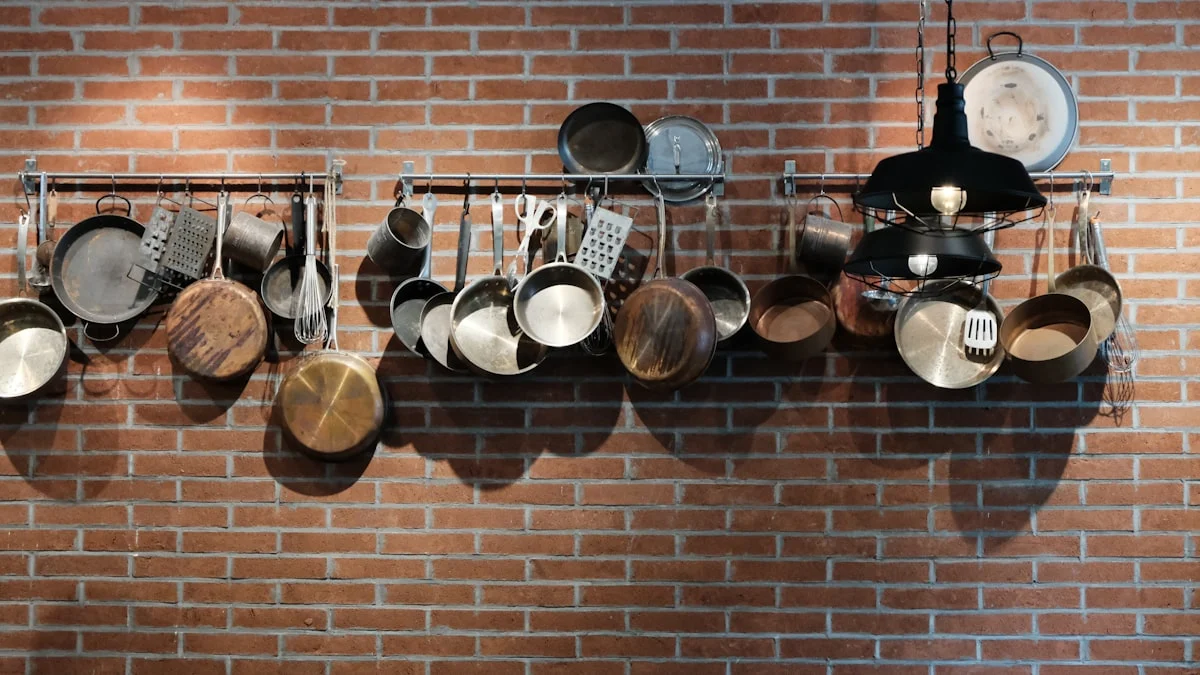
Walk into any kitchen store and you’ll find two completely different products both marketed as “titanium cookware.” Buying without knowing the difference is the fastest way to end up disappointed.
Titanium-coated pans are the most common type. The base is typically aluminum (for heat distribution) or stainless steel, with a nonstick surface that incorporates titanium particles. Brands like T-fal, Gotham Steel, and most budget “titanium” cookware fall into this category. The titanium content reinforces the coating, making it harder and more scratch-resistant than standard PTFE nonstick — but it’s still a coating that will eventually wear.
Pure titanium pans are made almost entirely from titanium alloy (typically Grade 1 or Grade 2 commercially pure titanium). Brands like Snow Peak, MSR, and Kaizen sell these. They have no coating at all — the cooking surface is bare titanium. They’re PFAS-free by definition, extraordinarily durable, and genuinely last decades. The trade-off: they require oil, a learning curve with heat, and cost significantly more.
A third category: titanium-bonded cookware like the Hestan NanoBond uses physical vapor deposition (PVD) to bond titanium molecules directly into a stainless steel surface. It’s neither a coating nor pure titanium — it’s stainless steel with titanium fused into the exterior. Performance is closer to high-end stainless.
For this article, I’m primarily addressing the two mainstream types: titanium-coated and pure titanium pans. Here’s how both stack up.
How Titanium Compares to Other Cookware Materials
This table gives you everything you need to make an informed decision without reading five separate articles.
| Titanium-Coated | Pure Titanium | Stainless Steel | Cast Iron | Ceramic Nonstick | |
|---|---|---|---|---|---|
| Heat Distribution | Good (aluminum base) | Poor (hot spots) | Good–Excellent (tri-ply) | Good (once fully heated) | Good (aluminum base) |
| Nonstick Performance | Good (new) | Moderate (needs oil) | Low (needs technique) | Good (seasoned) | Good (new) |
| Coating Safety | PFAS-free options available | No coating | No coating | No coating | PFAS-free |
| Weight | Light–Medium | Very Light | Medium–Heavy | Very Heavy | Light–Medium |
| Durability | 3–7 years (coating) | 10–20+ years | Lifetime | Lifetime | 1–3 years (coating) |
| Price Range | $30–$150 | $80–$350+ | $50–$300+ | $25–$150 | $25–$120 |
| Induction Compatible | Depends on base | No (pure Ti) | Yes | Yes | Depends on base |
| Learning Curve | Low | Medium | Medium–High | High | Low |
| Dishwasher Safe | Often yes | Yes | Yes | No | Usually no |
The table tells a nuanced story: there’s no single best material. Titanium-coated pans fill the same niche as ceramic nonstick but last 2–3× longer. Pure titanium occupies a different niche entirely — it’s not competing with stainless or cast iron on heat performance, it’s competing on longevity, weight, and chemical inertness.
Where Titanium Pans Genuinely Excel
1. Safety and Chemical Inertness
Titanium is one of the least reactive metals used in cookware. It’s the same material used in surgical implants, orthopedic hardware, and dental fixtures — a designation that comes with extensive biocompatibility testing. Titanium doesn’t leach detectable amounts of metal into food, even with acidic ingredients like tomatoes or citrus.
Compare this to stainless steel, which can leach small amounts of nickel and chromium into food — typically at levels below health thresholds for most people, but relevant for anyone with a nickel allergy. Cast iron leaches iron, which is a minor benefit for some people and a consideration for others. Titanium leaches essentially nothing.
For PFAS-free cooking, pure titanium is the gold standard — there is no coating to degrade. Quality titanium-coated pans from reputable manufacturers now use PFAS-free reinforced coatings, but buyers should verify this on the product page. The term “titanium pan” doesn’t automatically mean PFAS-free if the nonstick layer contains PTFE.
2. Weight

Pure titanium weighs about 4.5 g/cm³, compared to steel at roughly 7.9 g/cm³. In practical terms, a pure titanium 10-inch skillet typically weighs 1.3–1.8 lbs (600–800g). A comparable tri-ply stainless steel pan weighs 2.5–3.5 lbs (1.1–1.6kg). Cast iron can hit 5–7 lbs (2.3–3.2kg) for the same size.
For backpackers and outdoor cooks, this difference is decisive. For home cooks who struggle with wrist fatigue or arthritis, a lightweight pan makes a real difference over a long cooking session.
3. Durability
Titanium-coated pans outlast standard PTFE nonstick pans by a meaningful margin. The titanium particles in the coating create a harder surface that resists micro-abrasion better than plain PTFE. In real-world use, a well-maintained titanium-coated pan typically lasts 3–7 years before the nonstick surface degrades noticeably, compared to 1–3 years for most budget nonstick pans. This is based on manufacturer claims and consistent patterns in long-term Amazon review threads — I haven’t personally run a controlled durability test.
Pure titanium pans are essentially indestructible within normal cooking use. The metal itself won’t degrade, crack, or chip. Snow Peak titanium cookware, for example, is a one-time purchase with lifetime warranty claims. The caveat: they develop a heat tint (a golden-blue patina) over time, which is purely cosmetic and doesn’t affect performance.
Where Titanium Pans Fall Short
Heat Distribution: The Real Weakness
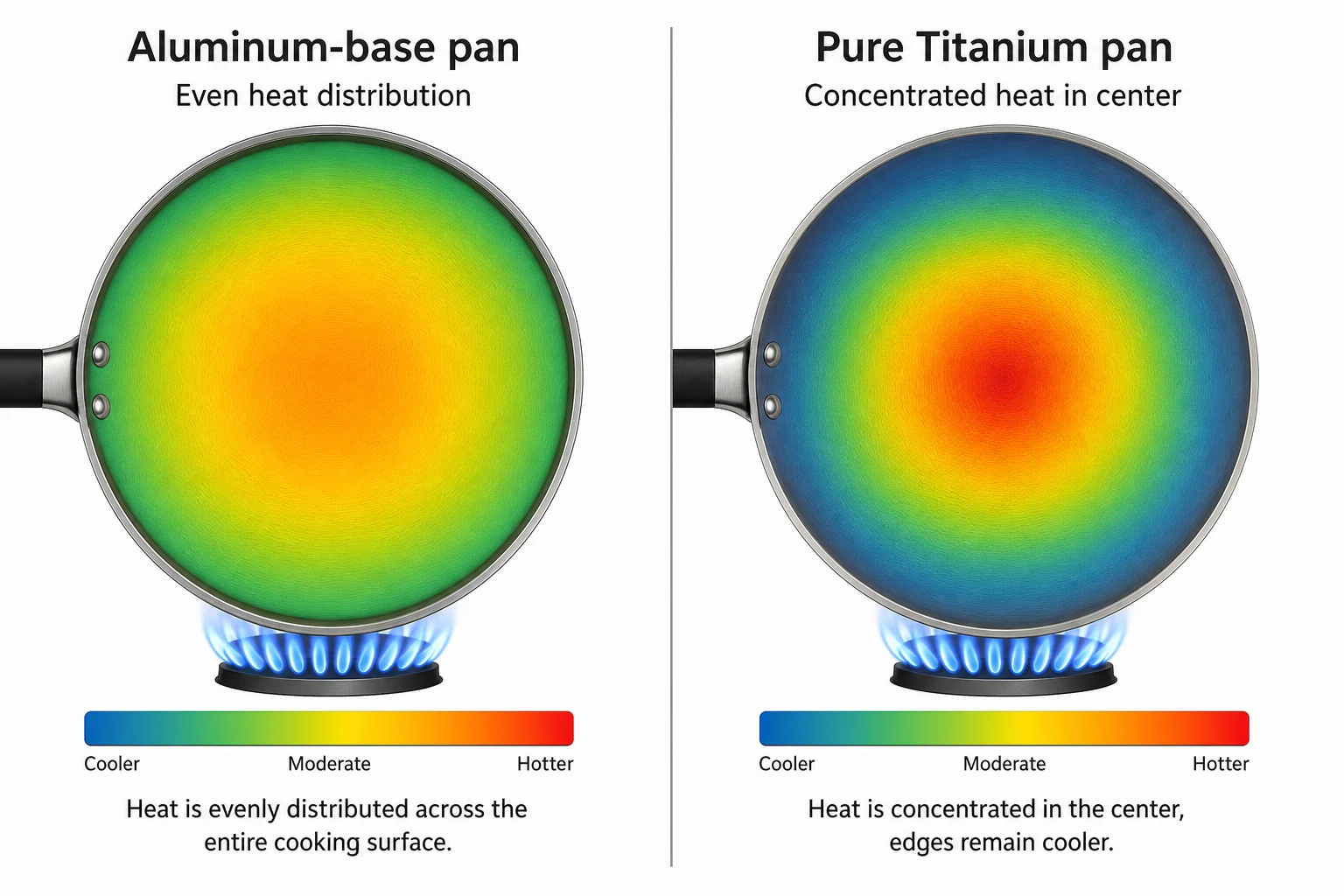
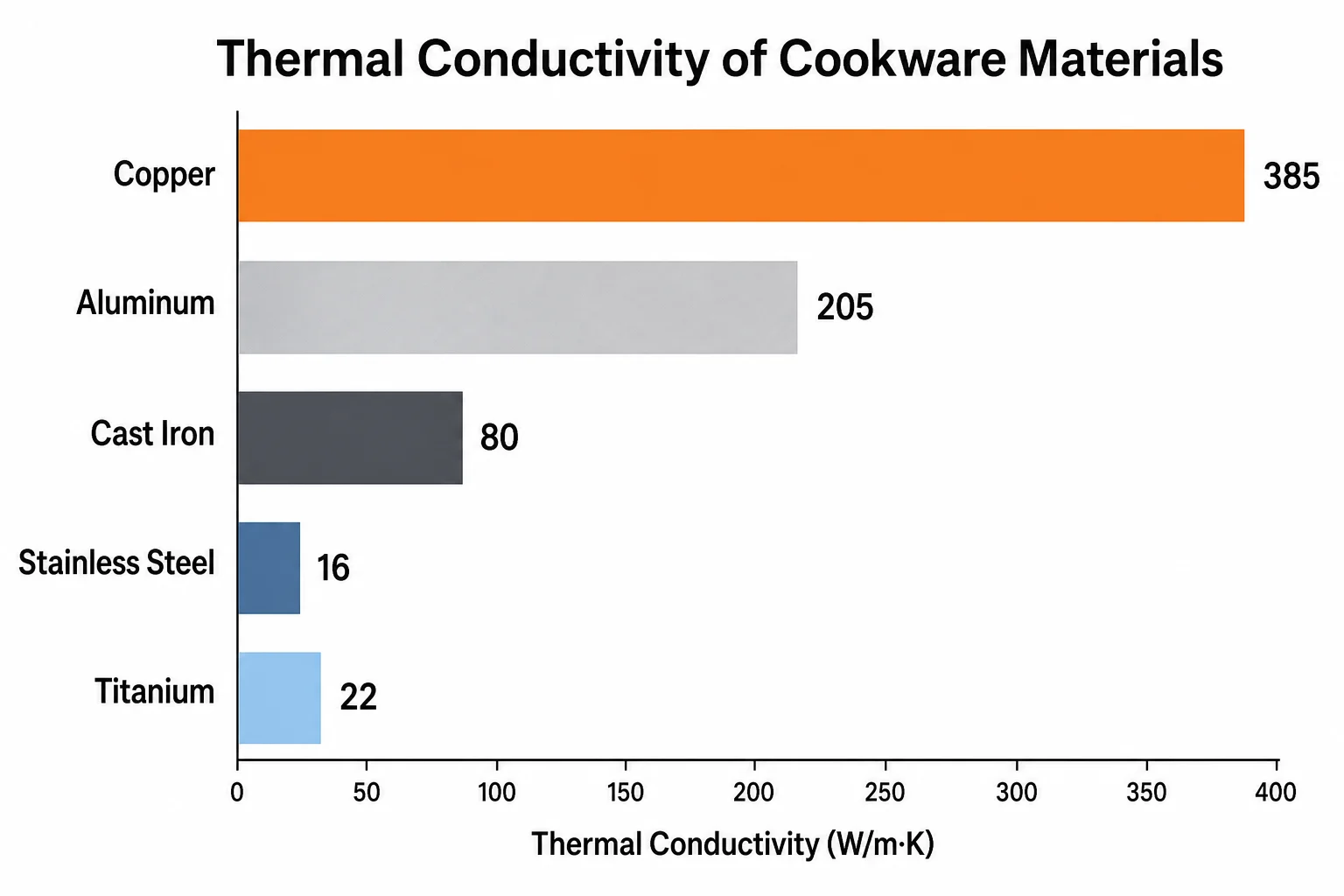
This is the part most “titanium pan” articles either downplay or skip entirely. Titanium is a poor heat conductor. Its thermal conductivity is approximately 21.9 W/m·K — far lower than aluminum (~205 W/m·K) or copper (~385 W/m·K). Even cast iron, often criticized for slow, uneven heating, conducts heat better than pure titanium.
What this means in practice: on a gas burner, pure titanium pans develop hot spots directly above the flame. Food above the flame scorches while food at the edges barely cooks. This is why outdoor camp stoves — which have broader, more even heat patterns — suit titanium cookware far better than high-output home gas burners.
Titanium-coated pans dodge this problem because the base is aluminum or clad stainless, not titanium. The titanium is only in the surface coating. So if you’re buying titanium-coated, heat distribution is as good as the underlying base material — usually fine.
For pure titanium, the workaround is technique: preheat slowly, use medium-low heat, and let the pan equalize before adding food. It’s not difficult, but it’s different from stainless or cast iron cooking.
It’s Not Effortlessly Nonstick
Pure titanium has no coating. Food doesn’t slide off it without fat — it needs oil, just like carbon steel or stainless. Users expecting Teflon-level food release will be disappointed. With the right amount of fat and proper heat management, it performs well. Without both, eggs stick.
Titanium-coated pans do provide genuine nonstick performance when new. But as the coating ages, they require more oil, and eventually they perform like a well-seasoned stainless pan. This is normal for any nonstick surface.
Induction Compatibility
Pure titanium is not ferromagnetic — it won’t work on induction cooktops without an induction adapter disc. This is a hard limitation. Titanium-coated pans may or may not be induction-compatible depending on the base material; aluminum-base pans need a magnetic bottom plate added. Check the product specs specifically.
Who Should Buy a Titanium Pan (and Who Shouldn’t)
Buy titanium-coated if:
- You’re replacing worn Teflon nonstick and want something more durable
- You want PFAS-free nonstick without the learning curve of stainless or carbon steel
- You cook on any heat source (most are induction-compatible)
- Budget: $40–$120 for a quality option
Buy pure titanium if:
- You backpack, camp, or travel cook — ultralight matters
- You want truly chemical-free cookware as a one-time purchase
- You’re willing to use fat and adjust your technique
- Budget: $80–$300+; treat it as a multi-decade investment
Stick with what you have if:
- You cook at high heat on gas and want precise, even searing → stainless steel or carbon steel is better
- You want the deepest flavor from fond and pan sauces → stainless or cast iron
- You want induction compatibility guaranteed with no add-ons → stainless or cast iron
- Budget is under $40 → a decent stainless pan will outlast a cheap titanium coating
Getting the Best Results: A Short Technique Guide
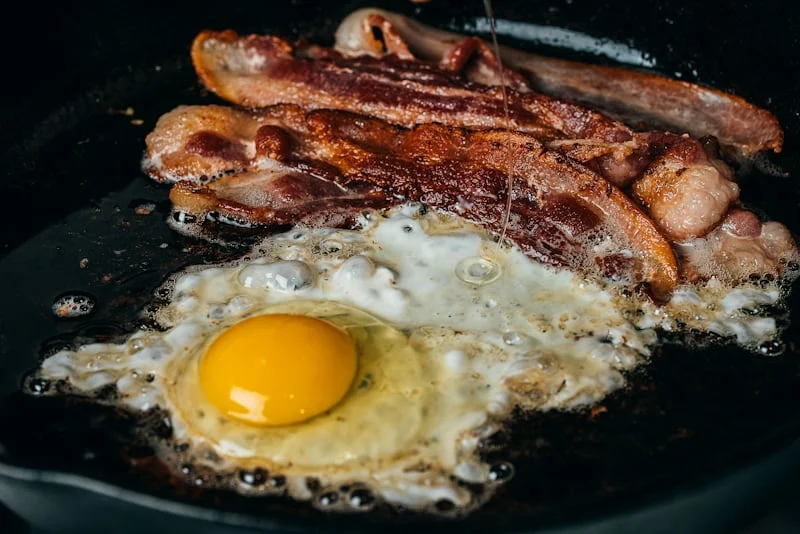
If you already own a titanium pan or are buying one, these habits make a meaningful difference:
- Preheat before adding oil. Heat the pan on medium for 30–60 seconds, then add oil. This creates a brief barrier effect that helps food release.
- Medium heat is enough. Titanium (coated or pure) doesn’t need high heat for most cooking. High heat degrades coatings faster and creates hot spots on pure titanium.
- Use enough fat. A thin film of oil is enough for titanium-coated pans. For pure titanium, you need more — similar to stainless steel.
- Let food release naturally. Don’t force it. Eggs, fish, and pancakes will release cleanly once cooked through. Pulling early is the main cause of sticking.
- Avoid metal utensils on coated pans. Even “scratch-resistant” titanium coatings will micro-abrade over time with metal contact. Use wood, silicone, or nylon.
Frequently Asked Questions
Are titanium pans safe to cook with?
Yes. Titanium is one of the most chemically inert materials used in cookware — the same metal used in medical implants. Pure titanium doesn’t leach detectable amounts into food. Titanium-coated pans are safe if the manufacturer has confirmed a PFAS-free coating; always verify this on the product page, as some titanium-labeled pans still use PTFE underneath.
Why don’t professional chefs use titanium pans?
Two main reasons. First, professional kitchens rely on fond — the browned bits that stick to the pan and form the base of pan sauces. Stainless and carbon steel develop fond easily; titanium (especially coated) releases food too readily for this technique. Second, chefs need precise, responsive heat control for searing, which requires good thermal mass and conductivity. Pure titanium’s poor heat conductivity makes it unpredictable on high-output commercial burners. Titanium cookware is optimized for low-stick everyday cooking, not classical culinary technique.
How long do titanium pans last?
Pure titanium pans can last 15–20+ years with normal use. The metal itself doesn’t degrade. Titanium-coated pans last approximately 3–7 years depending on care — longer than standard PTFE nonstick (1–3 years), but the coating does eventually wear. Avoid dishwashers and metal utensils to maximize coating lifespan.
Is titanium cookware worth the money?
For titanium-coated pans: yes, if you’re replacing nonstick. The durability advantage over cheap Teflon typically justifies a moderate price premium ($60–$100 range). For pure titanium: yes for outdoor cooking or if you want a lifetime purchase and are willing to adjust your technique. No, if you want effortless nonstick performance at home without any learning curve.
Can titanium pans go in the dishwasher?
Pure titanium: yes, the metal won’t corrode. Titanium-coated pans: technically possible but not recommended. Dishwasher detergents and high heat accelerate coating wear. Hand washing extends coating life significantly.
Does titanium cookware work on induction?
Titanium-coated pans: depends on the base. Aluminum-base pans need a magnetic plate; many manufacturers now add one. Pure titanium: no, titanium is not ferromagnetic and won’t work on induction without a separate adapter disc.
Summary
Titanium pans are genuinely good cookware — they’re not a marketing gimmick. The catch is knowing which type you’re buying. Titanium-coated pans are a practical, durable Teflon replacement with real longevity advantages. Pure titanium pans are exceptional for outdoor use and as chemical-free lifetime cookware, but require technique adjustment and don’t suit induction or high-heat searing.
The category falls short in two areas: heat distribution (pure titanium especially) and truly effortless nonstick performance. If those are your priorities, stainless steel or carbon steel may serve you better. But for health-conscious buyers wanting durable, PFAS-aware cookware that’s lighter than cast iron and lasts longer than standard nonstick, a quality titanium pan is one of the more honest investments in a kitchen.