
Titanium anodizing grows a TiO₂ oxide layer directly from the substrate using electrical voltage — no dyes, no coatings, no added material. Colors arise from thin-film interference (the same physics behind soap bubble rainbows), and the oxide thickness is governed by a simple formula: thickness (nm) ≈ 1.6 × voltage (V). The process spans 15–110 V DC, producing colors from bronze through green, but true red and true black are physically impossible via anodizing. For B2B buyers: the governing aerospace specification is SAE AMS 2488 (not MIL-A-8625, which covers aluminum only). Anodized titanium offers excellent corrosion resistance in salt spray testing (ASTM B117) and surface hardness of 300–600 HV — but the color layer is only 20–160 nm thick and will scratch under mechanical abrasion. If you need extreme wear resistance, pair anodizing with Type II functional treatment or consider PVD coating as an alternative.
What Is Titanium Anodizing and How Does the Process Work?
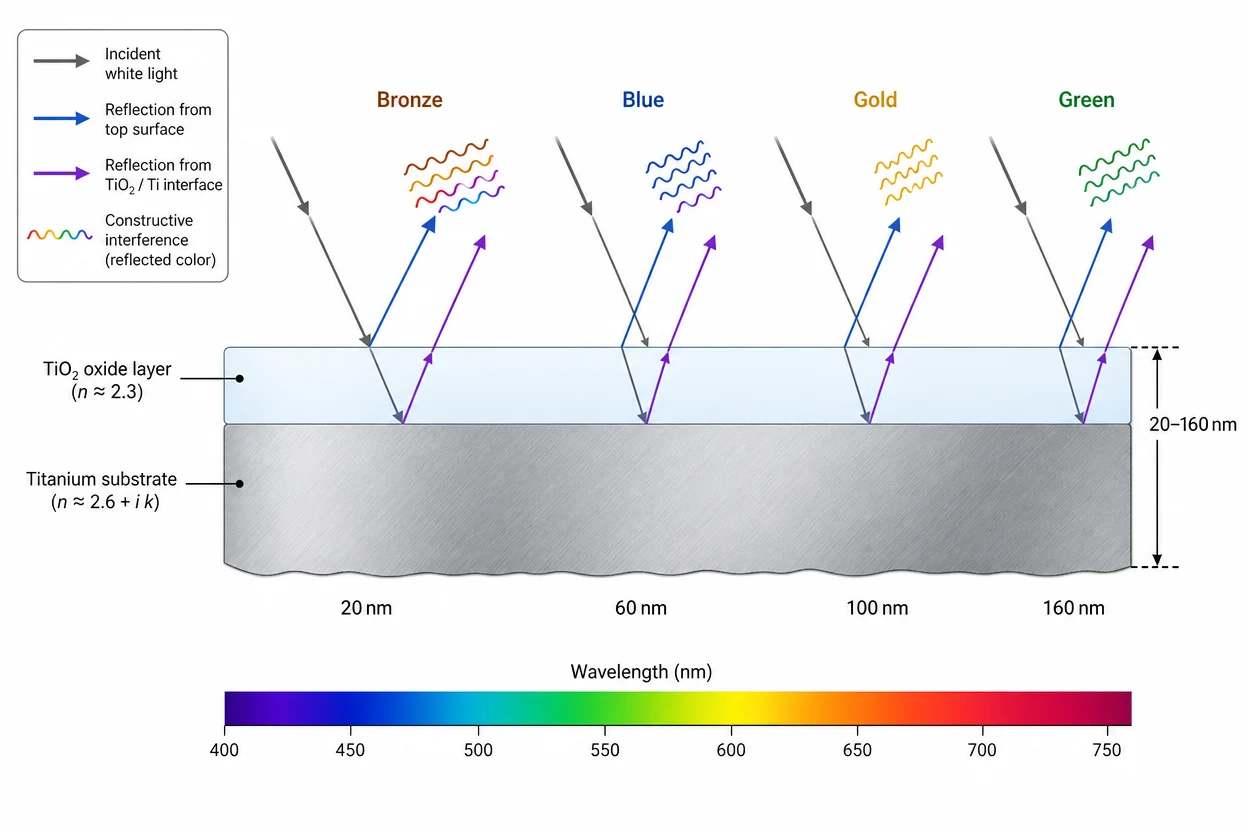
Titanium anodizing is an electrochemical oxidation process that grows a titanium dioxide (TiO₂) layer directly from the substrate — no coating is deposited, no dye is absorbed, and no material is added to the surface.
Here is how it works in plain terms: you place the titanium part as the anode (positive electrode) in an electrolyte bath. Apply DC voltage. Oxygen ions from the electrolyte migrate to the titanium surface and combine with titanium atoms, forming TiO₂ that grows inward from the original surface. The oxide is not a separate layer sitting on top — it is chemically bonded to the titanium below.
The voltage you apply controls the oxide thickness. The relationship is remarkably linear:
Oxide thickness (nm) ≈ 1.6 × voltage (V)
At 20 V, you get roughly 32 nm of oxide. At 60 V, approximately 96 nm. This thickness determines which wavelengths of light constructively interfere within the transparent oxide layer — and that interference pattern is what your eyes perceive as color.
Key Process Parameters
| Parameter | Recommended Range | Tolerance |
|---|---|---|
| DC Voltage (Type III color) | 15–110 V | ±0.1 V critical |
| Current Density | 0.02–0.04 A/in² (~1.5–4 A/dm²) | Avoid exceeding 10 A/dm² |
| Electrolyte | 5–10 wt% Trisodium Phosphate (TSP) | One of the most common electrolytes |
| Temperature | 20–25°C (68–77°F) | ±1–2°C for repeatability |
| Duration | 30–90 seconds | Voltage sets color; amperage sets time |
| DI Water Resistivity | ≥17 MΩ·cm | Rinse quality matters |
The electrolyte choice matters. Trisodium phosphate (TSP) at 5–10% is one of the most commonly used electrolytes for color anodizing. Sulfuric acid (1–2 M) and phosphoric acid (1% solution) also work but produce different surface textures. Chromic acid baths have been largely abandoned due to hexavalent chromium toxicity and OSHA regulations (29 CFR 1910.1026 limits Cr(VI) exposure to 5 μg/m³).
Surface Preparation — The Step Most People Underestimate
Before anodizing, the titanium surface must be chemically clean and uniformly etched:
- Alkaline clean: 50–60°C for 10–15 minutes
- Acid etch: 20–40% HNO₃ + 1–5% HF for 30–60 seconds
- DI water rinse: Conductivity < 5 μS/cm
- Time window: Anodize within 2–6 hours of etching (oxide regrows spontaneously)
I have seen production batches fail color specification because parts sat overnight between etching and anodizing. The spontaneous oxide regrowth changes the starting surface, shifting the final color by 2–3 volts worth of hue. The fix is simple: keep the etch-to-anodize window under 2 hours for critical parts.
Titanium Anodizing Color Chart: Voltage-to-Color Reference
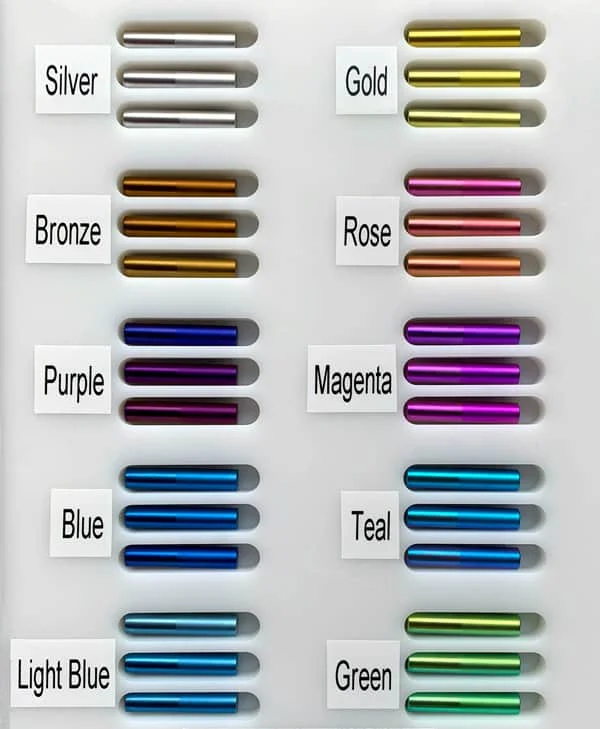
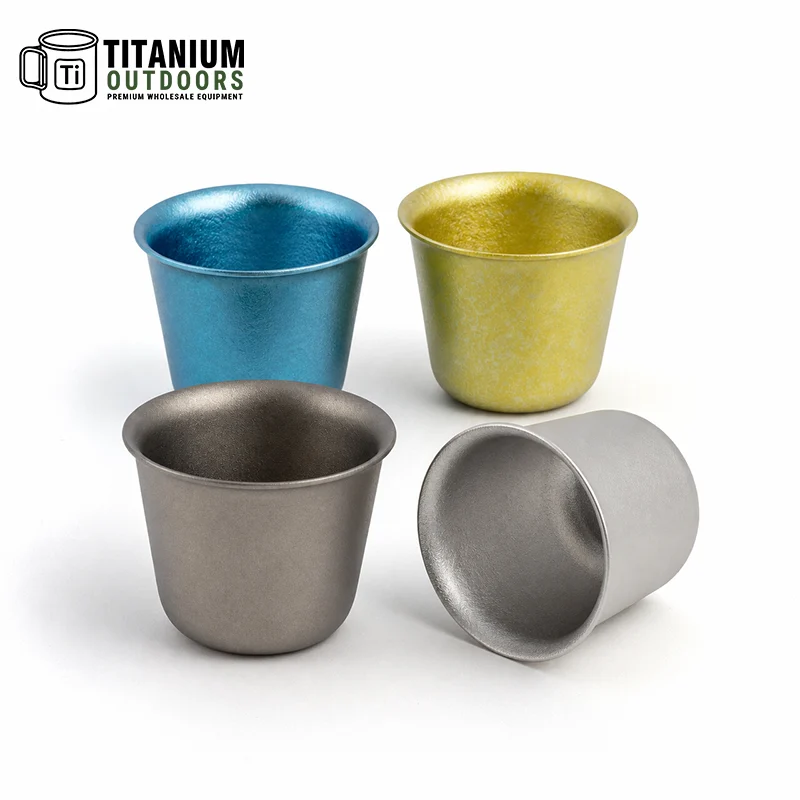
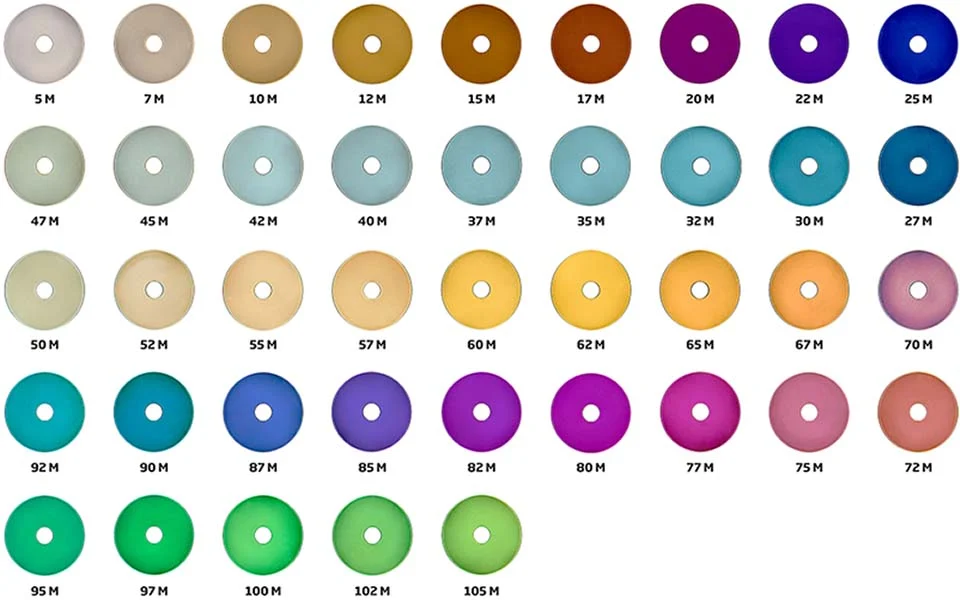
The full color spectrum of titanium anodizing maps directly to voltage, with each voltage step producing a distinct hue through thin-film interference.
Here is the reference chart based on commercial anodizing data:
| Voltage (V) | Approximate Color | Oxide Thickness (nm) | Light Wavelength (nm) |
|---|---|---|---|
| 15–16 | Bronze/Brown | ~25–30 | ~580 |
| 20–25 | Dark Blue/Purple | ~35–45 | ~470 |
| 30–35 | Light Blue (Sky) | ~50–60 | ~470 |
| 40–50 | Gold/Yellow | ~65–80 | ~580 |
| 55–60 | Pink/Magenta | ~90–100 | ~550 |
| 70–80 | Teal/Green | ~110–130 | ~520 |
| 90–100 | Deep Green | ~145–160 | ~520 |
| 106–110 | Dark Green (limit) | ~170+ | ~520 |
Why Red and Black Are Physically Impossible
To achieve red (620–750 nm wavelength), the oxide layer would need to be approximately 180–220 nm thick. At that thickness, the TiO₂ layer exceeds its stable growth limit and begins to break down — producing a dull, non-uniform surface rather than a vibrant red. True black requires absorbing all wavelengths, which no transparent interference film can accomplish. For black finishes on titanium, you need PVD (physical vapor deposition) or DLC (diamond-like carbon) coating instead.
The “Grade 5 Effect” — Why Your Titanium Grade Changes the Color
This is one of the most underreported factors in titanium anodizing. Commercially pure (CP) titanium (Grades 1–2) produces bright, highly saturated colors. Ti-6Al-4V (Grade 5), the most common aerospace alloy, produces noticeably muted, less vibrant tones.
The reason is straightforward: the aluminum and vanadium alloying elements in Grade 5 interfere with oxide crystal structure, creating a more scattering, less uniform oxide layer. If you are specifying color-matched parts across a product line that uses both CP and Grade 5 titanium, budget for color variance — or request that the supplier run test coupons for each alloy before production.
Surface Finish Impact
| Surface Finish | Ra (μm) | Color Appearance |
|---|---|---|
| Mirror polished | < 0.2 | Bright, vivid, high saturation |
| Satin/brushed | 0.4–0.8 | Moderate saturation, directional sheen |
| Bead-blasted | 0.8–1.5 | Muted, diffuse, low saturation |
| As-machined | > 1.5 | Gray, inconsistent, poor color uniformity |
Types of Titanium Anodizing: AMS 2488E Explained
SAE AMS 2488 is the governing aerospace specification for titanium anodizing. It defines three types — and no single military specification covers titanium anodizing the way MIL-A-8625 covers aluminum.
This distinction matters more than most engineers realize. I have reviewed purchasing specifications that incorrectly referenced MIL-A-8625 for titanium parts. The supplier correctly noted the discrepancy, but not every supplier will catch it.
AMS 2488 Type Classification
| Type | Purpose | Color | Oxide Thickness | Key Properties |
|---|---|---|---|---|
| Type I | High-temperature forming coating | Gray | Thicker range | Thermal control surfaces |
| Type II | Anti-galling, wear-resistant | Gray (matte) | Functional range | Reduces friction, prevents seizing |
| Type III | Color/identification anodizing | Spectrum (bronze→green) | ~20–160 nm | Visual part identification |
Type II vs Type III — Choosing the Right One
Type II is your workhorse for functional performance. It produces a dense, matte gray oxide that provides:
- Anti-galling protection (critical for threaded fasteners)
- Improved lubricity for moving parts
- Enhanced corrosion resistance
- Dimensionally stable — no measurable thickness change
Type III is for color. It provides visual identification (surgical instrument sizing, aerospace part tracking) but does not significantly improve wear resistance. The oxide is too thin (20–160 nm) to provide mechanical protection.
There is also a Type IV — an extension of Type II with PTFE (Teflon) impregnation for self-lubricating surfaces. This is less common but valuable for aerospace applications where external lubricants are prohibited.
Key AMS 2488 Requirements
- Dimensional stability: “No dimensional change” for all types — the oxide grows inward from the substrate surface, converting titanium to TiO₂ rather than depositing material on top
- Color stability: Colors described as “stable, unfading, highly replicable”
- Solution pH: Must be ≥13 for all types
Titanium Anodizing vs PVD Coating vs Powder Coating: Which Finish Fits Your Application?
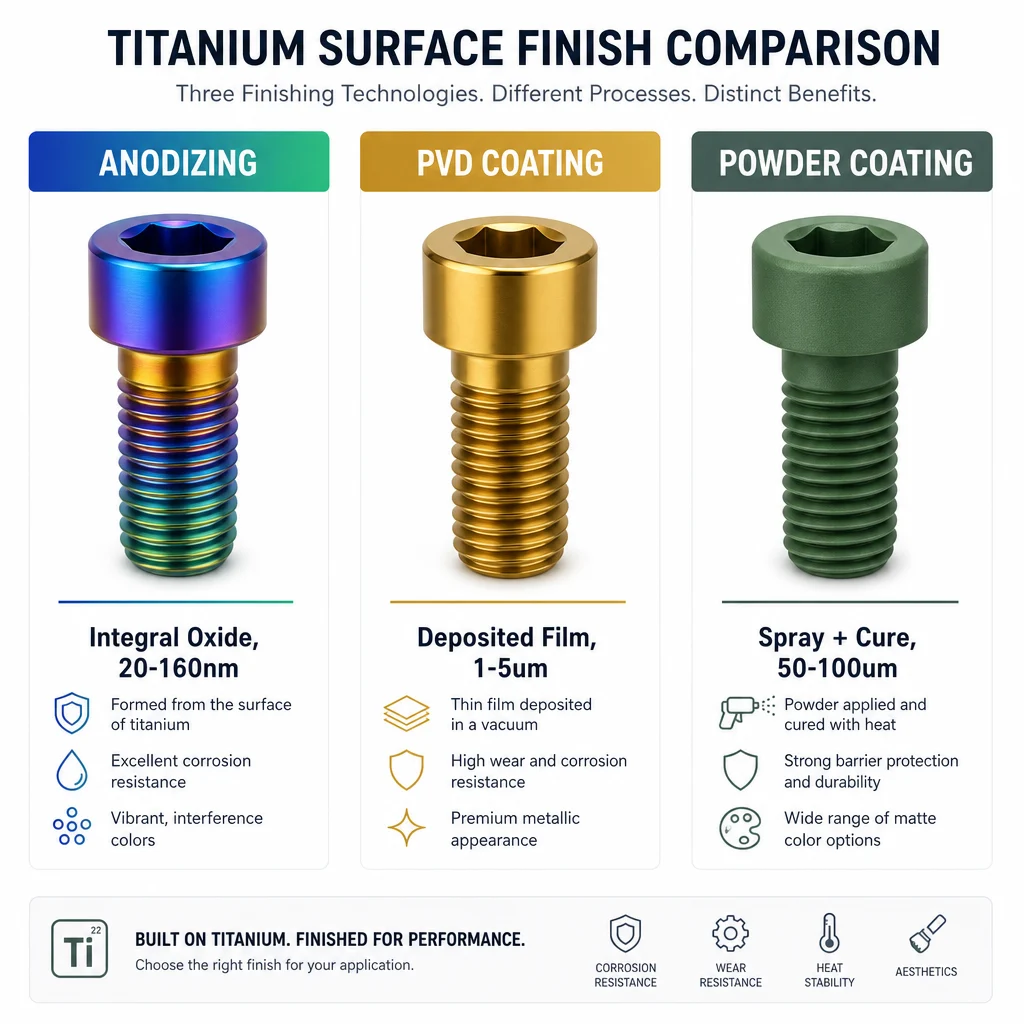
The choice between titanium anodizing, PVD coating, and powder coating comes down to three factors: whether you need the finish to be integral to the substrate, what color range you require, and how much mechanical abuse the part will endure.
Here is the direct comparison:
| Property | Titanium Anodizing | PVD Coating | Powder Coating |
|---|---|---|---|
| Process | Electrochemical oxide growth | Vacuum deposition (TiN, TiAlN, CrN) | Electrostatic spray + heat cure |
| Layer Bond | Integral (grows from substrate) | Deposited (separate film) | Mechanical/chemical adhesion |
| Thickness | 20–160 nm (Type III color) | 1–5 μm | 50–100 μm |
| Hardness | 300–600 HV | 2,000–2,500 HV (TiN) | 200–400 HV |
| Color Range | Bronze→green (limited spectrum) | Gold, black, blue, rainbow | Unlimited (pigment-based) |
| True Red/Black | Not achievable | Achievable | Achievable |
| UV Stability | Excellent (structural color) | Excellent | Moderate (pigment can fade) |
| Failure Mode | Surface scratch only | Can peel, chip, or crack | Can chip and delaminate |
| Temperature Resistance | Stable to 600°C+ (TiO₂ compound stable; anatase-to-rutile phase transition begins ~400–500°C) | 300–500°C (varies by coating) | ~93–120°C (standard); up to 260°C (high-temp specialty) |
| Biocompatibility | FDA-approved for implants | Varies by coating material | Not suitable for implants |
| Relative Cost | Lowest | Medium-High | Lowest-Medium |
When to Choose Anodizing
- Medical implants requiring biocompatibility (ISO 10993 compliance)
- Aerospace fasteners needing anti-galling (Type II)
- Visual part identification in surgical kits
- Applications where coating delamination is unacceptable
- UV-exposed parts where pigment fading is a concern
When to Choose PVD
- Applications requiring true black or gold color
- High-wear surfaces (cutting tools, bearing surfaces)
- Consumer electronics where scratch resistance matters
- Decorative jewelry requiring gold-like appearance
When to Choose Powder Coating
- Large structural components where thickness is not critical
- Applications requiring unlimited color matching (RAL/Pantone)
- Cost-sensitive projects with moderate durability needs
- Non-food-contact, non-medical applications
Medical Implant Anodizing: Biocompatibility, Standards, and Practical Limits
Anodized titanium is FDA-approved for medical implants — but the color has a practical expiration clock. Industry reports indicate that color-anodized implant surfaces lose their color within 48–72 hours after human implantation.
This is not a defect. It is a known physical consequence of the body’s oxygen-poor, reducing environment interacting with the thin TiO₂ layer. The oxide partially dissolves and reforms in a colorless configuration. The underlying titanium biocompatibility is unaffected — the part remains safe and functional.
Medical-Grade Standards Chain
| Standard | Scope | Authority |
|---|---|---|
| ASTM F136 | Wrought Ti-6Al-4V ELI (Extra Low Interstitial) alloy specification for surgical implants | ASTM International |
| ASTM F86 | Surface preparation and marking of metallic surgical implants | ASTM International |
| ISO 10993-1:2025 | Biological evaluation framework (cytotoxicity, sensitization, irritation) | ISO |
| ISO 13485:2016 | Medical device QMS (required for FDA/EU MDR compliance) | ISO |
Why Color Is Used in Medical Implants Despite Its Impermanence
Surgical teams use anodized color coding during instrument identification in the OR — not as a permanent implant feature. A color-coded bone screw tray allows the surgeon to grab the correct size without counting threads. Once the implant is in the body, the color is irrelevant to function.
The QC benchmark is that anodized implant parts survive at least 3 autoclave cycles (134°C steam sterilization) without color deterioration — sufficient for the instrument’s useful sterilization life.
Anodized vs Ceramic-Coated Implants
| Property | Anodized TiO₂ | Plasma-Sprayed Hydroxyapatite (HA) |
|---|---|---|
| Hardness | 300–600 HV | 300–700 HV |
| Biocompatibility | Excellent (bioinert) | Excellent (bioactive — promotes bone bonding) |
| Bond Type | Integral (no delamination risk) | Mechanical (delamination possible) |
| Color Options | Limited interference spectrum | White/opaque only |
| Primary Use | Instrument identification | Permanent bone integration |
Aerospace Anodizing: Certification Requirements and Production Considerations
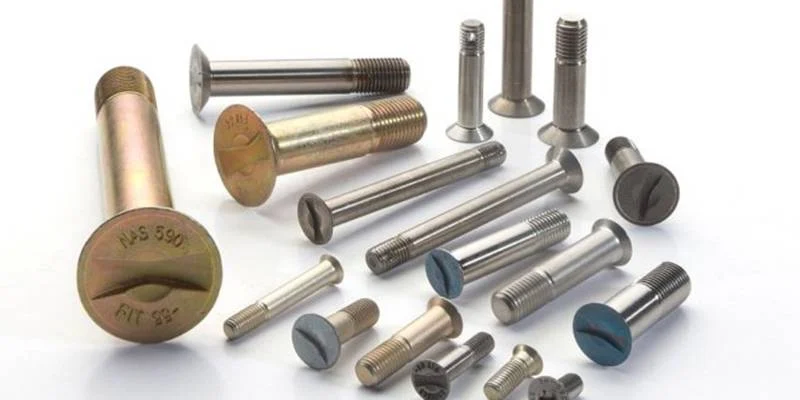
Aerospace titanium anodizing requires navigating a three-tier certification chain: AMS 2488 (process specification) → AS9100 Rev D (quality management) → NADCAP (special process accreditation).
Most aerospace OEMs — Boeing, Airbus, Lockheed Martin — will not accept anodized titanium parts from suppliers lacking all three certifications. Here is how they stack up:
| Certification | Issuing Body | What It Covers | Required Before |
|---|---|---|---|
| SAE AMS 2488 | SAE International | Anodic treatment process for titanium | — |
| AS9100 Rev D | IAQG (published by SAE) | Aerospace QMS (extends ISO 9001) | NADCAP audit |
| NADCAP (AC7108) | PRI (Performance Review Institute) | Chemical processing accreditation | AS9100 |
| ISO 9001:2015 | ISO | Baseline QMS | AS9100 |
Aerospace Applications
- Fasteners: Type II anti-galling anodize on bolts, nuts, and inserts — prevents thread seizure during assembly and maintenance
- Structural components: Color identification for part traceability (e.g., alloy grade identification on wing fittings)
- Engine parts: Type II for wear resistance in high-temperature environments (TiO₂ stable to 600°C+)
Production-Scale Considerations
Single-part anodizing is straightforward. Production-scale (1,000+ parts per batch) introduces challenges that most articles gloss over:
- Current distribution: Complex geometries cause uneven oxide growth. Racks and fixtures must be designed to equalize current density across all surfaces.
- Batch color consistency: ±1 V fluctuation shifts perceived color dramatically. Production rectifiers need ±0.1 V accuracy and active voltage monitoring.
- Salt spray benchmark: Anodized titanium typically achieves 500–1,000+ hours in ASTM B117 salt spray testing. For reference, NASA requires only 168 hours for space flight hardware near seacoasts.
- Throughput: Typical cycle time is 30–90 seconds per batch, but total process time (prep → etch → rinse → anodize → rinse → QC) runs 30–45 minutes per batch.
Color Durability and Real-World Performance Data
Anodized titanium colors do not fade from UV exposure — they degrade from mechanical abrasion. This is a critical distinction that most product specifications fail to communicate clearly.
The thin-film interference effect is structural, not pigment-based. Unlike dyed aluminum anodize (which fades under sunlight), titanium interference colors are generated by the oxide layer’s physical thickness. UV photons cannot alter the oxide geometry.
What will damage the color:
- Scratching through the 20–160 nm oxide layer exposes bare titanium
- Abrasive contact (sand, grit, metal-on-metal friction)
- Chemical attack from strong acids (HCl, HF) that dissolve TiO₂
Real-World Durability by Application
| Application | Expected Color Life | Primary Wear Factor |
|---|---|---|
| Surgical instruments (reusable) | 3–5 years / 500+ autoclave cycles | Sterilization chemicals |
| Aerospace fasteners | 10–20+ years (internal threads protected) | Assembly/disassembly wear |
| EDC knife handles | 1–3 years (visible surfaces) | Pocket carry abrasion |
| Watch cases | 5–10+ years | Wrist contact, desk scratching |
| Body jewelry | 1–3 years (high-contact areas) | Skin oils, cleaning chemicals |
Quantitative Performance Data
| Metric | Value | Source |
|---|---|---|
| Salt spray resistance (ASTM B117) | 500–1,000+ hours | Industry data / ASTM B117 |
| Surface hardness (anodized) | 300–600 HV | Microhardness testing |
| Surface hardness (CP Ti baseline) | ~120–150 HV (Grades 1–2) | MatWeb / ASTM |
| Natural oxide formation time | Seconds to minutes (1.5–10 nm) | PMC / industry consensus |
| Oxide thickness formula | d ≈ 1.6 × V (nm) | Best Technology / HonTitan |
Reddit/YouTube Real-World Feedback
- r/knives: Users report DIY anodized EDC items showing color wear on contact surfaces within 6–12 months of daily carry
- r/piercing: PVD considered more durable for body jewelry; anodizing preferred for affordability and color variety
- YouTube (Surface Finish and Anodizing): Demonstrates how different titanium grades and surface finishes produce different colors at the same voltage — “very unpredictable” as one reviewer notes
- r/FidgetSpinners: DIY anodizing tutorials show achievable results with $20–30 setup cost, but color consistency across batches is difficult without precision voltage control
Environmental Compliance and Regulatory Considerations
Titanium anodizing is significantly cleaner than hexavalent chrome plating, but it is not regulation-free. Facilities must comply with EPA 40 CFR Part 433 (Metal Finishing Effluent Guidelines) and, for export to the EU, REACH and RoHS requirements.
Key Regulations
| Regulation | Scope | Impact on Anodizing |
|---|---|---|
| EPA 40 CFR Part 433 | Metal finishing wastewater discharge | Anodizing listed as core operation; NPDES permits for direct dischargers |
| OSHA 29 CFR 1910.1026 | Hexavalent chromium exposure | PEL 5 μg/m³ (8-hr TWA) — relevant if chromic acid used |
| EU REACH (EC 1907/2006) | Chemical registration/restriction | Cr(VI) restricted under Annex XVII; electrolyte chemicals must be registered if >1 tonne/year |
| EU RoHS (2015/863) | Restricted substances in electronics | Cr(VI) limited to 0.1% by weight in EEE components |
| EPA PFAS Rulemaking (2026) | PFAS discharge from metal finishing | Proposed amendments to 40 CFR Part 433 may affect chromium-related operations |
Wastewater Treatment
Chromic acid rinse water is RCRA hazardous waste (40 CFR 261). The standard treatment: reduce Cr(VI) to Cr(III) using sodium bisulfite or ferrous sulfate at pH 2–3, then precipitate as Cr(OH)₃ at elevated pH. Most modern titanium anodizing facilities use TSP (trisodium phosphate) baths instead, which produce non-hazardous wastewater — a significant operational advantage.
Industry Trend
The shift away from chromic acid electrolytes accelerated after OSHA tightened Cr(VI) limits. TSP-based baths now dominate new installations. If you are evaluating suppliers, ask which electrolyte they use — it directly impacts their environmental compliance burden and, by extension, their pricing.
Common Titanium Anodizing Problems and Troubleshooting
Most color consistency problems trace back to three root causes: voltage instability, inadequate surface preparation, or temperature drift.
| Problem | Likely Cause | Solution |
|---|---|---|
| Color shift batch-to-batch | Voltage fluctuation > ±0.5 V | Use precision rectifier (±0.1 V accuracy) |
| Muted/dull colors | Temperature > 30°C or electrolyte depleted | Maintain 20–25°C; refresh electrolyte |
| Uneven color on single part | Non-uniform current distribution | Redesign rack/fixture; increase cathode proximity |
| Color disappears after handling | Oxide thinner than ~25 nm | Increase voltage; minimum 15 V for visible color |
| Patchy color after etching | Incomplete surface cleaning | Verify alkaline clean (50–60°C, 10–15 min) |
| Color changes after storage | Spontaneous oxide regrowth | Anodize within 2 hours of etching |
| Gray/muddy appearance | Surface roughness Ra > 1.0 μm | Improve mechanical finish before anodizing |
The “Crawl-Up” Technique
For complex geometries where voltage cannot be evenly distributed, some shops use a “crawl-up” method: start at 0 V and slowly ramp to target voltage over 30–60 seconds. This allows oxide to nucleate uniformly across the entire surface before accelerating growth. It adds cycle time but reduces rejection rates on intricate parts.
Frequently Asked Questions
What is titanium anodizing used for?
Titanium anodizing serves three primary functions: (1) visual part identification in aerospace assemblies and surgical instrument trays, (2) anti-galling and wear resistance on threaded fasteners and moving components (Type II per AMS 2488), and (3) corrosion resistance enhancement for parts exposed to marine or chemical environments. Medical implant anodizing promotes osseointegration, though color fades within 48–72 hours of implantation.
Does titanium anodization rub off?
Yes, the oxide layer can be scratched or scraped through mechanical abrasion. The color layer is only 20–160 nm thick (Type III), so aggressive friction will remove it. However, the color does not fade from UV exposure — the interference effect is structural, not pigment-based. For applications requiring extreme scratch resistance, PVD coating (TiN at 2,000+ HV) outperforms anodizing (300–600 HV).
What is the color spectrum of anodized titanium?
The achievable color range spans bronze (~15 V) → dark blue/purple (~25 V) → light blue (~35 V) → gold/yellow (~45 V) → pink/magenta (~60 V) → teal/green (~80 V) → deep green (~110 V). True red and true black are physically impossible via anodizing. The color spectrum is limited by the stable growth range of TiO₂ (maximum ~160 nm thickness).
Is anodized titanium food safe?
TiO₂ is FDA-approved as a color additive for food contact applications (21 CFR 73.575). Anodized titanium cookware and food processing equipment are considered safe. Note: the EU banned TiO₂ as a food additive (E171) in 2022, but this applies to ingested TiO₂ powder, not bonded surface oxide on metallic titanium — the two are chemically and physically distinct.
How long does titanium anodizing last?
Under normal conditions (no abrasive contact), anodized titanium colors remain stable for 10–20+ years. Aerospace fasteners with protected thread contact surfaces can maintain color indefinitely. High-contact applications (EDC items, body jewelry) show visible wear within 1–3 years. The color does not degrade from UV or chemical exposure under normal use conditions.
Can you anodize titanium at home?
Yes, basic titanium anodizing can be done with a DC power supply ($20–30), trisodium phosphate (available as a cleaning agent), a titanium cathode piece, and distilled water. Results are achievable but color consistency is poor without precision voltage control (±0.1 V). Professional anodizing uses calibrated rectifiers and temperature-controlled baths that home setups cannot replicate.
What is the difference between titanium anodizing and titanium PVD coating?
Anodizing grows an integral oxide from the substrate (like permanent hair dye penetrating the hair shaft), while PVD deposits a separate thin film on the surface (like a semi-permanent coating). Anodizing excels in biocompatibility and delamination resistance; PVD excels in hardness (2,000+ HV vs 300–600 HV) and color range (PVD can produce true black and gold).
Summary: What I Want You to Take Away
If you are specifying titanium surface treatment for a B2B application, here are the five points I would want you to remember from this article:
1. The voltage-color relationship is physics, not chemistry. Thin-film interference means color is determined by oxide thickness, which is determined by voltage. The formula d ≈ 1.6 × V gives you a reliable starting point. But your titanium grade, surface finish, and electrolyte temperature will shift results by ±2–3 volts.
2. MIL-A-8625 does not cover titanium. The correct specification is SAE AMS 2488. If your purchasing specification references MIL-A-8625 for titanium parts, it needs to be corrected.
3. Color anodizing is identification, not protection. Type III color anodizing (20–160 nm) provides no meaningful wear resistance. For anti-galling and surface protection, use Type II. For extreme wear, use PVD.
4. Know the limitations upfront. True red and true black are impossible via anodizing. Color disappears within 48–72 hours of implantation. The oxide scratches under mechanical abrasion. Designing around these constraints saves time and money.
5. Certification is non-negotiable for aerospace and medical. AS9100 → NADCAP → AMS 2488 is the chain. If your supplier cannot produce current certificates, they are not qualified for production work.
I wrote this article because I kept running into the same problem: titanium anodizing information is scattered across Reddit DIY posts, aerospace engineering forums, and supplier marketing pages — none of which provide a complete picture for someone making a real procurement or engineering decision. This guide is my attempt to consolidate that into a single, verifiable reference.