Pure titanium melts at 1668°C (3034°F) — higher than most carbon and stainless steels. But the melting point alone tells only part of the story. Ti-6Al-4V, the most common engineering alloy, has a usable service temperature of just 315°C (600°F) under structural load. Above ~600°C, titanium begins absorbing oxygen, causing embrittlement. This guide breaks down melting points by grade, compares titanium to steel across the full thermal spectrum, and explains why “melts higher” does not always mean “performs better at high temperatures.”

Titanium Melting Point: The Fast Answer
Pure titanium (commercially pure, Grades 1–4) melts at 1668°C (3034°F).
That puts it comfortably above carbon steel (1425–1540°C) and standard stainless steels (1370–1400°C). On paper, titanium wins the melting point comparison against most common structural steels.
But here’s where most articles stop — and where the real engineering story begins. Melting point is a phase-change threshold, not a service temperature. The temperature at which a metal melts and the temperature at which it fails under load are very different numbers, and confusing them has caused real design problems.
I’ve seen procurement teams specify titanium for high-temperature industrial applications based on its melting point, only to find that the alloy they selected begins losing tensile strength at temperatures they hadn’t anticipated. The data below is what I’d give those teams before they made that call.
Melting Points by Titanium Grade

Not all titanium is the same. Alloying elements — primarily aluminum and vanadium — shift the melting range. Here’s the breakdown across the grades you’re most likely to encounter:
| Grade | Common Name / Spec | Melting Range (°C) | Melting Range (°F) | Notes |
|---|---|---|---|---|
| Grade 1 | CP-Ti (softest) | 1660–1668 | 3020–3034 | Purest form; highest melting point |
| Grade 2 | CP-Ti (standard) | 1660–1668 | 3020–3034 | Most common CP grade |
| Grade 4 | CP-Ti (strongest CP) | 1655–1668 | 3011–3034 | Higher O content; slightly wider range |
| Grade 5 | Ti-6Al-4V / AMS 4928 | 1604–1660 | 2919–3020 | Most widely used alloy globally |
| Grade 9 | Ti-3Al-2.5V | 1600–1650 | 2912–3002 | Tubing and hydraulic lines |
| Grade 23 | Ti-6Al-4V ELI | 1604–1660 | 2919–3020 | Medical/aerospace; lower interstitials |
Key takeaway: Grade 5 (Ti-6Al-4V) — the alloy used in 50%+ of titanium products — has a melting range that starts about 64°C lower than pure titanium. The difference matters in extreme thermal environments.
Titanium vs Steel Melting Point: Full Comparison
The table most engineers want to see — titanium grades against the steel grades they’re likely comparing:
| Material | Melting Range (°C) | Melting Range (°F) | Density (g/cm³) | Typical Use Case |
|---|---|---|---|---|
| CP Titanium (Grade 2) | 1660–1668 | 3020–3034 | 4.51 | Chemical equipment, marine |
| Ti-6Al-4V (Grade 5) | 1604–1660 | 2919–3020 | 4.43 | Aerospace, motorsport, medical |
| ASTM A36 Carbon Steel | 1425–1540 | 2597–2804 | 7.85 | Structural, general engineering |
| 304 Stainless Steel | 1400–1450 | 2552–2642 | 7.93 | Food, chemical, general |
| 316 Stainless Steel | 1370–1400 | 2498–2552 | 7.99 | Marine, medical, chemical |
| 17-4 PH Stainless | 1400–1440 | 2552–2624 | 7.78 | Aerospace, defense |
| Inconel 718 (reference) | 1260–1336 | 2300–2437 | 8.19 | Jet engines, extreme heat |
Titanium melts at higher temperatures than all common carbon steels and most stainless grades. The one class where titanium’s lead shrinks is precipitation-hardened stainless, and nickel superalloys like Inconel 718 actually melt lower than titanium while outperforming it at service temperatures above 650°C — a point we’ll return to.
Melting Point vs. Service Temperature: The Distinction That Matters
This is the section most competitor articles skip, and it’s where engineers make expensive mistakes.
A metal’s melting point tells you when it becomes liquid. Its service temperature tells you when it becomes unreliable.
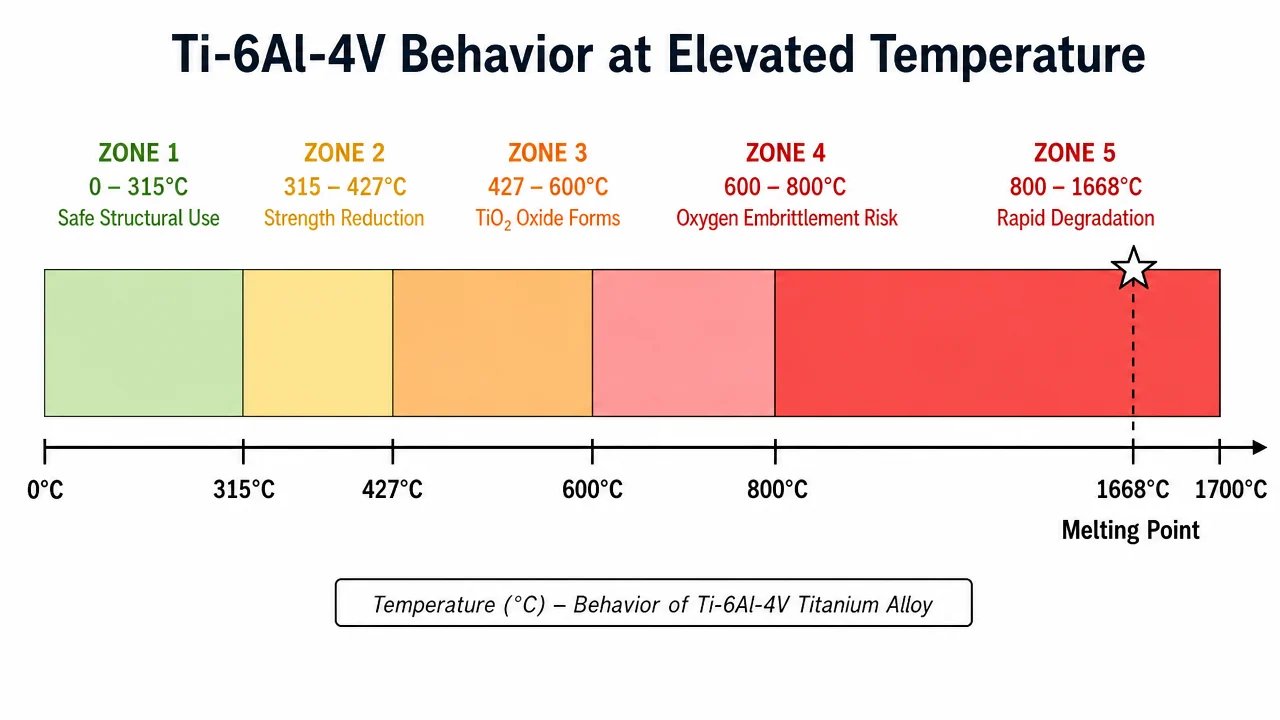
Titanium begins losing tensile strength at temperatures well below its melting point. Here’s what the data shows for Ti-6Al-4V, the grade most engineers actually specify:
| Temperature | Effect on Ti-6Al-4V |
|---|---|
| RT to ~150°C (302°F) | Full rated strength maintained |
| 150–315°C (302–600°F) | Gradual strength reduction; still within design margins for most aerospace specs |
| 315°C (600°F) | Generally accepted maximum continuous service temperature for structural applications |
| 427–540°C (800–1004°F) | Significant strength loss; acceptable only for short-term or lightly loaded applications |
| Above 600°C (1112°F) | Oxygen pickup begins degrading mechanical properties — embrittlement risk |
| 800°C (1472°F)+ | Rapid degradation; not suitable for structural use |
For comparison, 316 stainless steel maintains usable strength up to ~870°C (1600°F) continuously. If your application runs above 400°C continuously, 316 SS or a nickel alloy is almost certainly the right call, not titanium — regardless of which metal has the higher melting point.
How Titanium Behaves at High Temperatures

Oxidation: Protective — Until It Isn’t
Titanium naturally forms a thin, stable TiO₂ (titanium dioxide) layer when exposed to oxygen. This is the same mechanism that gives titanium its exceptional corrosion resistance. Below ~427°C (800°F), this oxide layer is self-healing and protective.
Above ~600°C (1112°F) with sustained exposure, titanium starts absorbing oxygen into the bulk metal rather than forming a surface film. This process — called oxygen embrittlement or alpha case formation — progressively reduces ductility and fracture toughness. The metal becomes brittle before it comes anywhere close to melting.
This is why aerospace titanium components that experience thermal events are carefully inspected and often scrapped, even if they look undamaged.
Creep Behavior
Creep — slow plastic deformation under sustained load at elevated temperature — begins at lower temperatures in titanium than many engineers expect. For Ti-6Al-4V, meaningful creep can occur above ~300°C (572°F) under significant stress. This is one reason the 315°C service limit exists as a conservative design boundary.
Thermal Conductivity: The Counterintuitive Data Point

Most engineers assume titanium, being a strong and light metal, would conduct heat like steel. It doesn’t.
| Material | Thermal Conductivity (W/m·K) |
|---|---|
| Carbon steel (A36) | ~50.2 |
| CP Titanium | ~21.9 |
| Ti-6Al-4V | ~6.7 |
| 316 Stainless Steel | ~16.3 |
| Aluminum 6061 | ~167 |
Ti-6Al-4V conducts heat at roughly 1/7 the rate of carbon steel. This is a double-edged property: in aerospace structures, low thermal conductivity means titanium acts as a partial thermal barrier. In heat exchanger or tooling applications, it means titanium won’t efficiently transfer heat away from a hot zone — which can be a problem.
CP titanium (~21.9 W/m·K) is closer to 316 SS in conductivity, but Ti-6Al-4V is dramatically lower.
Real-World High-Temperature Applications
Aerospace: Where Titanium Lives

Jet engine fan blades and compressor discs are among titanium’s highest-profile high-temperature applications. Crucially, titanium is used in the cooler sections of the engine — fan stages and low-pressure compressor — where temperatures are in the 200–350°C range. The hot sections (combustion chamber, high-pressure turbine) use nickel superalloys precisely because titanium can’t handle those temperatures.
The F-16’s airframe uses Ti-6Al-4V extensively in areas exposed to aerodynamic heating, but skin temperatures stay within titanium’s service window. SR-71 Blackbird, which cruised at Mach 3+, is the exception — it used titanium for ~93% of its structure because skin temperatures reached ~315°C, right at the edge of what titanium handles reliably.
Industrial: Chemical Processing
CP titanium (Grades 1–2) is widely used in heat exchangers for aggressive chemicals at moderate temperatures — below 300°C (572°F). The combination of corrosion resistance plus adequate heat transfer (better than 316 SS) makes it viable. Above 300°C, corrosion resistance and mechanical integrity both need re-evaluation.
Motorsport and Automotive
Titanium fasteners, connecting rods, and exhaust components appear in high-performance engines. Exhaust applications are a good example of understanding the limits: titanium exhaust headers are used where gas temperatures are managed or where the pipe wall temperature stays within acceptable bounds, not because titanium is fireproof.
When Titanium Loses to Steel at High Temperature

To be direct about where titanium is the wrong choice thermally:
- Sustained temperatures above 400°C (752°F): 316 SS maintains structural integrity up to ~870°C. Titanium doesn’t.
- Extreme heat applications (furnaces, kilns, engine hot sections): Inconel, Hastelloy, or refractory alloys are the right answer.
- Applications requiring high thermal conductivity: Carbon steel transfers heat ~7× faster than Ti-6Al-4V.
- Cost-sensitive high-temp work: 316 SS at a fraction of titanium’s price outperforms it above 400°C.
Titanium’s thermal advantage is real but narrow: it melts higher than most steels, maintains strength well up to ~300°C, and resists corrosion in that range better than almost any other structural metal. The moment continuous service temperatures exceed ~400°C, other materials take over.
FAQ
What is the melting point of titanium in Celsius and Fahrenheit?
Pure titanium melts at 1668°C (3034°F). The most common alloy, Ti-6Al-4V (Grade 5), has a melting range of 1604–1660°C (2919–3020°F).
Does titanium melt at a higher temperature than steel?
Yes — titanium’s melting point of 1668°C exceeds carbon steel (1425–1540°C) and standard stainless steels (1370–1400°C). However, titanium’s service temperature for structural applications is lower than many stainless steel grades.
What is the maximum service temperature for titanium?
For Ti-6Al-4V under structural load, the generally accepted continuous service limit is 315°C (600°F). Above ~600°C (1112°F), oxygen embrittlement becomes a serious concern regardless of applied load.
Can titanium withstand fire or extreme heat?
Titanium does not ignite under normal conditions, and its high melting point makes it fire-resistant in terms of structural integrity at moderate temperatures. However, titanium powder and fine chips can ignite in air — this is a known machining hazard. For fire-rated structural applications above 400°C, stainless steel is the standard choice.
Why is titanium used in jet engines if it can’t handle extreme heat?
Titanium is used in the cold sections of jet engines (fan blades, low-pressure compressor) where temperatures are 150–350°C. The hot sections — combustion chamber and high-pressure turbine — use nickel superalloys. The two materials divide the thermal environment between them.
Is titanium a good heat conductor?
Titanium is a poor thermal conductor compared to most structural metals. Ti-6Al-4V conducts heat at ~6.7 W/m·K, compared to ~50 W/m·K for carbon steel. This makes it useful as a thermal barrier but problematic in applications requiring efficient heat transfer.
Summary
Titanium’s melting point of 1668°C (3034°F) genuinely exceeds most steels — that fact is accurate and relevant for applications involving potential fire exposure or short-duration thermal events. But melting point and service temperature are not the same number.
The practical picture: Ti-6Al-4V, which covers the majority of structural titanium applications, is rated to 315°C (600°F) for continuous use. Above 600°C, oxygen embrittlement makes titanium unreliable before it comes close to melting. Meanwhile, 316 stainless steel operates continuously to 870°C. For B2B engineers making material selection decisions, the choice between titanium and steel at elevated temperatures is almost never about which melts higher — it’s about density requirements, corrosion environment, strength-to-weight ratio, and whether your service temperature fits within titanium’s usable window.
If your application runs above 400°C continuously, specify steel or a nickel alloy. If you need maximum strength-to-weight ratio at temperatures below 315°C with excellent corrosion resistance, titanium is difficult to beat.