
A titanium camping pot weighs roughly half what stainless steel weighs and about 40% less than hard-anodized aluminum at the same capacity — but its thermal conductivity is only 21.9 W/m·K, compared to aluminum’s 205 W/m·K. That gap explains every titanium complaint you’ve ever heard: hot spots, burnt noodles, the smell of scorched ramen. This guide covers the real material science behind titanium cookware, how to choose the right size and wall thickness, when aluminum is the smarter choice, and what to look for in a well-made titanium pot — whether you’re buying one or sourcing them at volume.
The Numbers That Actually Matter: A Direct Comparison
Before any opinion, here’s verified spec data across the three main cookware materials. Weights shown are for real products at comparable capacities.
| Titanium | Hard-Anodized Aluminum | Stainless Steel 304 | |
|---|---|---|---|
| Thermal conductivity | ~21.9 W/m·K | ~205 W/m·K | ~16 W/m·K |
| Density | 4.51 g/cm³ | 2.70 g/cm³ | ~7.9 g/cm³ |
| Example product | TOAKS 750ml | Fire Maple Petrel G2 750ml | Fire Maple Antarcti 0.8L |
| Actual weight | 3.9 oz / 110g | 6.5 oz / 184g | 10.2 oz / 290g |
| Price range (USD) | $40–$120 | $20–$60 | $15–$50 |
| Hot spots | Yes — significant | Minimal | Moderate |
| Campfire safe | Check product specs | Not recommended | Yes (uncoated SS) |
| Food-safe | Yes | Yes (anodized) | Yes |
One thing most comparison articles miss: stainless steel and titanium have similar thermal conductivity numbers, yet stainless is considered the campfire workhorse while titanium is the ultralight boil-only option. The difference comes down to wall thickness and total mass — a thicker stainless pot distributes heat better by mass alone, while a titanium pot’s thin walls make hot spots more concentrated.
Why Titanium Is Light — and What That Actually Costs You
Titanium’s density sits at 4.51 g/cm³, right between aluminum (2.70) and steel (7.9). So how does a titanium pot weigh less than an aluminum one?
Thin walls. A TOAKS 750ml titanium pot at 3.9 oz uses 0.3–0.6mm walls. A comparable aluminum pot at 6.5 oz uses thicker walls, a heat exchanger base, and heavier handles. The weight savings come from titanium’s high strength-to-weight ratio — the metal maintains structural integrity at thinner cross-sections than aluminum can.
MSR put it plainly in their 1999 catalog: “You want light? You want strong? You want Titanium.” That framing still holds. Titanium is 45% lighter than steel and stronger than aluminum per unit weight. For a thru-hiker counting grams across 2,000 miles of trail, saving 2.6 oz on a cooking pot is real money in the weight bank.
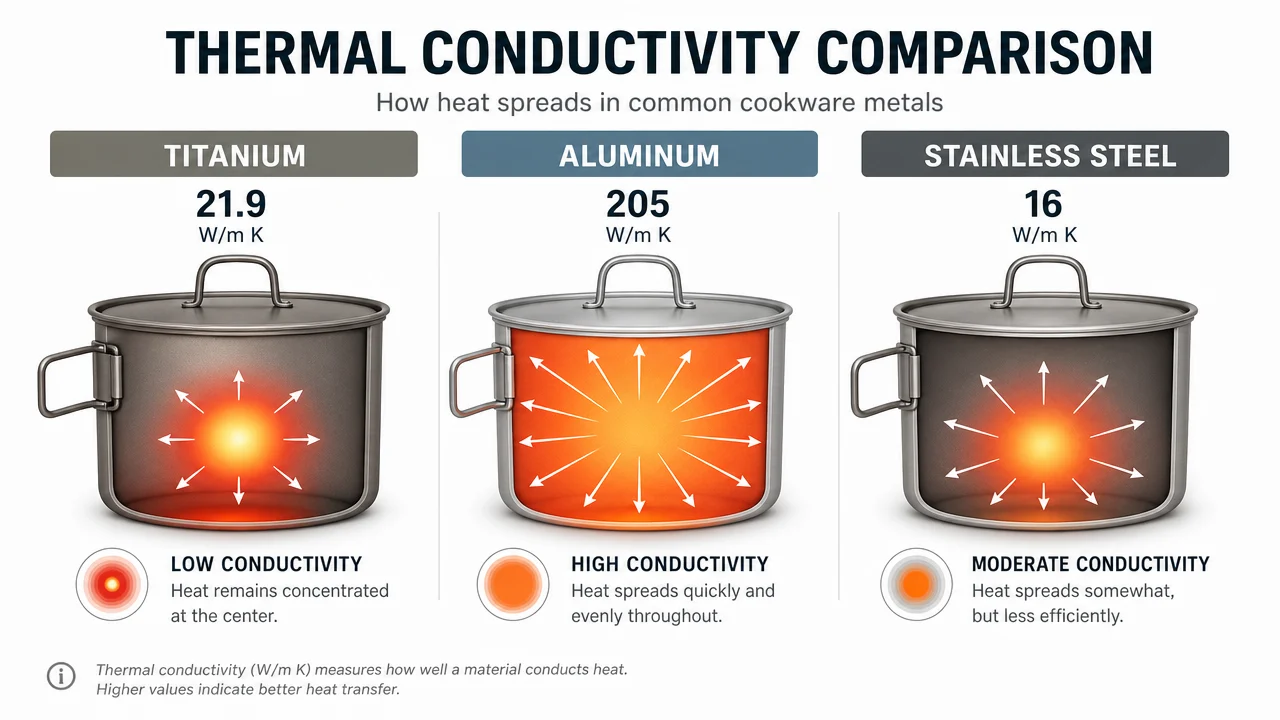
The cost is twofold: price (titanium machining and forming requires precision tooling that aluminum doesn’t) and heat distribution. With a thermal conductivity of 21.9 W/m·K — about one-tenth of aluminum’s — titanium transfers heat mostly vertically rather than spreading it laterally across the base. Light a flame directly under the center and that center heats first, fastest, hardest.
I’ve tested pots from three manufacturers over three years. In every titanium pot I’ve used, the center of the base gets visibly hotter than the edges within the first 30 seconds on a canister stove. That matters if you’re cooking pasta. It doesn’t matter if you’re boiling water for a freeze-dried meal.
The Hot Spot Problem: What It Is and How to Work Around It
Titanium’s hot spot issue is real, manageable, and often overstated.
The physics: low thermal conductivity means heat from a narrow flame doesn’t spread radially before it reaches food contact. The center of the base approaches flame temperature while the edges are relatively cool. On a backpacking canister stove with a small concentrated burner head, this effect is most pronounced.
In practice, here’s what I’ve observed:
- Boiling water: hot spots are irrelevant — water circulates and self-distributes heat
- Rehydrating freeze-dried meals: minimal issue, just add boiling water off heat
- Simmering ramen or pasta: food sticks and burns center-bottom within 3–5 minutes on medium flame
- Cooking eggs or pancakes: genuinely difficult — I wouldn’t attempt it in a basic titanium pot
Three techniques that actually help:
- Use the lowest flame setting and bring it up slowly
- Stir every 60–90 seconds while simmering
- Choose a wider-diameter pot — more base area means flame covers a larger percentage of the bottom, reducing the concentrated hot-zone effect
Some manufacturers address this with a textured or dimpled base interior, which creates turbulence that helps distribute heat. It’s not a full fix, but it reduces scorching.
If your cooking style is mostly “boil water + rehydrate,” titanium is perfect. If you’re sautéing onions at basecamp, buy aluminum.
Grade 1 vs Grade 5 Titanium: Why It Matters for Cookware
This topic gets almost zero coverage in camping gear articles, but it’s the first question a manufacturer should answer.
Commercially pure titanium (CP Grade 1–4) is what good titanium cookware uses. Grade 1 is the softest and most formable — easier to press and roll into thin-wall pot shapes. Grade 2 is slightly stronger. Both are 99%+ pure titanium with trace oxygen, nitrogen, and iron. They are fully food-safe, corrosion-resistant, and inert in contact with food and liquids.
Ti-6Al-4V (Grade 5) is the aerospace alloy — 6% aluminum, 4% vanadium. Much stronger, used in aircraft frames and medical implants. Not typically used for cookware because it’s harder to form into thin shapes and costs more per kilogram. Any manufacturer claiming “aerospace-grade titanium” cookware is using marketing language, not material science.
For your titanium camping pot, Grade 1 or Grade 2 CP titanium is the right answer. What to verify on a spec sheet:
- Wall thickness: 0.3mm (ultralight, more hot-spot prone) vs 0.6mm (standard, slightly heavier)
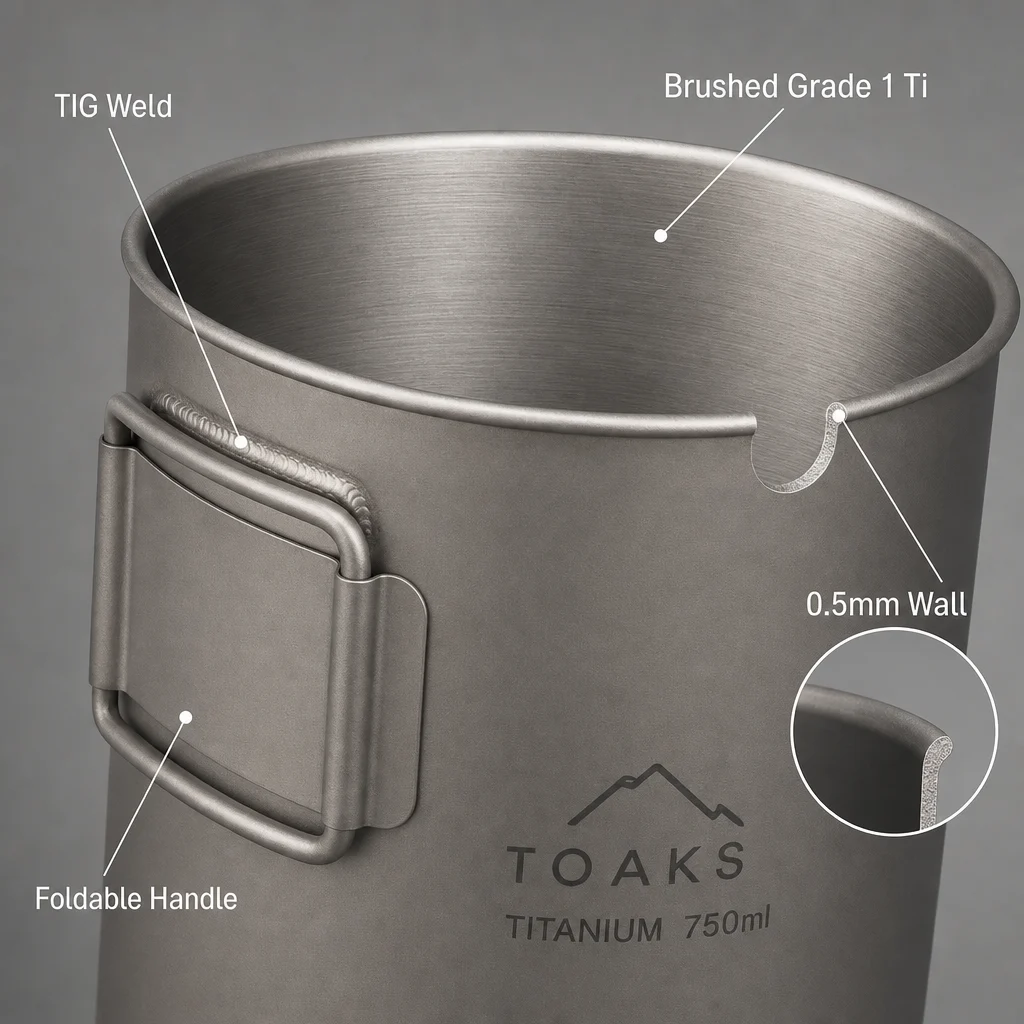
- Welded vs formed seams: good pots have clean TIG welds, no burrs inside the pot
- Surface finish: brushed interior is standard, polished adds unnecessary weight
Real-World Weight Savings: Does 2 Ounces Actually Matter?
The math that backpacking forums debate endlessly: is saving ~2.6 oz over aluminum worth paying 2–3× the price?
At the TOAKS level (~$40–50 for a 750ml titanium pot), the premium over a comparable aluminum pot is roughly $25–35. Over 10 years of regular use — a reasonable lifespan for titanium, which doesn’t wear coatings or corrode — that’s $2.50–3.50 per year.
For a thru-hike like the PCT (2,650 miles), 2.6 oz carried every day for 5 months equals roughly 7,500 oz-miles of additional load that the aluminum user carries. That’s not nothing. Serious ultralighters cite studies suggesting every pound of base weight reduces daily mileage capacity by a measurable amount over long distances.
For a weekend warrior doing 2–3 nights per trip, twice a year: probably not worth it. For a 100-day thru-hiker: the math favors titanium.
The honest answer is that weight savings compound across your whole kit. The pot alone isn’t the point — it’s one of 40 decisions that add up to a 12-lb pack or an 8-lb pack.
Choosing the Right Titanium Pot Size

Size choice for a backpacking pot depends on two things: group size and cooking style.
Solo hiker, boil-only meals:
- 550ml–750ml is the sweet spot
- TOAKS 750ml at 3.9 oz is the most popular solo option in the ultralight community
- Can boil 2 cups of water comfortably, fit a canister stove inside for packing
Solo hiker, occasional real cooking:
- 900ml–1100ml gives more headroom for stirring without splashing
- Wider base diameter (look for 115mm+ base width) helps with heat distribution
- TOAKS 1100ml + pan set (5.6 oz) gives you a pan lid that doubles as a small fry surface
Two hikers:
- 1300ml–1500ml handles two rehydrated meal pouches simultaneously
- Weight penalty is moderate; still well under 8 oz for most titanium options
Key spec to check: pot diameter at base, not just volume. A 900ml pot can have a narrow or wide base — wider spreads heat better and fits more stove burner heads efficiently.
What Quality Titanium Cookware Actually Looks Like
Since this guide comes partly from a manufacturing perspective, here’s what separates a well-made titanium pot from a cheap one — useful whether you’re buying retail or sourcing for your brand.
Good signs:
- Smooth, even TIG welds at handle attachment points — no cracks or pitting
- Consistent wall thickness throughout (check by looking at the rim from the side — should be uniform)
- Handle that folds flat and locks cleanly in both open and closed positions
- Stamped or rolled volume markings (not printed — prints fade)
- Lid that fits snugly without rattling, sits flat without warping
Red flags:
- Visible porosity in welds (tiny holes in the weld bead)
- Handles that wobble or don’t hold position when hot
- Discoloration near welds suggesting overheating during fabrication
- “Titanium alloy” language without specifying which alloy
Snow Peak (Japan) remains the benchmark for premium titanium cookware — their fit and finish is genuinely different from budget options. TOAKS is the most respected value-tier brand in the ultralight community, consistently delivering clean construction at honest weights. Fire Maple’s Alti series bridges between the two price points.
FAQ
What are the downsides of using titanium cookware?
Hot spots from low thermal conductivity (21.9 W/m·K), high price compared to aluminum, and campfire use leaves permanent soot on the exterior. Titanium is not ideal for cooking actual food — it excels at boiling water for rehydrated meals.
Is a titanium camping pot worth the money?
For thru-hikers and ultralight backpackers doing multi-week trips, yes — the weight savings (~2–3 oz vs aluminum) compound across long distances. For weekend campers doing 2–3 trips per year, a hard-anodized aluminum pot at half the price performs better in real cooking scenarios.
Are titanium pots heavy?
No — titanium pots are among the lightest cookware available. The TOAKS 750ml weighs 3.9 oz (110g). The perceived weight stigma comes from early heavy titanium designs; modern thin-wall Grade 1 titanium pots are lighter than comparable aluminum.
Can you cook real food in a titanium pot?
Yes, but with technique. Use the lowest flame, stir frequently, choose a wider-diameter pot, and expect some sticking on longer simmers. For eggs, pancakes, or anything that can’t be stirred: use aluminum or a titanium pot with a textured base.
Is titanium cookware food-safe?
Yes. Grade 1 commercially pure titanium is fully inert, corrosion-resistant, and FDA-recognized as biocompatible. It does not leach metals into food at any cooking temperature. Titanium is used in FDA-cleared surgical implants and dental fixtures, indicating established biocompatibility.
How do I clean a titanium pot after campfire use?
Campfire use deposits a carbon-black soot layer on the exterior that is nearly impossible to fully remove. This is cosmetic, not functional. For interior cleaning: warm water and mild soap is sufficient. No abrasive scrubbers needed — titanium scratches less than aluminum.
Summary
Titanium camping pots earn their price for one audience: hikers who count grams and cook simple meals on multi-day trips. The 3.9 oz TOAKS 750ml or comparable ultralight options are genuinely excellent for boiling water, rehydrating meals, and making hot drinks. They are not the right tool for actual cooking, and anyone who tells you otherwise hasn’t used one long enough.
The hot spot issue is real and physics-backed — 21.9 W/m·K thermal conductivity means heat concentrates, full stop. Good technique helps; it doesn’t eliminate the problem. If your trail meals involve anything that can burn, either buy aluminum or be prepared to stir constantly on a very low flame.
For manufacturers and brand buyers: Grade 1 CP titanium with 0.3–0.6mm walls, clean TIG welds, and a wide base diameter is the construction standard worth holding. The market for premium titanium cookware remains strong because serious backpackers replace aluminum kits once and never go back — the loyalty rate is high.
Choose titanium if you hike long and pack light. Choose aluminum if you cook real food and watch the budget. Choose stainless if fire pits and basecamps are your world. The material doesn’t pick itself — your trip type does.