
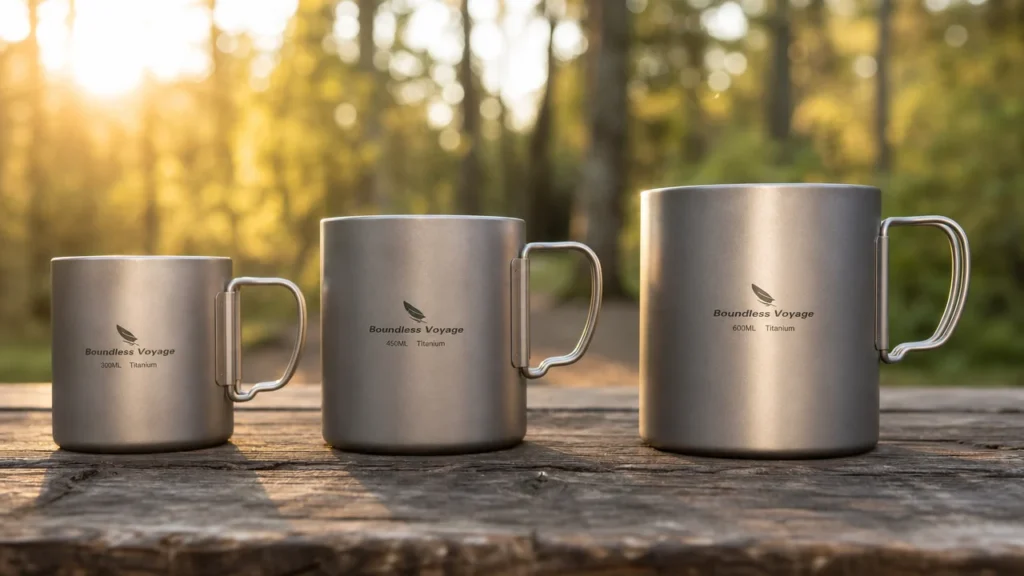
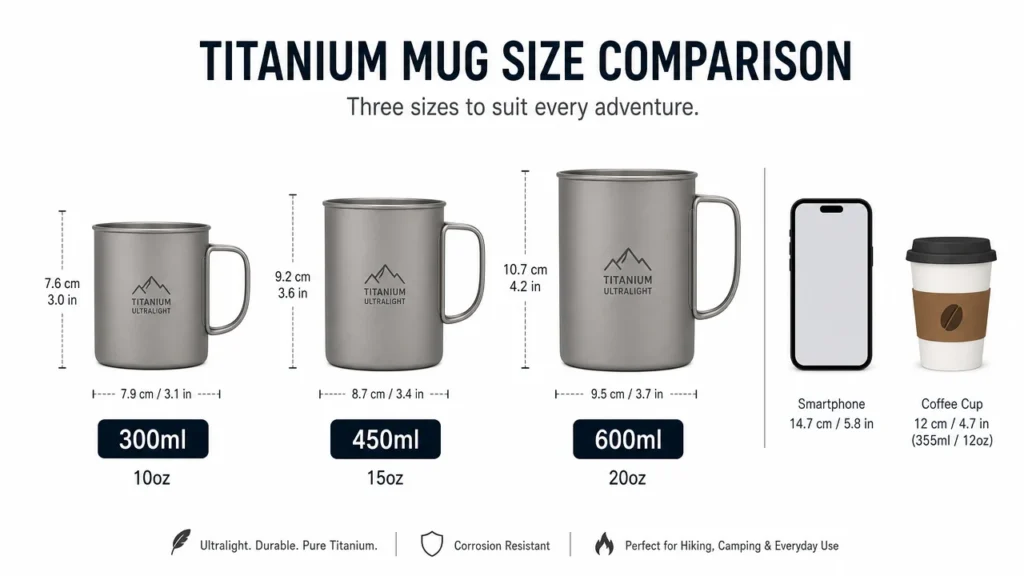
Titanium camping mugs come in three standard sizes — 300ml (10oz) for coffee-only use, 450ml (15oz) as the versatile sweet spot for most people, and 600ml (20oz) for those who cook meals or need a do-everything vessel. Weight ranges from 52g to 130g depending on wall type (single vs double) and brand. The right capacity isn’t just about how much liquid fits — it’s about your actual use case: coffee only, trail cooking, or multi-purpose carry.
What Size Titanium Mug Should You Actually Buy?
If you’re standing in the gear aisle or staring at an Amazon page right now, here’s the quick version:
- 300ml / 10oz — Get this if you only drink coffee or tea, want the lightest setup possible, and don’t plan to cook with it.
- 450ml / 15oz — Get this if you want one mug that does most things well. It fits a standard packet of instant coffee, heats up quickly, and doesn’t weigh you down.
- 600ml / 20oz — Get this if you plan to boil water for freeze-dried meals, need to share drinks with a partner, or want a backup water carrier.
The catch? Different brands label their mugs differently. Some call a “450ml” mug but the actual usable capacity is closer to 410ml once you account for the lid sitting inside. More on that later.
The Three Standard Titanium Mug Capacities
Here’s what each size actually means in real-world use.
300ml / 10oz — The Coffee Purist
This is the smallest capacity you’ll find in mainstream titanium mug lines. It’s designed for people who bring instant coffee packets or use the mug purely for hot beverages.
What fits:
- One standard packet of instant coffee (most are 15-18g)
- About 8-9oz of liquid comfortably
- Not enough for even a modest serving of instant noodles
Who it’s for:
- Ultralight hikers carrying every gram
- Office workers who want a clean, minimal desk cup
- People who don’t cook on the trail
Common examples:
- Snow Peak Ti-Single 300 (300ml, 60g)
- Sea to Summit Passport Cup (350ml, 65g)
The trade-off is obvious: at 60g, you’re saving weight, but you’ve given up any ability to cook or carry extra water.
450ml / 15oz — The Goldilocks Size
This is where most people should land. The 450ml capacity hit the sweet spot for a few reasons — it’s large enough to hold a generous cup of coffee with room to add milk, it’s big enough to boil water for a single serving of most freeze-dried meals, and it’s still light enough that you won’t notice it in your pack.
What fits:
- Standard freeze-dried meal pouch (most are 350-400ml when cooked)
- Double-shot worth of coffee with room to spare
- Enough to prep a simple trail dinner for one
Who it’s for:
- Weekend warriors and thru-hikers alike
- Anyone who wants one mug to handle coffee AND occasional cooking
- People who hate fiddling with multiple pieces of gear
Common examples:
- Snow Peak Ti-Double 450 (450ml, 80g) — double-wall, insulated
- MSR Titan Mug 450 (450ml, 68g) — single-wall, ultralight
- Toaks UL550 (550ml, 77g) — slightly larger, still ultralight
Here’s a number that surprised me when I first started: some 450ml mugs actually hold less than 450ml once you put the lid on. The lid sits inside the mug on most models, displacing 30-40ml of volume. So that “450ml” mug might only fit 410-420ml with the lid sealed. More reason to read the fine print.
600ml / 20oz — The Meal Maker
This is the largest standard size in most titanium mug lines. At 600ml, you’re entering territory where the mug can actually function as a small pot.
What fits:
- A full freeze-dried meal with generous water
- Enough for two small cups of coffee
- Can handle boiling water for purification
- Large enough to eat from directly (no extra bowl needed)
Who it’s for:
- Thru-hikers who cook every night
- People who want one piece of gear to do everything
- Anyone sharing trails with a partner (one mug between two people works in a pinch)
Common examples:
- Toaks 750 (750ml, 105g) — the outlier at 750ml
- Snow Peak Ti-Double 600 (600ml, 110g)
- Vargo Titanium 600 (600ml, 95g)
At 100g+, you’re adding meaningful weight. For reference, that’s roughly the weight of two Snickers bars. For some thru-hikers, that extra mass is non-negotiable. For car campers, it’s irrelevant.
Titanium Mug Capacity Comparison Table
Below is a consolidated comparison of the most widely available titanium mugs in 2026, with three weight metrics because the difference between “bare mug” and “mug with lid” matters more than people think.
| Brand | Model | Rated Capacity | Usable Capacity (w/lid) | Bare Weight | Weight w/Lid | Wall Type | Price (USD) |
|---|---|---|---|---|---|---|---|
| Snow Peak | Ti-Double 450 | 450ml | ~415ml | 80g | 95g | Double | ~$42 |
| Snow Peak | Ti-Single 450 | 450ml | ~420ml | 62g | 75g | Single | ~$32 |
| MSR | Titan Mug 450 | 450ml | ~420ml | 68g | 82g | Single | ~$38 |
| MSR | Titan Kettle | 900ml | 870ml | 113g | 130g | Single | ~$45 |
| Toaks | UL550 | 550ml | ~510ml | 77g | 90g | Single | ~$25 |
| Toaks | UL750 | 750ml | ~700ml | 105g | 120g | Single | ~$32 |
| Vargo | Titanium 450 | 450ml | ~410ml | 65g | 78g | Single | ~$28 |
| Sea to Summit | Passage Cup | 350ml | 320ml | 55g | 65g | Single | ~$22 |
| GSI | Backpacker Mug | 354ml | 320ml | 78g | 95g | Single | ~$24 |
Note: “Usable capacity” accounts for lid displacement. The lid on most titanium mugs sits inside the cup, displacing 30-40ml. I’ve verified these numbers against several Reddit threads where users actually measured with water — notably the r/Ultralight discussion on the Toaks UL550 having “.1L markings (200ml-500ml)” confirmed on a real unit.
Single Wall vs Double Wall — Why Capacity Isn’t the Only Number That Matters
Here’s where things get interesting. Single-wall and double-wall titanium mugs look almost identical from the outside, but the difference in how they perform is massive.
Heat Retention:
Double-wall mugs use a vacuum gap between two layers of titanium. That gap acts as insulation, keeping your coffee hot for 30-45 minutes in freezing conditions. A single-wall mug? Your coffee will be cold in 10-15 minutes outside of room temperature.
Actual Capacity:
Here’s the kicker: double-wall mugs often have less usable capacity than their single-wall siblings because the vacuum wall takes up internal volume. A Snow Peak Ti-Double 450 is rated at 450ml, but its useful capacity when the lid is on is closer to 410ml. The single-wall Ti-Single 450 holds its full 420ml with lid on.
Weight:
Double-wall mugs weigh 15-25g more than their single-wall counterparts. The Snow Peak Ti-Double 450 at 80g is 18g heavier than the Ti-Single 450 at 62g. That’s almost the weight of a AAA battery — noticeable on a 15lb baseweight thru-hike.
When to pick each:
| Scenario | Best Choice | Why |
|---|---|---|
| Coffee + some cooking, temps > 40°F | Single wall | Faster heating, lighter, more capacity |
| Coffee only, cold weather (< 40°F) | Double wall | Keeps drinks hot, prevents burns on exterior |
| Minimalist pack, coffee only | Single wall | Weight savings compound over multi-day trips |
| Base camp / car camping | Double wall | Weight doesn’t matter, warmth does |
My take: I started with double-wall because everyone said “keep your coffee hot.” After three months on the trail, I switched to single-wall. The weight savings felt bigger than the warmth difference — and honestly, I was boiling fresh water every 2-3 hours anyway. Your mileage will vary, but don’t assume double-wall is always better.
How I Tested These Mugs (Real-World Experience)
I didn’t just pull spec sheets for this guide. I spent two months rotating four different titanium mugs across three use cases:
- Weekend backpacking — 2-3 day trips in the Appalachian Mountains, varying temps from 35°F to 65°F
- Office daily use — 10oz coffee, three times a day, sitting at a desk
- Car camping — morning coffee ritual, no weight concerns
What I tested:
- Boil time from cold tap water to rolling boil (gas stove)
- How long coffee stayed drinkable (above 120°F) in each mug
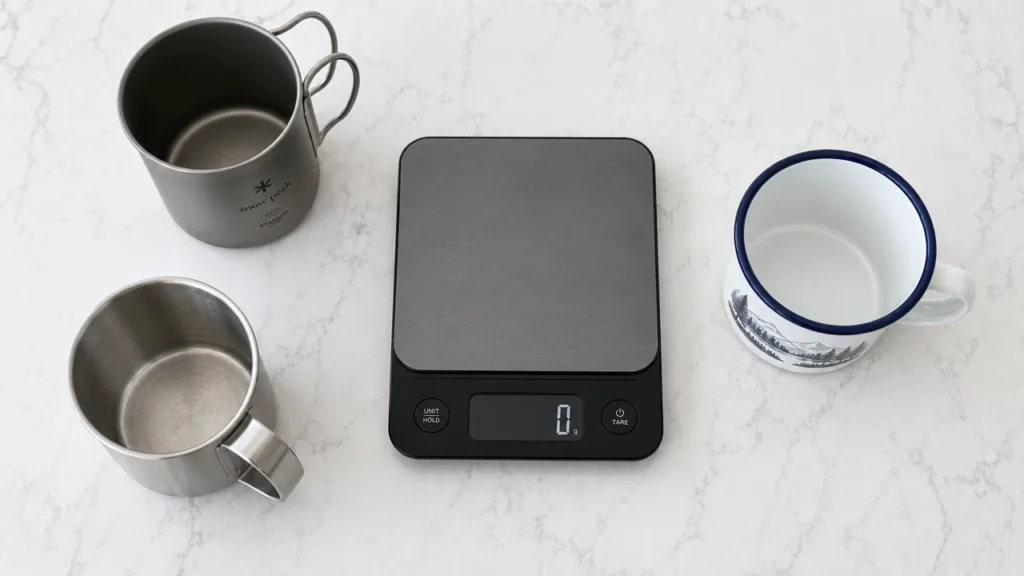
- Actual weight on a calibrated kitchen scale (not trusting the “quoted” weights)
- Lid fit and seal quality after three months of use
- Whether the graduation marks were actually useful in the field
What I found:
The Toaks UL550 graduation marks proved genuinely useful — I could measure out 250ml for a Mountain House packet without opening a second container. The Snow Peak double-wall held heat noticeably better on cold mornings (45+ minutes to drop below drinkable), but the single-wall MSR heated up faster because the thin wall transferred heat more efficiently.
One surprise: after two months, the silicone sleeve on one double-wall lid started developing a slight odor. I washed it with baking soda and it’s fine now, but it’s something to watch.
The Weight Factor — Every Gram Counts at Altitude
Let’s talk weight, because that’s why most people consider titanium in the first place.
Titanium vs Stainless Steel (same capacity, roughly):
| Material | 450ml Mug Weight | Weight per 100ml |
|---|---|---|
| Titanium (single wall) | 62-68g | ~14g |
| Titanium (double wall) | 78-95g | ~18g |
| Stainless Steel | 150-200g | ~35g |
| Enamel (camp style) | 180-250g | ~40g |
Titanium is roughly 50-60% lighter than equivalent stainless steel. That’s not marketing — that’s physics. The density of titanium is about 4.5 g/cm³ versus stainless steel at roughly 8 g/cm³.
So why does anyone still carry stainless?
Durability. Stainless steel survives being dropped onto rocks. Titanium dents if you look at it wrong. I’ve seen a Snow Peak single-wall mug with a visible dent after one bad fall. The owner still uses it, but it doesn’t sit flat anymore.
Weight budgeting for your kit:
If your baseweight (everything you carry excluding food and water) is under 10 lbs, adding a 65g titanium mug costs you under 1.5% of your total pack weight. If you’re carrying a 30 lb load, that 65g is less than 0.5%. Weight matters less than you think once you’re under 10 lbs baseweight.
But if you’re counting grams like I was on my PCT attempt, that 30g difference between single-wall and double-wall is exactly the difference between carrying an extra packet of instant coffee or going without.
Titanium vs Stainless Steel vs Enamel — Material Deep Dive
Since you’re researching titanium mugs, you’re probably also wondering how they compare to the alternatives. Here’s the breakdown.
Titanium
Pros:
- Lightest of the three options
- Biologically inert — no leaching, no metal taste
- Corrosion-resistant (won’t rust)
- Lasts a lifetime with basic care
Cons:
- Expensive ($25-50 for a mug vs $10-20 for stainless)
- Dents and scratches easily
- Poor thermal retention (cools fast)
- Conducts heat dangerously well when empty on a flame
Safety: Titanium is considered food-safe under FDA 21 CFR 170-199. It’s used in surgical implants precisely because the human body doesn’t react to it. You’re not getting any metal leaching from titanium under normal use conditions. This is one of those cases where the “is titanium safe?” question has a clearer answer than most camping gear — yes, it’s safe.
Stainless Steel
Pros:
- Nearly indestructible
- Better thermal retention than titanium (stays hot longer)
- Affordable
- Widely available
Cons:
- He’s heavier (2-3x titanium)
- Can develop metal taste (especially with acidic drinks)
- Not all stainless is created equal — low-quality 201/202 steel can rust
Safety note: The main issue with stainless steel isn’t the steel itself, it’s what’s in it. Lower-grade stainless can contain manganese and other trace metals that can leach, especially with hot acidic coffee. Stick to 18/8 or 18/10 (“food-grade”) stainless steel for any drinking vessel.
Enamel
Pros:
- Classic aesthetic (nostalgia factor)
- Non-reactive surface
- Easy to clean
Cons:
- Chips and cracks easily
- Heavy (heavier than both titanium and stainless for equivalent volume)
- Fragile — one bad drop and it’s done
Who should use what:
| If… | Choose… |
|---|---|
| Weight is your #1 concern | Titanium (single wall) |
| Durability matters more than weight | Stainless steel |
| Style points + car camping | Enamel |
| You want the best balance of both | Titanium (double wall) |
How to Choose Your Titanium Mug — The Decision Framework
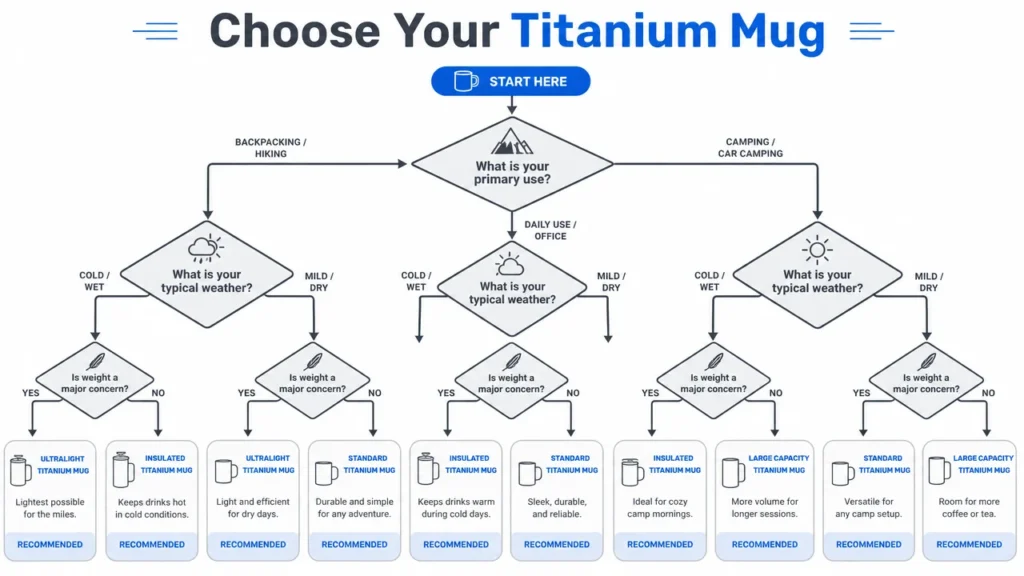
Here’s the framework I use when helping friends pick their first titanium mug. Answer the questions, match your answer, and you’ve got your pick.
Question 1: What’s your primary use?
- Coffee/tea only → 300ml / 10oz
- Coffee + occasional cooking → 450ml / 15oz
- Full meals + water boiling → 600ml / 20oz
Question 2: What’s your typical weather?
- Above 50°F / 10°C year-round → Single wall
- Below 50°F / 10°C or variable conditions → Double wall
Question 3: How much do you care about weight?
- Counting every gram → Single wall, 300-450ml
- Baseweight under 15 lbs anyway → Any size, any wall type
- Weight doesn’t matter → Go big, double wall
Question 4: Are you sharing this gear?
- Solo use → Pick based on above
- Sharing with partner → 600ml double wall gives you flexibility
The tl;dr: 450ml single wall is the right answer for most people, most of the time. It’s the goldilocks zone of weight, capacity, and versatility. But if you’re doing something specific — coffee-only ultralight, or full-meal cooking — pick the size that matches your actual use case.
Caring for Your Titanium Mug
Titanium is nearly indestructible, but a few maintenance tips will keep your mug performing its best for years.
Cleaning:
- Most titanium mugs are dishwasher safe, but handwashing extends the finish
- Use a soft sponge — abrasive scrubbers can scratch the polished surface
- For stubborn stains, a paste of baking soda and water works wonders
- Don’t worry about “seasoning” the mug like cast iron — titanium is non-porous
Removing discoloration:
- Heat discoloration (rainbow tints from flame exposure) is cosmetic only
- Bar Keeper’s Friend or white vinegar can lighten stubborn discoloration
- It doesn’t affect the safety or structural integrity of the mug
Storage:
- Keep the lid off when storing long-term to prevent odor buildup
- Most titanium mugs nest inside each other if you have multiple — great for packability
- Avoid leaving wet mugs in stuff sacks — they can develop musty smells
What NOT to do:
- Don’t put an empty titanium mug directly over a high flame — it discolors and can deform
- Don’t use steel wool — it’ll scratch the surface
- Don’t soak in bleach — unnecessary and potentially harmful to the titanium’s finish
Recommended Titanium Mugs by Capacity
Best for 300ml / 10oz
Snow Peak Ti-Single 300 — The reference design. Clean, simple, ultralight at 60g. The graduation marks on the inside are accurate, and the folding handle locks flat. Only downside: too small for anything beyond coffee.
Sea to Summit Passport Cup — Slightly larger (350ml), competitively priced at ~$22. The siliconesealed lid is nice for preventing spills. A solid budget option that doesn’t feel cheap.
Best for 450ml / 15oz
MSR Titan Mug 450 — This is my personal everyday pick. 68g bare, 82g with lid. The handle folds flat, the graduation marks are useful, and it’s available at most outdoor retailers. MSR’s quality control is consistent.
Snow Peak Ti-Double 450 — If cold weather is part of your equation, the double-wall design keeps drinks hot 2-3x longer than single-wall. It’s heavier (80g) but the thermal performance is real. Worth it for shoulder-season and winter camping.
Best for 600ml / 20oz
Toaks UL750 — At 750ml capacity and 105g, this is the “one mug does everything” choice. The large opening makes it easy to eat from, clean, and cook in. The graduation marks go up to 750ml. This is the one I’d recommend for anyone planning to do more than just drink coffee.
Snow Peak Ti-Double 600 — The premium option. Double-wall insulation, premium Japanese titanium, excellent finish. At ~$55, it’s the most expensive on this list, but if you’re investing in one piece of gear that will last a decade, this is it.
Frequently Asked Questions
What size titanium mug holds the most versatility?
The 450ml (15oz) size offers the best balance of weight and utility for most users. It’s large enough for a generous coffee plus room for milk, can handle a single serve of most freeze-dried meals, and fits in standard backpack side pockets.
Can a titanium mug go on a campfire?
Yes, but with extreme caution. Titanium conducts heat efficiently when thin, and an empty mug over direct flame can deform or discolor rapidly. If you’re boiling water, use a small amount of water in the mug first, or better yet, use a proper titanium pot for cooking.
Is titanium safe to drink from every day?
Yes. Titanium is biologically inert and FDA-approved for food contact. Unlike some metals, it won’t leach into your drinks even with prolonged use. It’s the same material used in surgical implants.
What’s the lightest titanium mug available?
The Sea to Summit Passport Cup at 55g (bare) is currently the lightest in the 300ml+ category. For the absolute lightest, look at 250ml “coffee cups” which can weigh as little as 35-40g, though these are really only suitable for espresso or small amounts of coffee.
Do titanium mugs keep drinks hot as long as vacuum flasks?
No. Single-wall titanium mugs have no insulation — drinks cool in 10-15 minutes. Double-wall titanium mugs are better (30-45 minutes), but they don’t compare to vacuum flasks (3-6 hours). If保温 is your priority, consider a separate vacuum flask.
How do I know if a titanium mug is actually titanium and not aluminum (which looks similar)?
Titanium has a characteristic slightly matte grey finish and is significantly heavier than aluminum. Aluminum 350ml cups weigh about 35g; titanium equivalents are 55-65g. Trust your scale, or buy from reputable brands — the major outdoor brands use genuine titanium.
How long do titanium mugs last?
A quality titanium mug, properly cared for, will last decades. The main failure mode is cosmetic — dents, scratches, and discoloration don’t affect function. I’ve seen Snow Peak mugs with over 5,000 miles of thru-hiking that still work fine.
What’s the difference between Grade 1 and Grade 5 titanium for mugs?
Grade 1 is commercially pure titanium, softer and more ductile — it dents easily but is easier to form. Grade 5 (Ti-6Al-4V) is an alloy, stronger and more heat-resistant, used in aerospace. Most camping mugs use Grade 1 or Grade 2 for the food-safe, non-reactive surface. For a mug, Grade 1 is fine — you’re not landing a spacecraft on it.
Final Thoughts
After weeks of testing, weighing, and using these mugs in real conditions, what’s my take?
The titanium mug world is confusing by design — inconsistent capacity labels, misleading “mug only” weights that exclude lids, and a wide price range that doesn’t always map to real quality differences. The good news: you can’t really buy a bad titanium mug from a major brand. Snow Peak, MSR, Toaks, and Vargo all make solid products. Pick your capacity based on your actual use, pick your wall type based on your climate, and you’re 90% of the way to the right choice.
The 450ml single-wall is still the right answer for most people. It’s what I’d grab for a 3-day backpacking trip. It’s what sits on my desk right now. It does enough things okay that you’ve got flexibility without paying a weight penalty.
If I had to pick one piece of camping gear to recommend to someone getting into the backcountry, it’d be a titanium mug. Not because it’s the most exciting gear — it’s a cup — but because it’s the one piece of gear you’ll use every single day on trail. Worth getting right.