
Yes — but it depends entirely on which type of “titanium pan” you actually have. Pure titanium cookware (100% titanium metal, no coating) is among the safest cookware materials available: it’s biocompatible, chemically inert, PFAS-free, and won’t off-gas at any temperature you’d cook at. However, the vast majority of pans sold as “titanium” are not pure titanium — they’re standard nonstick coatings (usually PTFE) reinforced with titanium particles for extra scratch resistance. Those pans carry the same safety profile as any Teflon-coated pan. Understanding which type you have — or are buying — determines whether titanium cookware is genuinely safer or just better marketed.
The Word “Titanium” on a Pan Can Mean Three Very Different Things
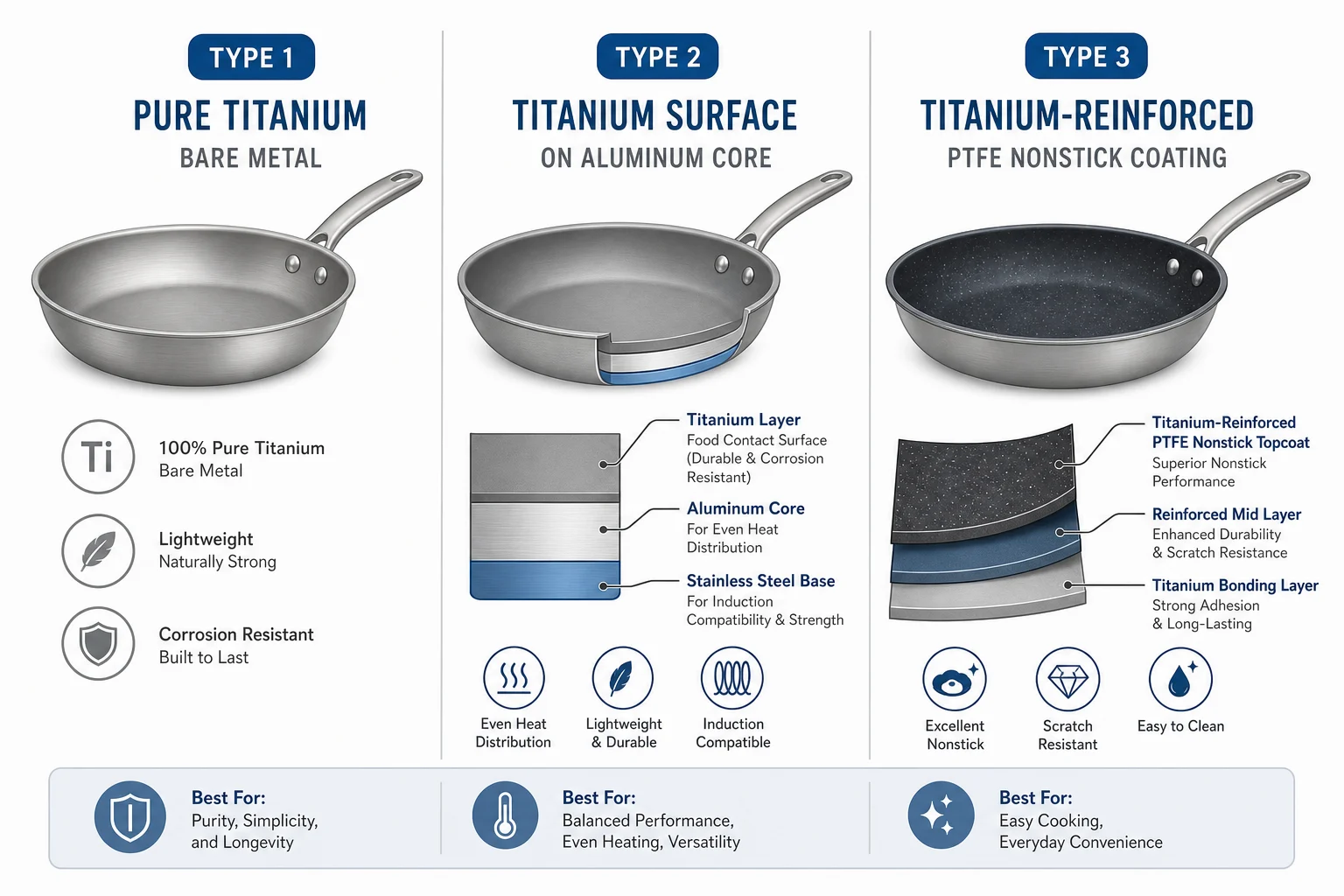
Walk into any cookware section or browse Amazon for a titanium pan and you’ll hit an immediate problem: the label “titanium” describes at least three distinct product categories, and they are not equally safe.
Type 1 — Pure/Solid Titanium
The pan body and cooking surface are made entirely of titanium with no coating whatsoever. Brands like Snow Peak (outdoor cookware) and some newer kitchen lines use commercially pure titanium, typically Grade 1 (≥99.1% Ti per ASTM B265) or Grade 2. What contacts your food is bare titanium metal. This is the safest option chemically, though it has real cooking performance limitations.
Type 2 — Titanium Food Surface on an Aluminum Core
The cooking surface is pure titanium — deposited by high-temperature spray, molecular bonding, or physical vapor deposition — over an aluminum or stainless base. Brands like Our Place (Titanium Always Pan Pro) and Hestan (NanoBond) use this construction. The aluminum manages heat distribution; the titanium handles food contact. No PTFE, no PFAS. This is genuinely titanium where it matters.
Type 3 — Titanium-Reinforced PTFE Nonstick
This is the most common type by far. The cooking surface is a standard nonstick coating — usually PTFE (the same polymer as Teflon) — with titanium particles mixed in. The titanium makes the coating harder and more scratch-resistant. Your food still touches nonstick coating, not titanium. A pan labeled “5-layer titanium reinforced nonstick” in this $25–$45 price range is almost certainly Type 3. The titanium is in the coating matrix, not the cooking surface.
The price signal is reliable: genuine Type 1 or Type 2 pans start around $100–$120 for smaller sizes and typically run $150–$300+. If the price is under $60 for a 10-inch skillet marketed as “titanium,” you’re almost certainly buying Type 3.
This distinction is what almost every article on titanium cookware safety fails to make actionable — and it’s the only fact that actually answers the safety question.
Why Pure Titanium Is Safe: The Science
Pure titanium’s safety record comes from medical science, not cookware marketing.
Titanium is biocompatible. It is the standard material for surgical bone implants, dental crowns, and joint replacements specifically because the human body does not react to it. A 2014 review published in Materials (Sidambe, PMC5456424) — cited over 1,000 times in materials science literature — describes commercially pure titanium as “the most biocompatible metal” due to its stable, inert oxide layer and resistance to corrosion from biological fluids. The same property that makes it safe inside the human body makes it safe in contact with food.
Titanium doesn’t leach. A 2020 study in the Journal of Food Science and Technology (Onyeka & Ibeawuchi) found titanium cookware produced better micronutrient retention than aluminum, stainless steel, and enamel cookware — consistent with titanium’s known chemical inertness. It doesn’t react with acidic foods like tomato sauce or citrus, which can leach trace metals from uncoated aluminum or damaged stainless steel.
No coating means no PFAS — structurally. PFAS (per- and polyfluoroalkyl substances) are a family of synthetic compounds used in nonstick coatings. They are found in PTFE (polytetrafluoroethylene) and in some ceramic coatings. A solid titanium pan has no coating — there is physically nothing to contain PFAS in. This is a categorically different claim from “PFOA-free,” which only means one specific PFAS compound was removed. A pan can be PFOA-free and still contain PTFE and dozens of other PFAS compounds. Pure titanium avoids the entire category, not just one chemical.
No thermal off-gassing threshold. PTFE-coated cookware begins breaking down at approximately 500°F / 260°C, releasing fumes that cause polymer fume fever — a flu-like illness documented by America’s Poison Centers. According to poison.org, “Teflon coating starts breaking down when exposed to temperatures above about 500°F.” This threshold matters because a preheated pan on high heat reaches 500°F faster than most people expect. Titanium has no such threshold: its melting point is 1,670°C / 3,040°F (ASTM B265, MatWeb). You could heat a pure titanium pan until it glowed orange before it posed any chemical risk. In practice, this means one fewer thing to manage in a hot kitchen.
The Real Risk: “Titanium” Pans That Still Use PTFE
If you own a nonstick pan that claims to be “titanium” and cost under $60, there is a good chance the food-contact surface is PTFE reinforced with titanium particles, not pure titanium. This is not inherently dangerous at normal cooking temperatures — but it is not meaningfully safer than standard Teflon just because the word “titanium” appears on the box.
The safety considerations for Type 3 pans are identical to any PTFE-coated cookware:
- Do not overheat above 500°F / 260°C — this means no preheating an empty pan on high heat, no storing in an oven above that temperature
- Scratched coatings raise legitimate questions about ingesting coating particles — there is no scientific consensus that this is harmful in small amounts, but degraded coatings generally indicate the pan should be replaced
- “PFOA-free” is a minimum legal standard in most markets, not a comprehensive safety certification. Look for explicit PTFE-free or PFAS-free documentation for stronger assurance
The frustration in forums like Reddit’s r/cookware is real: multiple threads document buyers discovering, after purchase, that their “titanium” pan is a PTFE coating. One YouTube test of five popular “titanium” pans found PFAS compounds in several — consistent with PTFE use. The titanium is real; it’s just not the food-contact surface.
Performance Trade-offs You Should Know Before Buying
Pure titanium is one of the safest cookware materials available. It is also one of the worst heat conductors.
Titanium Grade 1 has a thermal conductivity of 16.0 W/m·K (MatWeb, ASTM B265). Grade 2 is similar at approximately 17 W/m·K. For reference:
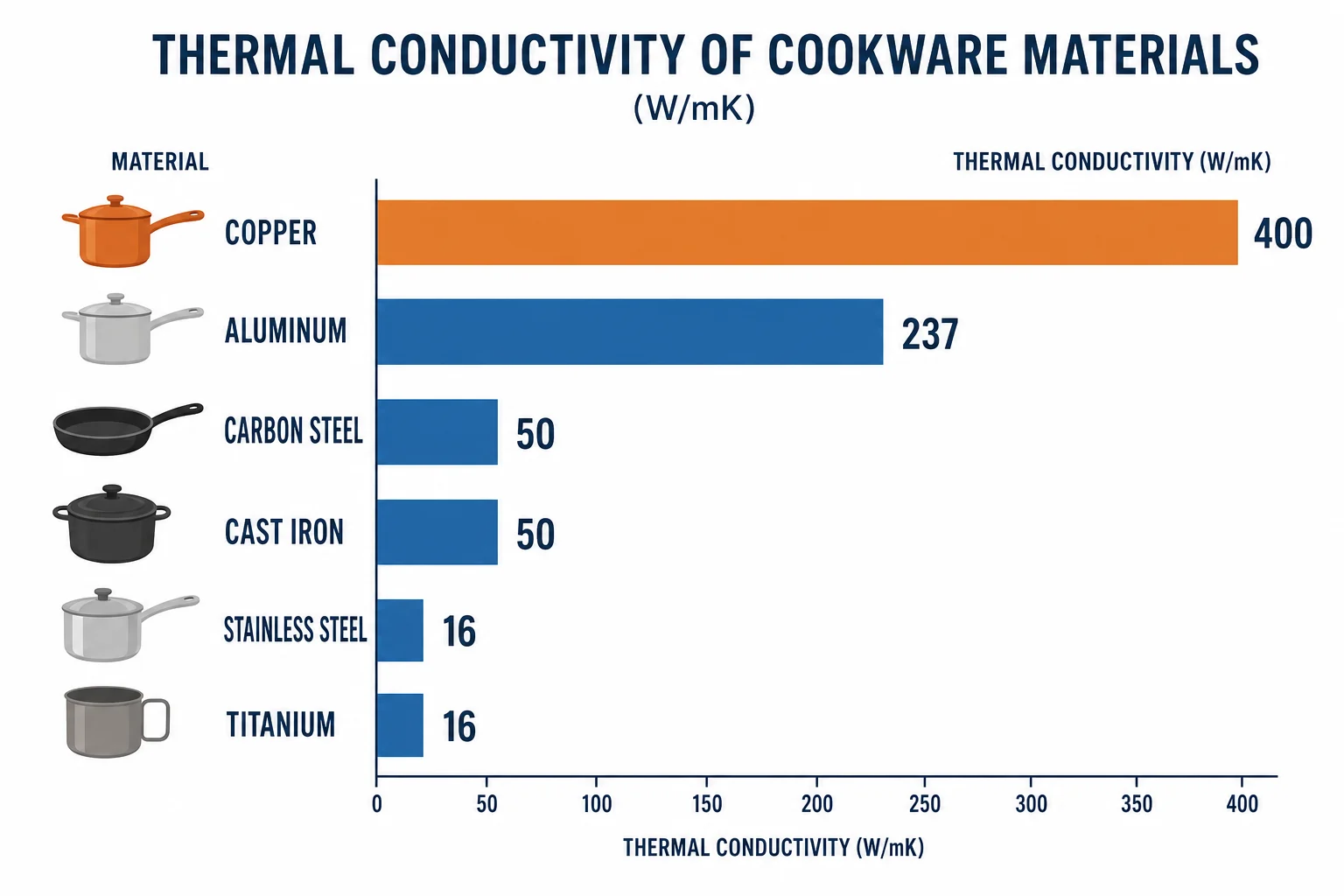
| Material | Thermal Conductivity |
|---|---|
| Copper | ~400 W/m·K |
| Aluminum | ~237 W/m·K |
| Carbon steel | ~50 W/m·K |
| Cast iron | ~50 W/m·K |
| Stainless steel 304 | ~16 W/m·K |
| Pure titanium (Grade 1) | ~16 W/m·K |
Pure titanium conducts heat comparably to stainless steel — and far worse than the aluminum and carbon steel alternatives most home cooks use. The practical result: a pure titanium pan heats unevenly. The burner contact zone gets hot fast while the edges stay cooler. For searing a steak, that creates noticeable hot spots. For cooking eggs or a crepe that needs uniform heat, it requires technique adjustment and patience.
This is why Type 2 hybrid designs exist. When titanium is deposited onto an aluminum core, the aluminum distributes heat evenly and the titanium provides a chemically inert food-contact surface. This construction resolves the heat distribution problem while keeping the food surface PTFE-free.
On sticking: a raw titanium surface is not slick the way PTFE is. It behaves more like stainless steel — proteins will stick if you add food too early or at the wrong temperature. This is manageable with technique (discussed below), but buyers expecting Teflon-level non-stick from a pure titanium pan will be disappointed initially. The r/Ultralight and r/cookware subreddits both contain consistent long-term user reports: titanium gets easier once you understand the heat management, but the first few uses are often frustrating.
Weight advantage is real. Titanium’s density is 4.51 g/cm³ versus stainless steel at approximately 7.8 g/cm³. A solid titanium 10-inch skillet weighs roughly half what an equivalent stainless steel pan does. For users with wrist or grip issues, or for any outdoor cooking context, this matters.
Induction compatibility: solid titanium is not magnetic and will not work on induction cooktops. Type 2 hybrid pans with a stainless steel exterior base are induction-compatible.
Durability: pure titanium does not rust, does not corrode, and has no coating to scratch or peel. With normal use, it will outlast any coated pan. The trade-off is entirely about cooking performance, not longevity.
How to Actually Cook with a Pure Titanium Pan
The most common reason people give up on pure titanium is skipping the preheat.
Pure titanium, like stainless steel, requires a different approach than nonstick. Jump straight to adding food and you’ll get sticking every time. The method below is consistent with how experienced users across r/cookware and r/Ultralight describe their process:
1. Preheat low and slow. Set the burner to medium-low and leave the pan for 2–3 minutes before adding anything. The goal is even warmth across the whole pan surface, not just the center. Because titanium conducts heat poorly, this step matters more than with aluminum or copper pans.
2. Use the water-drop test. Once preheated, drop a few water droplets on the surface. If they sit and steam, the pan is too cool. If they skitter and dance across the surface before evaporating (the Leidenfrost effect), the temperature is right for cooking proteins. This test works on stainless steel too — same principle.
3. Add fat before food, not before heating. Add a thin layer of oil or butter to the warm pan, let it heat for 30 seconds, then add food. Unlike PTFE, titanium needs fat to create a non-stick interface.
4. Don’t move protein too early. Chicken, fish, and red meat will initially stick on titanium. This is normal. A proper sear forms in 2–3 minutes and the food will naturally release. If you tug it and it resists, wait. If it’s been more than 4 minutes and still sticks, heat adjustment is needed.
5. Medium heat is sufficient once hot. Titanium’s low conductivity means it also retains heat well once warm. You rarely need high heat — and high heat creates the uneven hotspot problem. Medium is where titanium performs best.
6. Metal utensils are fine. One genuine advantage of pure titanium: the surface is harder than stainless steel. Metal spatulas, tongs, and whisks will not scratch it.
7. Cleaning is simple. Pure titanium is dishwasher-safe and won’t corrode. For stuck food, soak in warm water for 10–15 minutes, then use a non-abrasive scrubber. No seasoning required.
How to Tell What You’re Actually Buying: The 3-Question Test
Before purchasing any pan marketed as “titanium,” ask the brand (or check product documentation) for answers to these three questions:
Question 1: Is the food-contact surface pure titanium with no coating, or is it a nonstick coating reinforced with titanium?
A legitimate Type 1 or Type 2 pan will state clearly: “no coating,” “bare titanium,” “titanium surface,” or “molecular titanium bonding.” If the description talks about “layers” of titanium reinforcement in a nonstick context, it’s Type 3.
Question 2: Is the pan PTFE-free and PFAS-free — not just PFOA-free?
“PFOA-free” has been a legal minimum requirement in most markets since 2023. It tells you almost nothing about current safety. Ask for explicit confirmation that the pan contains no PTFE and no PFAS compounds. Brands with clean answers here will have documentation. Brands that deflect or only cite “PFOA-free” probably have a PTFE-based coating.
Question 3: What is the price?
A genuine pure titanium or titanium-surface pan costs $120 at minimum for smaller sizes, and $150–$300 for full-size skillets. This is not a brand premium — it reflects the actual cost of raw titanium and precision manufacturing. A $35 “titanium nonstick” cannot be what it claims to be.
Brands that can clearly answer Questions 1 and 2 in writing are worth trusting. The price will confirm it.
Frequently Asked Questions
Are titanium pans safe to cook with?
Pure titanium pans (no coating) are among the safest cookware available. They are biocompatible, chemically inert, PFAS-free, and have no thermal breakdown threshold. Budget “titanium” pans with PTFE nonstick coatings are as safe as any Teflon-coated pan — not more, not less — despite the marketing.
Does titanium leach into food?
No meaningful leaching occurs. Titanium is one of the least reactive metals used in cookware. Research published in the Journal of Food Science and Technology (2020) found titanium cookware showed the best micronutrient retention among cookware materials tested, consistent with its inert behavior. This is the same material used inside the human body for surgical implants.
Why does my titanium pan stick?
Almost always a preheat issue. Pure titanium requires 2–3 minutes of low-medium preheating before food is added. Using the Leidenfrost water-drop test confirms when the temperature is correct. Adding food too early — or at too high a temperature — causes proteins to bond to the surface. The fix is technique, not the pan.
Can titanium pans go on induction?
Solid pure titanium is not magnetic and will not work on induction. Hybrid pans with a stainless steel outer base (Our Place Titanium Always Pan Pro, Hestan NanoBond) are induction-compatible.
Why don’t professional chefs use titanium pans?
Two reasons: heat distribution and cost. Professional kitchens prioritize fast, even, controllable heat — which favors carbon steel, stainless with copper cores, or cast iron. Pure titanium’s low thermal conductivity (16 W/m·K, similar to stainless steel) creates hot spots that make precise cooking harder. For home cooks prioritizing safety over high-performance cooking, this trade-off is more acceptable.
What’s the difference between PFOA-free and PFAS-free?
PFOA (perfluorooctanoic acid) is one specific compound in the PFAS family. “PFOA-free” only means that one compound was removed — the coating can still contain PTFE and many other PFAS compounds. “PFAS-free” means no per- and polyfluoroalkyl substances at all. For maximum safety assurance, look for PFAS-free claims with supporting documentation, not just PFOA-free labeling.
Summary
Pure titanium cookware is genuinely safe — but “titanium cookware” as a category label is unreliable until you verify what type you’re actually buying.
The safety question has a clear answer: bare titanium metal is biocompatible, inert, PFAS-free, and has no thermal breakdown risk. These are verified material properties, not marketing claims. The confusion arises because most pans sold under the “titanium” label use titanium-particle-reinforced PTFE coatings, which carry the same safety profile as standard Teflon regardless of branding.
If you’re switching from nonstick cookware for health reasons, a Type 1 or Type 2 pure titanium pan is a legitimate long-term option — but it comes with a real learning curve on heat management and a genuine performance gap on heat distribution compared to carbon steel or aluminum. Type 2 hybrids (titanium surface over aluminum core) narrow the performance gap significantly at higher cost.
The purchase decision comes down to three things: verify the food-contact surface is pure titanium, verify PFAS-free documentation beyond “PFOA-free,” and confirm the price reflects genuine titanium construction. Pans that pass all three tests are worth the investment for health-conscious cooks who plan to keep cookware for a decade or more.