
Il titanio puro ha una densità di 4,506 g/cm³ (4.506 kg/m³ / 0,163 lb/in³), collocandosi tra l'alluminio (2,70 g/cm³) e l'acciaio al carbonio (7,85 g/cm³). Il titanio è circa il 43% più leggero dell'acciaio inossidabile e circa il 67% più pesante dell'alluminio a parità di volume. Il Grado 5 (Ti-6Al-4V), che rappresenta oltre il 50% del consumo mondiale di titanio, ha una densità leggermente inferiore, pari a 4,43 g/cm³, grazie al suo contenuto di alluminio. Il parametro determinante nella selezione dei materiali è però la resistenza specifica — rapporto tra resistenza a trazione e densità — dove il titanio Grado 5 (214 MPa·cm³/g) supera l'acciaio inossidabile (65) e la maggior parte delle leghe di alluminio. Questa guida riporta i valori di densità esatti per tutti i gradi comuni, confronti diretti con acciaio e alluminio, una tabella della resistenza specifica e una formula per il calcolo del peso, utile ai team di approvvigionamento e progettazione.
Densità del Titanio in Tutte le Unità di Misura
La maggior parte dei database sui materiali riporta i valori in g/cm³. I tecnici che operano in officine nordamericane utilizzano lb/in³. I team di approvvigionamento che ordinano per tonnellata hanno bisogno di kg/m³. Di seguito sono riportati i valori per il titanio commercialmente puro (CP) — Gradi da 1 a 3 — convertiti in tutte le unità di misura più diffuse:
| Unità | Valore |
|---|---|
| g/cm³ (grammi per centimetro cubo) | 4.506 |
| kg/m³ (chilogrammi per metro cubo) | 4,506 |
| lb/in³ (libbre per pollice cubo) | 0.163 |
| lb/ft³ (libbre per piede cubo) | 281.3 |
Questi valori sono ricavati dalle tabelle delle proprietà fisiche dell'ASM International per il titanio CP. Il Grado 4 presenta una densità leggermente superiore, pari a 4,54 g/cm³: il maggiore contenuto di ossigeno aumenta la massa senza modificare significativamente il volume.
Un controllo rapido sul campo: il titanio è circa 4,5 volte più denso dell'acqua. Una barra piena in titanio deve risultare sensibilmente più pesante di una in alluminio di dimensioni identiche. Se così non fosse, c'è un problema con il materiale.
Non Tutti i Gradi di Titanio Hanno la Stessa Densità
La prassi diffusa di citare un unico valore di “densità del titanio” maschera variazioni significative tra i diversi gradi. Gli elementi in lega modificano la densità finale: elementi più leggeri come l'alluminio la riducono, elementi più pesanti come cromo e molibdeno la aumentano.
| Grado | Designazione | Densità (g/cm³) | Note |
|---|---|---|---|
| Grado 1 | Ti CP | 4.51 | Il più duttile, massima formabilità |
| Grado 2 | Ti CP | 4.51 | Il grado CP più diffuso a livello mondiale |
| Grado 3 | Ti CP | 4.51 | Resistenza superiore al G2, stessa densità |
| Grado 4 | Ti CP | 4.54 | Grado CP a più alta resistenza |
| Grado 9 | Ti-3Al-2,5V | 4.48 | “Half-6-4,” telai bici, tubi |
| Grado 5 | Ti-6Al-4V | 4.43 | Lega di riferimento, ~50% del consumo mondiale di Ti |
| Beta C | Ti-3Al-8V-6Cr-4Zr-4Mo | 4.81 | Alta resistenza, applicazioni per molle |
Fonte: AZoM / tabelle delle proprietà fisiche ASM International
La densità del Grado 5 scende a 4,43 g/cm³ perché l'aggiunta del 6% di alluminio — con densità di 2,70 g/cm³ — diluisce la miscela. Le leghe beta hanno densità più elevate perché cromo, molibdeno e vanadio superano tutti il titanio in termini di densità. Se si specifica il titanio per un'applicazione in cui il peso è un fattore critico e un fornitore cita ’4,51“, è opportuno chiedere di quale grado si tratti. Sostituire il Beta C con il Grado 5 comporta un aumento di circa l”8% del peso del componente a parità di volume.
Titanio vs Acciaio: il Divario del 43%
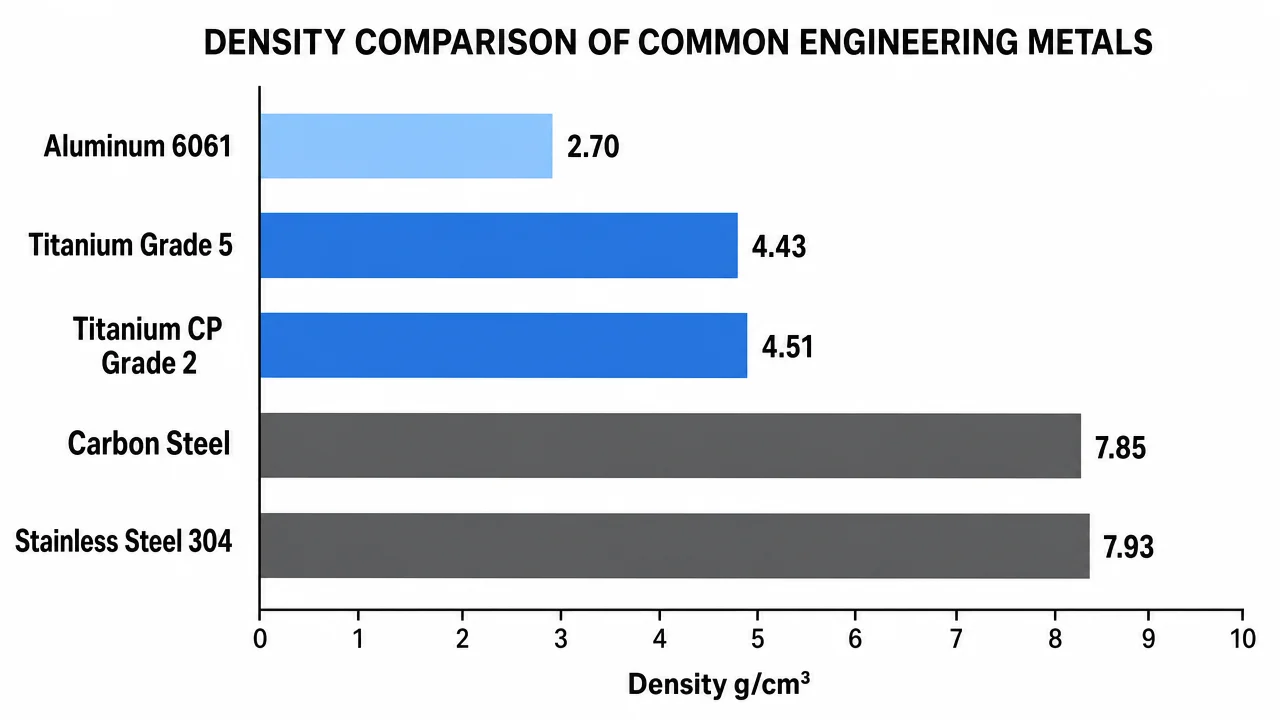
L'acciaio è stato il metallo strutturale di riferimento per oltre un secolo. Ogni analisi di sostituzione con il titanio parte da questo confronto.
| Materiale | Densità (g/cm³) | Densità (kg/m³) |
|---|---|---|
| Titanio Grado 2 (CP) | 4.51 | 4,510 |
| Titanio Grado 5 (Ti-6Al-4V) | 4.43 | 4,430 |
| Acciaio al carbonio AISI 1020 | 7.85 | 7,850 |
| Acciaio inossidabile 304 | 7.93 | 7,930 |
| Acciaio inossidabile 316 | 8.00 | 8,000 |
Il titanio CP (Grado 2) è il 43% più leggero dell'inossidabile 304 a parità di volume. Il Grado 5 offre un ulteriore risparmio di peso. Un componente in acciaio inossidabile 304 del peso di 10 kg avrebbe un peso di circa 5,7 kg in titanio CP a geometria identica — stesso volume, 4,3 kg in meno.
Quel delta si accumula rapidamente. Su una produzione di 5.000 elementi di fissaggio, si traduce in centinaia di chilogrammi di peso eliminato da una struttura assemblata. Nel settore aerospaziale, dove il consumo di carburante scala direttamente con la massa della cellula, questo tipo di riduzione sistematica del peso genera un valore economico misurabile nell'arco della vita operativa di una flotta.
L'aspetto più rilevante, però, riguarda la resistenza meccanica. L'acciaio inossidabile 304 ha una resistenza a trazione ultima (UTS) intorno a 515 MPa. Il titanio Grade 5 raggiunge 950 MPa allo stato ricotto. Poiché è possibile progettare pareti più sottili per sopportare carichi equivalenti, il vantaggio reale in termini di peso in un design governato dalla resistenza supera il semplice divario di densità del 43%. Gli ingegneri aerospaziali riportano abitualmente risparmi di peso totali del 50–65% nella riprogettazione di componenti in acciaio in titanio — il risparmio aggiuntivo deriva dalla riduzione della sezione trasversale.
Titanio vs Alluminio: Densità a Confronto — Metallo Più Pesante, Spesso Componente Più Leggero
L'alluminio è il “metallo leggero” per eccellenza nell'automotive, nell'elettronica di consumo e nella produzione di biciclette. Il titanio è più pesante sotto ogni misura di densità. Ed è qui che la questione diventa controintuitiva.
| Materiale | Densità (g/cm³) | UTS Tipica (MPa) | Resistenza Specifica (MPa·cm³/g) |
|---|---|---|---|
| Alluminio 6061-T6 | 2.70 | 310 | 115 |
| Alluminio 7075-T6 | 2.81 | 572 | 204 |
| Titanio Grado 2 (CP) | 4.51 | 340 | 75 |
| Titanio Grado 5 (Ti-6Al-4V) | 4.43 | 950 | 214 |
| Acciaio inossidabile 304 | 7.93 | 515 | 65 |
Fonti UTS: AMS 4928 (Grade 5 ricotto), ASTM A276 (304 SS), ASTM B209 (6061-T6, 7075-T6)
Il titanio è più denso dell'alluminio di circa il 67% su base volumetrica. Una barra identica in titanio pesa 1,67× in più rispetto a una in alluminio.
Ma si osservi la resistenza specifica. Il titanio Grade 5 (214 MPa·cm³/g) supera di poco il 7075-T6 in alluminio (204) superando più del doppio il 6061-T6 (115). Per le applicazioni in cui la resistenza a trazione e la vita a fatica governano il progetto — attacchi del carrello di atterraggio, impianti chirurgici, componenti ad alto carico per biciclette — è possibile progettare il componente in titanio con una sezione trasversale ridotta. Il componente finito in titanio può risultare paragonabile in peso al suo equivalente in alluminio, nonostante la densità superiore.
Il titanio CP di Grado 2 presenta caratteristiche diverse: la resistenza specifica di 75 è inferiore persino all'alluminio 6061. Il titanio CP viene scelto per la resistenza alla corrosione e la biocompatibilità, non per l'efficienza strutturale. Se si sta approvvigionando titanio CP per una struttura in cui il peso è critico, probabilmente si sta utilizzando il grado sbagliato. La risposta è il Grado 5.
L'altro fattore che orienta definitivamente la scelta tra titanio e alluminio è la temperatura. L'alluminio 7075-T6 inizia a perdere resistenza sopra circa 150°C. Il titanio di Grado 5 mantiene le proprie proprietà meccaniche fino a circa 315°C. Per strutture vicine ai vani motore, agli scarichi o ai veicoli di rientro atmosferico, l'alluminio non soddisfa i requisiti termici indipendentemente dalla resistenza specifica.
Il parametro che guida davvero la selezione dei materiali: la resistenza specifica
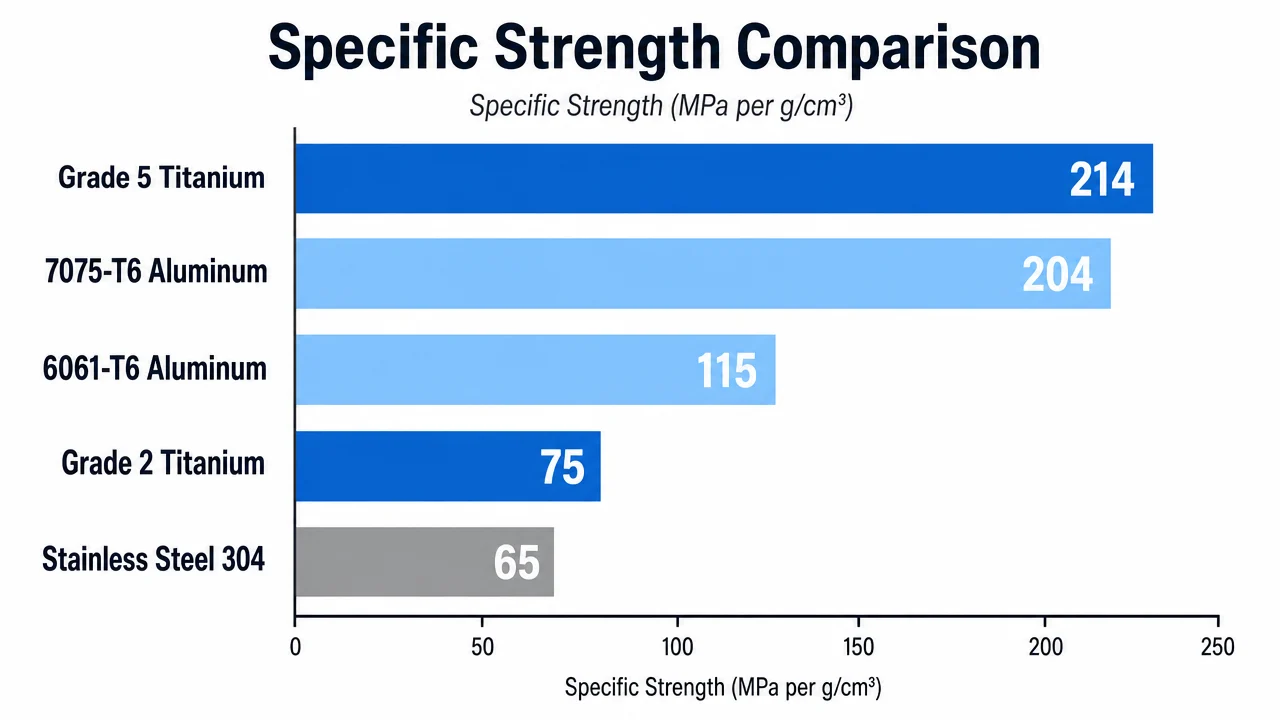
La densità indica quanto pesa un determinato volume di metallo. La resistenza specifica indica il carico strutturale che quel metallo è in grado di sopportare per unità di massa. Per confrontare i materiali in fase di progettazione ingegneristica, la resistenza specifica è il parametro di riferimento.
Resistenza specifica = UTS (MPa) ÷ Densità (g/cm³)
Confronto tra titanio Grado 5 e acciaio inossidabile 304: 950 ÷ 4,43 = 214 vs 515 ÷ 7,93 = 65. Il Grado 5 offre oltre 3× le prestazioni strutturali per grammo. È questo rapporto che ha spinto il settore aerospaziale a sostituire, nel corso di diversi decenni, gli organi di fissaggio e i componenti strutturali in acciaio con il titanio — non perché il titanio sia più leggero in termini assoluti, ma perché, a parità di requisito strutturale, la soluzione in titanio risulta significativamente più leggera.
Il confronto tra alluminio e titanio è più equilibrato. Il 7075-T6 con 204 è quasi pari al Grado 5 con 214. Per questo motivo, in ambito aerospaziale, la scelta tra i due non è una questione di densità, ma di temperatura. Dove le temperature rimangono al di sotto di 150°C e il costo è rilevante, vince il 7075. Dove le temperature superano i 150°C o la vita a fatica è critica, vince il Grado 5.
A titolo di riferimento: il polimero rinforzato con fibra di carbonio (CFRP) ha una resistenza specifica di circa 375 — pari a circa 1,75× quella del titanio Grado 5. Il motivo per cui il titanio coesiste con il CFRP in ambito aerospaziale risiede nella riparabilità, nell'isotropia e nella lavorabilità. Il titanio può essere saldato, lavorato e riparato anche in condizioni operative sul campo. Il CFRP no.
Calcolo del peso per gli acquisti B2B
Una volta definito il grado, il calcolo del peso del componente è semplice. La formula di base è:
Peso = Volume × Densità
Per una piastra rettangolare (unità metriche):
Peso (kg) = [L (mm) × W (mm) × T (mm) × densità (g/cm³)] ÷ 1.000.000
Esempio pratico — piastra Grado 5, 500 mm × 300 mm × 6 mm:
500 × 300 × 6 × 4,43 ÷ 1.000.000 = 3,99 kg
Stessa piastra in acciaio inossidabile 304 (densità 7,93 g/cm³):
500 × 300 × 6 × 7,93 ÷ 1.000.000 = 7,14 kg
Stessa geometria: il titanio Grado 5 è 44% più leggero. Su una produzione di 500 pezzi, ciò corrisponde a circa 1.575 kg di peso eliminato dall'assemblato finale — con un impatto diretto sui costi di spedizione e, per i componenti aerospaziali o automotive, sui consumi di carburante nell'arco della vita del prodotto.
Per barre tonde:
Peso (kg) = π × (D/2 in mm)² × L (mm) × densità (g/cm³) ÷ 1.000.000
Per il sistema imperiale (lb/in³), sostituire il valore di densità con 0,160 per il Grado 5 o 0,163 per il CP Grado 2, inserendo le dimensioni in pollici. Omettere la divisione per ÷ 1.000.000 — il risultato è direttamente in libbre.
Quando il vantaggio di densità del titanio è determinante — e quando non lo è
Il vantaggio in termini di peso del titanio è reale, ma non è sempre il fattore decisivo nella scelta del materiale.
Il vantaggio di densità del titanio è determinante quando:
- Il rapporto resistenza/peso è il vincolo progettuale principale: strutture aerospaziali, componenti automotive ad alte prestazioni, impianti medicali
- Le temperature operative superano i 150°C, escludendo le leghe di alluminio ad alta resistenza
- La resistenza alla corrosione è necessaria e la penalizzazione in peso dell'acciaio inossidabile è inaccettabile
- La vita a fatica sotto carichi ad alto numero di cicli è il criterio di progetto limitante
Il vantaggio di densità del titanio è secondario — o irrilevante — quando:
- Il costo è determinante: il titanio costa 5–10× in più dell'acciaio inossidabile al kg; il risparmio di peso raramente giustifica la spesa per strutture statiche a terra
- La lavorabilità è importante: la bassa conducibilità termica del titanio e la sua tendenza all'incrudimento lo rendono notevolmente più lento e costoso da lavorare rispetto all'acciaio o all'alluminio
- I volumi sono elevati e le tolleranze sono ampie: l'alluminio rimane più economico e più rapido per componenti ad alto volume e prestazioni moderate
- Il componente non è vincolato dal peso: un supporto strutturale in un impianto industriale fisso non trae alcun vantaggio dal risparmiare 4 kg per unità
Quando si valuta la sostituzione con il titanio nella produzione B2B, la prima domanda non è “qual è la densità del titanio?” — ma se il risparmio di peso genera un valore misurabile. Per un impianto medico che riduce il carico sul paziente o per una staffa satellitare che consente un payload più pesante, ogni grammo conta. Per un involucro di pompa a terra, il vantaggio di densità ha un'utilità prevalentemente teorica.
FAQ
Qual è la densità del titanio?
Il titanio puro (commercialmente puro) ha una densità di 4,506 g/cm³, ovvero 4.506 kg/m³, o 0,163 lb/in³. La lega più diffusa, il Grado 5 (Ti-6Al-4V), è di 4,43 g/cm³. Le leghe beta come la Beta C possono raggiungere 4,81 g/cm³.
Il titanio è più leggero dell'acciaio?
Sì. Il titanio è circa il 43% più leggero dell'acciaio inossidabile 304 a parità di volume. Un blocco di titanio da 10 cm³ pesa circa 45 g; lo stesso blocco in acciaio inossidabile 304 pesa approssimativamente 79 g.
Il titanio è più pesante dell'alluminio?
Sì — di circa il 67% a parità di volume. Tuttavia, la resistenza specifica del titanio Grado 5 (214 MPa·cm³/g) è paragonabile a quella dell'alluminio ad alta resistenza 7075-T6 (204), il che significa che un componente in titanio progettato per lo stesso carico strutturale arriva spesso a un peso simile al suo equivalente in alluminio.
Perché il titanio Grado 5 ha una densità inferiore al titanio puro?
Il Grado 5 (Ti-6Al-4V) contiene il 6% di alluminio, che ha una densità di soli 2,70 g/cm³ — ben al di sotto dei 4,506 del titanio. L'aggiunta di questo elemento più leggero alla lega riduce la densità complessiva da 4,51 (CP Grado 2) a 4,43 g/cm³.
Qual è la densità del titanio in kg/m³?
506 kg/m³ per il titanio CP (Gradi 1–3). Il Grado 5 è 4.430 kg/m³. Il Grado 4 è 4.540 kg/m³.
Il titanio è il metallo strutturale più leggero?
No. L'alluminio (~2,70 g/cm³) e il magnesio (~1,74 g/cm³) sono più leggeri. Il vantaggio del titanio risiede nella sua superiore resistenza specifica e nelle prestazioni ad alta temperatura rispetto a questi metalli più leggeri — non nella leggerezza assoluta.
Sintesi
Il titanio ha una densità di 4,506 g/cm³ — il 43% più leggero dell'acciaio inossidabile e il 67% più pesante dell'alluminio. La lega specificata è determinante: il Grado 5, con 4,43 g/cm³, è la lega strutturale di uso comune più leggera; il Beta C, a 4,81, è notevolmente più pesante. La densità da sola raramente è il fattore decisivo. È la resistenza specifica — dove il titanio Grado 5 (214 MPa·cm³/g) supera l'acciaio inossidabile (65) e la maggior parte delle leghe di alluminio — a giustificare il premium di costo del titanio nelle applicazioni strutturali. Per gli acquisti B2B e la progettazione di componenti, il calcolo del risparmio in peso è diretto: si moltiplica il volume per la densità, si confrontano le leghe e si valuta se la riduzione di massa genera un valore proporzionale al premium di prezzo del titanio.