
Titanium cookware has split into two distinct construction categories, and the difference between them is bigger than most buyers realize.
Walk into any outdoor gear store and you’ll see single-layer titanium pots — thin-walled, often hammered or matte-finished, ultra-light. These are the classic backpacking option and they’ve been around for decades. But a newer category has grown steadily: multi-layer clad titanium pots that bond titanium to aluminum or stainless steel cores. The marketing sounds similar. The cooking experience is not.
I’ve cooked with both. Here’s what actually separates them — and which one belongs in your kitchen or pack.
The Core Difference: One Metal vs Bonded Layers
Single-layer titanium pots are exactly what they sound like: a vessel made entirely from one sheet of commercially pure titanium, with no other materials bonded to it.
The titanium used is typically Grade 1 (≥99.5% pure Ti by impurity difference) or Grade 2 (≥98.9% pure Ti per ASTM B265 maximum impurity limits). These grades prioritize formability and corrosion resistance over strength. Camping pot walls typically run 0.3–0.6 mm — thin enough to stay light, thick enough to hold shape. Weight for a 900 mL single-layer titanium pot runs roughly 103–155 grams depending on the brand and wall thickness.
Multi-layer clad titanium pots bond titanium to one or more other metal layers to engineer specific performance properties. The titanium remains the food-contact surface — what your food actually touches — but the structural body uses other metals to handle heat distribution and structural rigidity.
The most common configurations:

- 3-ply: Titanium / Aluminum / Titanium (or Titanium / Stainless Steel / Aluminum)
- 5-ply: Titanium / Stainless / Aluminum / Stainless / Titanium
The aluminum layer is the functional core in most designs — it’s there specifically to compensate for titanium’s poor thermal conductivity. Stainless steel layers add rigidity, durability, and induction compatibility. The result is a pot that has a titanium cooking surface (safe, non-reactive, no coatings) backed by materials that actually conduct heat properly.
Clad titanium pots for similar volumes weigh 300–600+ grams — significantly more than single-layer alternatives.
Why Titanium’s Thermal Conductivity Changes Everything
Titanium is an exceptionally poor heat conductor, and this single fact explains most of the differences between single-layer and clad construction.
Pure titanium’s thermal conductivity sits at approximately 21.9 W/m·K for commercially pure grades. To put that in context:
| Material | Thermal Conductivity (W/m·K) |
|---|---|
| Copper | ~400 |
| Aluminum | ~237 |
| Carbon steel | ~50 |
| Pure titanium (Grade 2) | ~21.9 |
| Stainless steel 304 | ~14–15 |
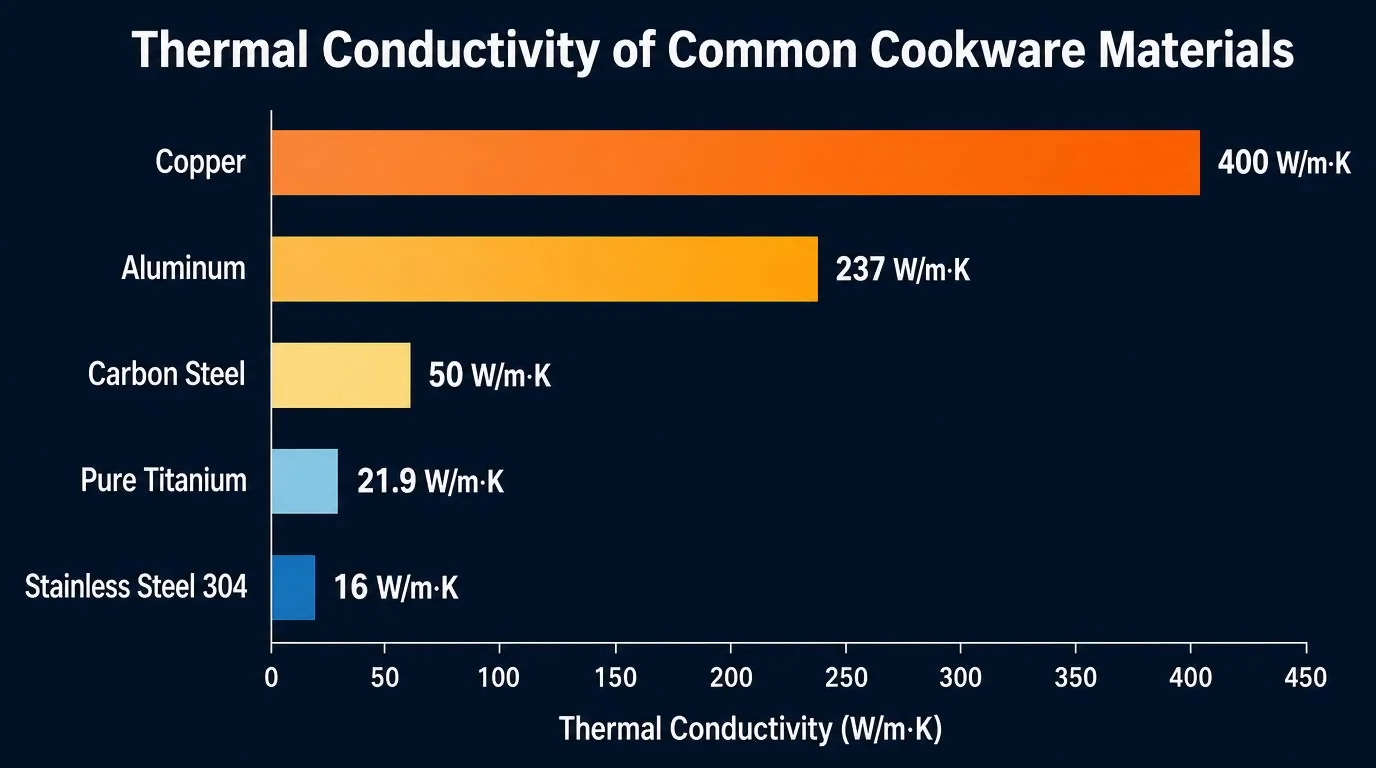
Titanium conducts heat roughly as poorly as stainless steel — at 21.9 W/m·K vs ~14–15 W/m·K for SS 304, both are far below carbon steel or aluminum — and about 11x worse than aluminum. On a stovetop, this means the heat from your burner stays concentrated near the flame contact point rather than spreading across the base. In a single-layer titanium pot, the area directly over the burner gets hot fast while the outer edges remain cooler.
On a camp stove with a focused flame, this matters less — you’re usually boiling water, which self-circulates and equalizes temperature. But on a home gas burner or electric stovetop, you’ll see and taste the difference when cooking anything that requires even heat: sautéed vegetables, scrambled eggs, sauces, grains.
In my own testing with a single-layer titanium skillet on a residential gas burner, the center registered about 38°F (21°C) hotter than the rim after three minutes on medium heat. The clad version of a similar size showed a spread of only 9°F (5°C) across the same surface area under identical conditions. That’s the aluminum core doing its job.
Clad titanium pots are specifically engineered to solve this problem. The aluminum core conducts heat laterally across the base, distributing it more evenly before it ever reaches the titanium food-contact surface. The result feels noticeably more like cooking on a quality stainless tri-ply pot — responsive, even, forgiving.
Weight: The Tradeoff That Matters Most for Backpackers
For anyone counting grams, single-layer titanium wins decisively on weight.
The numbers speak clearly:
| Pot Type | Volume | Typical Weight |
|---|---|---|
| Single-layer titanium | 750 mL | 85–110 g |
| Single-layer titanium | 900 mL | 103–155 g |
| 3-ply clad titanium | 900 mL | 280–380 g |
| 5-ply clad titanium | 1.0 L | 450–600 g |
| Stainless steel tri-ply | 1.0 L | 500–750 g |
A single-layer 900 mL titanium pot weighs roughly the same as a clad titanium pot’s lid alone. For thru-hikers on a weight budget, this isn’t a close call. The Snow Peak Trek 900 at about 105 grams (pot alone) and the MSR Titan Kettle at a similar weight have built loyal followings precisely because no clad construction comes close on weight.
But the weight argument flips for home cooking and car camping. When your kitchen stove is handling meal preparation and you’re not carrying the pot on your back, saving 300 grams means almost nothing. The cooking improvement from clad construction becomes the deciding factor instead.
For car camping or basecamp cooking where you’re transporting gear by vehicle, the clad option makes more sense — you get better cooking performance without paying a weight penalty that matters.
What You’re Actually Cooking: Use-Case Breakdown
The right construction depends entirely on what you’re cooking and where you’re cooking it.
Backpacking and Ultralight Travel
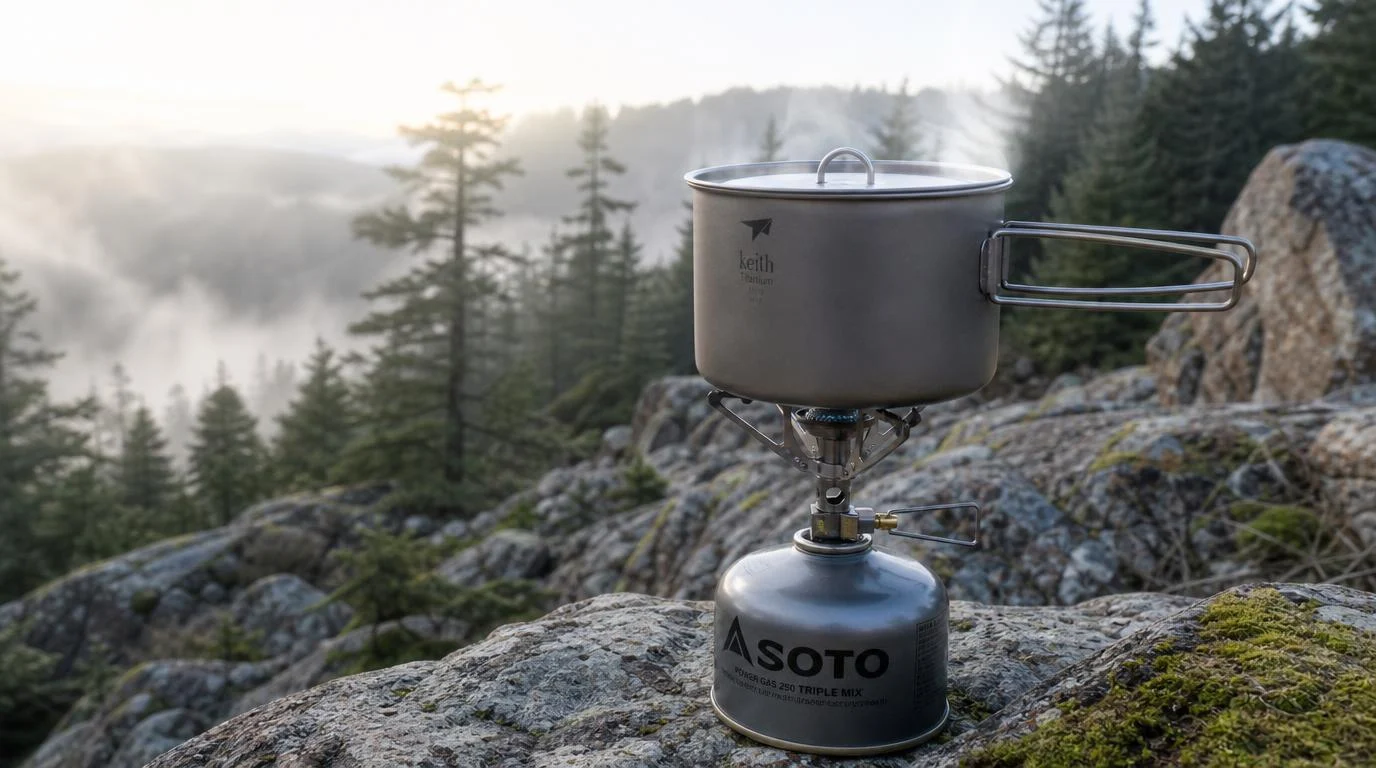
Single-layer titanium is the clear choice. The typical trail cooking repertoire — boiling water for instant meals, rehydrating freeze-dried food, making pour-over coffee, heating soup — doesn’t require even heat distribution. You’re boiling liquid, and boiling liquid self-distributes temperature regardless of the pot’s conductivity.
The single-layer pot is also more durable for trail abuse in one specific way: there’s no bonded interface to fail. Drop it, pack it hard, use it in ways the manufacturer didn’t intend — a single-layer pot has no layers to delaminate.
Snow Peak, MSR, Sea to Summit, and GSI Outdoors all make solid single-layer titanium pots that have proven track records in this application.
Home Cooking

Multi-layer clad wins for home use — and it’s not particularly close. If you want to use a titanium pot for general cooking (sautéing, braising, making sauces, cooking grains), the hot-spot problem in single-layer titanium creates real frustrations. Food burns in the center before the outer areas even come up to temperature. You’ll find yourself constantly stirring to compensate.
Clad titanium pots used in a home kitchen give you:
- Even heat across the base
- True titanium food-contact surface (no PTFE, no PFAS)
- Responsiveness to heat changes (better than cast iron, slightly less than copper)
- Oven compatibility at high temperatures
The Hestan NanoBond line uses a molecular titanium deposition process on a stainless steel base — technically not clad in the traditional bonded sense, but functionally similar: titanium at the food surface, stainless handling heat management and structure.
Outdoor Basecamp or Group Cooking
This is where you need to make a judgment call. If you’re preparing anything beyond boiling (stir-frying vegetables, cooking rice on a camp stove, making oatmeal without scorching), a clad pot performs noticeably better. The weight penalty matters less when you’re not carrying the pot on your back.
Durability and Longevity: Single-Layer Has an Edge
Single-layer titanium is structurally simpler, and simpler things generally last longer.
A single-layer titanium pot can, in principle, last indefinitely. There are no coatings to chip, no bonded interfaces to separate, nothing that can degrade except the metal itself. Grade 1 and Grade 2 titanium have excellent corrosion resistance — they form a stable, passive oxide layer that regenerates if scratched. Even after years of trail abuse, a single-layer titanium pot looks essentially the same as when new (minus dents and scratches from use).
Clad construction introduces a potential failure mode: delamination at the bonding interface. Modern hot-roll bonding and explosive bonding techniques have made clad titanium products significantly more durable than earlier versions, but the bonded interface remains a theoretical weak point. The practical risk is low with quality manufacturing — heat cycling within normal cooking temperatures doesn’t stress the bond meaningfully. Where you’ll see problems is:
- Severe thermal shock (dropping a hot clad pot in cold water)
- Overheating repeatedly above 300°C (uncommon in home cooking)
- Physical impact at the edges of the base where bonded layers are exposed
For a well-made clad pot used normally, delamination over a cooking lifetime is unlikely. But it’s a failure mode that doesn’t exist at all in single-layer construction.
Scratch resistance is similar for both types. Titanium itself (Grade 1/2) is harder than aluminum and comparable to 304 stainless. The food-contact surface of a clad titanium pot is titanium, so scratch behavior is essentially the same as single-layer for the cooking surface. The external surface of a clad pot (often stainless) is also durable.
Price: What You’re Paying For in Each Category
Single-layer titanium pots are substantially cheaper because they’re simpler to manufacture.
Forming a single-layer titanium pot requires cutting, pressing, and forming one sheet of metal. That’s a well-understood, scalable process. A quality single-layer 900 mL titanium pot from a reputable brand (Snow Peak, MSR, Sea to Summit) runs $45–$90.
Multi-layer clad titanium requires bonding dissimilar metals — a specialized process involving high heat, pressure, or explosion bonding followed by rolling to target thickness tolerances. The process requires more steps, more quality control, and produces less yield per unit of material. A comparable-volume clad titanium pot costs $150–$400+.
The price premium is real and largely justified by manufacturing complexity. You’re not just paying for marketing — the bonded aluminum core is genuinely doing something the single-layer version can’t. Whether that’s worth 2–5x the price depends on your use case.
For backpacking use, the single-layer is the right financial call even if money isn’t an issue — the weight benefits are the point, and clad construction erases those. For home cooking, the clad pot is a one-time purchase that will outlast any nonstick pan you’ll ever buy.
The Food Safety Picture
Both construction types are safe — this is one area where they’re equivalent.
Single-layer titanium pots use titanium as the food-contact surface. Commercially pure titanium is biocompatible, chemically inert, and doesn’t react with food acids (citrus, vinegar, tomatoes) at cooking temperatures. It has no PTFE, no PFAS, no ceramic coatings that can chip. It won’t leach metals into food under any normal cooking condition. The FDA recognizes titanium as food-safe, and it’s used in medical implants precisely because the body doesn’t react to it.
Multi-layer clad titanium pots also use titanium as the food-contact surface. The aluminum or stainless steel core is encapsulated inside the bonded construction and doesn’t contact food directly. As long as the titanium layer is intact, the food safety profile is identical to single-layer.
The only caveat: if a clad pot’s titanium surface is physically breached — deep gouges that expose the aluminum core, or edge delamination that exposes aluminum — that’s a situation to address. Aluminum itself is generally considered safe for cooking at normal temperatures, but if you’re buying a clad titanium pot specifically to avoid any non-titanium contact, inspect it periodically, especially at the edges of the base.
Which Titanium Pot Should You Buy?
The decision tree is simple once you know what you’re cooking:
Choose single-layer titanium if:
- You’re backpacking and weight is a priority
- Your primary use is boiling water or rehydrating meals
- You want maximum durability with zero failure modes
- Budget is a consideration
- You need a pot that handles rough use and storage abuse
Choose multi-layer clad titanium if:
- You’re cooking on a home stove where even heat matters
- You want to move away from PTFE nonstick but need better performance than single-layer
- You do car camping and don’t mind the weight
- Your cooking involves sautéing, simmering sauces, or cooking grains
- You can justify the price premium as a long-term kitchen investment
The short version: single-layer for the trail, clad for the kitchen. If you’re trying to do both with one pot, you’re better off with two pots — a light single-layer for travel and a clad pot for home — than compromising on either.
The Single-Layer vs Clad Titanium Pot: At a Glance
| Feature | Single-Layer Titanium | Multi-Layer Clad Titanium |
|---|---|---|
| Heat distribution | Uneven — hot spots common | Even — aluminum core distributes heat |
| Weight | 103–155 g (900 mL) | 280–600+ g (similar volumes) |
| Food-contact surface | Pure titanium | Pure titanium (core is encapsulated) |
| Durability | Excellent — no failure modes | Very good — delamination possible but rare |
| Best use | Backpacking, boiling, ultralight travel | Home cooking, car camping, general cooking |
| Price range | $45–$90 | $150–$400+ |
| Induction compatible | No (unless stainless base added) | Yes (if outer layer is stainless) |
| Oven safe temperature | High (Ti melts at ~1,668°C) | Depends on construction — check manufacturer |
| Nonstick feel | Similar to stainless — requires oil and technique | Similar to stainless — requires oil and technique |
| PFAS/coating concerns | None | None (Ti food surface) |
FAQ
What does “clad” mean in titanium cookware?
Clad refers to a manufacturing process where two or more different metals are bonded together under heat and pressure. In clad titanium cookware, titanium is bonded to aluminum, stainless steel, or both. The titanium forms the food-contact surface; the other metals handle heat distribution or structural properties.
Is a single-layer titanium pot safe to cook in?
Yes. Commercially pure titanium (Grade 1 or Grade 2) is biocompatible, chemically inert, and FDA-recognized as food-safe. Single-layer titanium pots have no coatings, no PTFE, and no PFAS — they’re as safe as cookware gets from a chemical standpoint.
Why do titanium pots get hot spots?
Titanium conducts heat poorly — about 21.9 W/m·K, compared to 237 W/m·K for aluminum. This puts it in the same range as stainless steel 304 (~14–15 W/m·K), far below carbon steel or aluminum. Heat doesn’t spread laterally across the base quickly, so the area directly over the heat source gets significantly hotter than the edges. Clad construction adds an aluminum core to solve this.
How heavy is a multi-layer clad titanium pot?
Significantly heavier than single-layer. A 900 mL single-layer titanium pot weighs roughly 103–155 grams. A comparable clad titanium pot weighs 280–450+ grams depending on the number of layers and construction. For backpacking, this matters enormously.
Can clad titanium pots delaminate?
Quality clad construction is highly resistant to delamination under normal cooking conditions. The bonded layers can fail under severe thermal shock or repeated overheating above 300°C, but this is uncommon in normal kitchen use. Single-layer titanium has no bonded interface and no delamination risk at all.
Does multi-layer clad titanium work on induction?
It depends on the outer layer. Pure titanium is not magnetic and won’t work on induction. Clad titanium pots with a stainless steel outer layer are typically induction-compatible. Check manufacturer specs — this varies by product.
Which titanium pot is better for backpacking?
Single-layer titanium is almost universally preferred for backpacking. The weight savings (often 200+ grams lighter than a comparable clad pot) are too significant to ignore on multi-day trips. The simple boiling tasks of trail cooking don’t require the even heat distribution that clad construction provides.
Choose the Construction, Then the Brand
Both single-layer and multi-layer clad titanium pots earn their place — they just solve different problems. Single-layer titanium is the correct engineering answer to “I need a lightweight, durable, safe pot for trail use.” Multi-layer clad is the correct answer to “I want titanium’s food-contact benefits in a pot that actually cooks evenly on a kitchen stove.”
The mistake most buyers make is treating these as competing products on a quality spectrum, where clad is just a “better” version of single-layer. They’re not. They’re tools designed for different jobs. Use the right one for the job, and both work exactly as intended.