
Sourcing titanium cookware OEM from China requires more than finding the lowest price per unit. The material grade (Grade 1 TA1 vs Grade 2), certification compliance (FDA, LFGB), factory QC process, and IP protection policies all determine whether your first shipment becomes a sellable product or a costly recall. This guide walks through every stage of the OEM/ODM engagement — from evaluating a titanium pan manufacturer to placing your first bulk order — drawing on real factory data and the processes used at Titanium Outdoor, a direct titanium cookware OEM manufacturer based in China.
OEM vs ODM Titanium Cookware — What’s the Actual Difference?
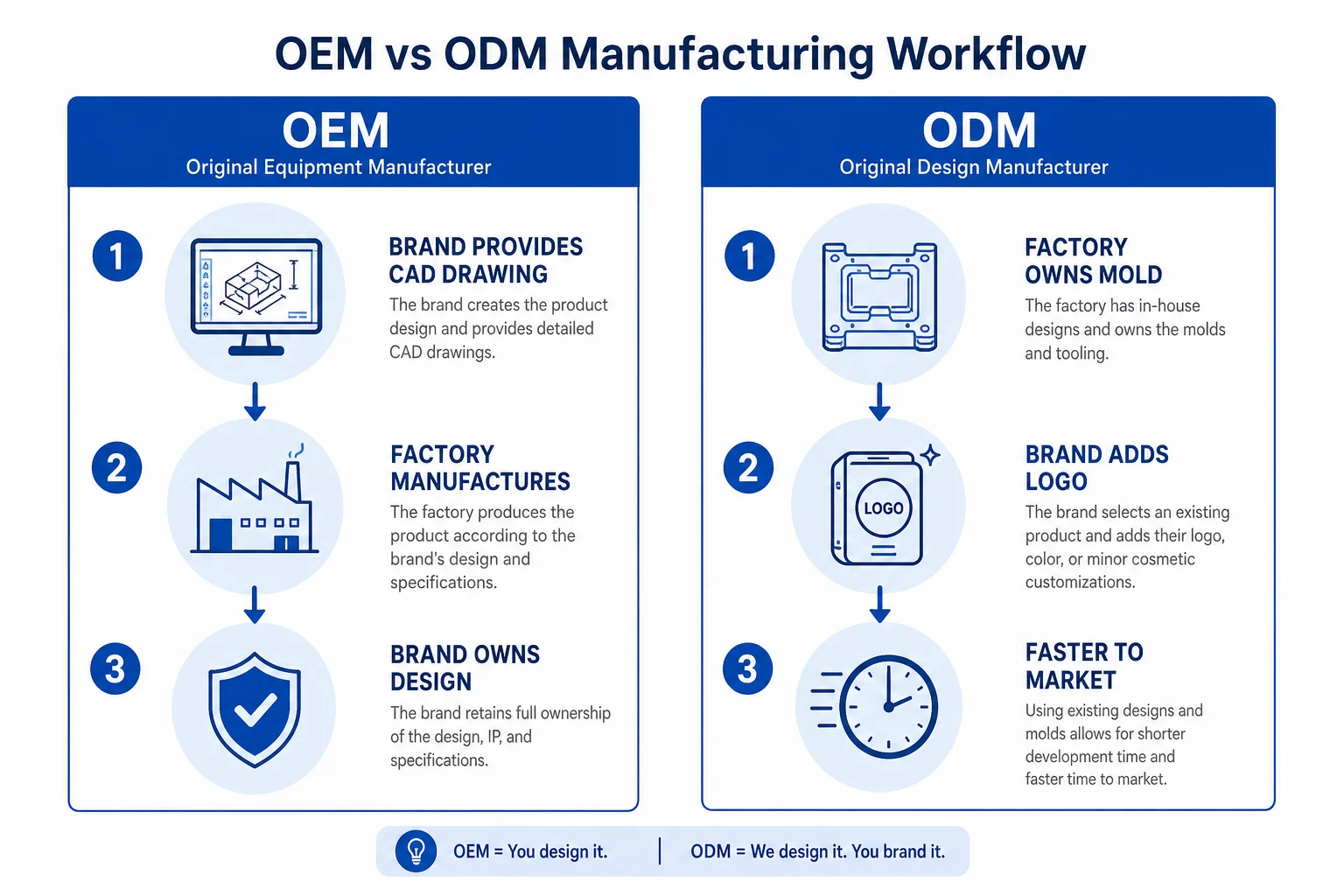
The short answer: OEM means you bring the design; ODM means the factory brings it.
Both terms get used interchangeably on Chinese supplier sites, which creates confusion when brands start comparing quotes. Here’s the practical breakdown for titanium cookware:
OEM (Original Equipment Manufacturer)
You supply the product specifications — dimensions, wall thickness, surface treatment, handle design, logo placement. The factory manufactures to your blueprint. You own the design, and the factory signs an NDA before you share CAD files. This route gives you the most differentiated product but requires more upfront work: 3D models, technical drawings, DFM review.
ODM (Original Design Manufacturer)
The factory owns existing molds and designs. You select from their catalog, apply your branding, and go to market faster. Lower tooling cost (often zero), shorter lead time, but you’re selling essentially the same product structure as other brands sourcing from the same factory.
For outdoor brands launching a titanium frying pan or camping pot set, a hybrid approach works well: start ODM with your logo on an in-stock mold, validate the market, then invest in a custom OEM mold for your hero SKU once sales justify it.
Key question to ask any supplier: “Do you own the mold for this product, or is it a shared mold?” Shared molds mean your competitors can source the same product with different packaging.
Why Grade 1 Pure Titanium Matters for Your OEM Product
The grade of titanium used in your cookware directly determines food safety, weight, and formability — not just marketing copy.
There are four commercially pure (CP) grades and multiple alloys. For cookware specifically, Grade 1 and Grade 2 are the relevant options:
| Property | Grade 1 (TA1) | Grade 2 (TA2) |
|---|---|---|
| Titanium purity | ≥99.5% | ≥99.2% |
| Density | 4.51 g/cm³ | 4.51 g/cm³ |
| Yield strength | 170 MPa min | 275 MPa min |
| Formability | Excellent (best for deep drawing) | Good |
| Food safety | Non-toxic, biocompatible | Non-toxic, biocompatible |
| Thermal conductivity | ~16–17 W/m·K | ~16–17 W/m·K |
| Typical use | Pots, mugs, sporks, thin-wall pans | Structural cookware, thicker items |
At Titanium Outdoor, Grade 1 TA1 is the standard for all cookware and drinkware OEM orders. The reason is practical: Grade 1’s lower yield strength means the sheet metal forms cleanly in deep-draw stamping dies without springback cracking — critical when producing thin-wall pots (0.6–1.0 mm) for backpacking use. Grade 2 is harder, which is useful for structural parts like wood stove bodies or tent stakes, not for a pan you’re deep-drawing at 1 mm wall thickness.
A supplier claiming “pure titanium” without specifying the grade is a red flag. Ask for the raw material certificate (mill cert) for every production batch. A legitimate titanium cookware OEM factory will provide this as standard practice.
One thing worth clarifying: titanium’s thermal conductivity of ~17 W/m·K is significantly lower than aluminum (~205 W/m·K) or copper (~401 W/m·K). This is a real tradeoff for home kitchen use. But for camping and backpacking cookware — where weight is paramount and you’re boiling water rather than searing at high heat — this is not a practical limitation. Brands targeting the outdoor/backpacking market should lean into this honestly in their product copy rather than obscuring it.
What to Expect from a Titanium Cookware OEM Factory (Process, Lead Times, MOQ)
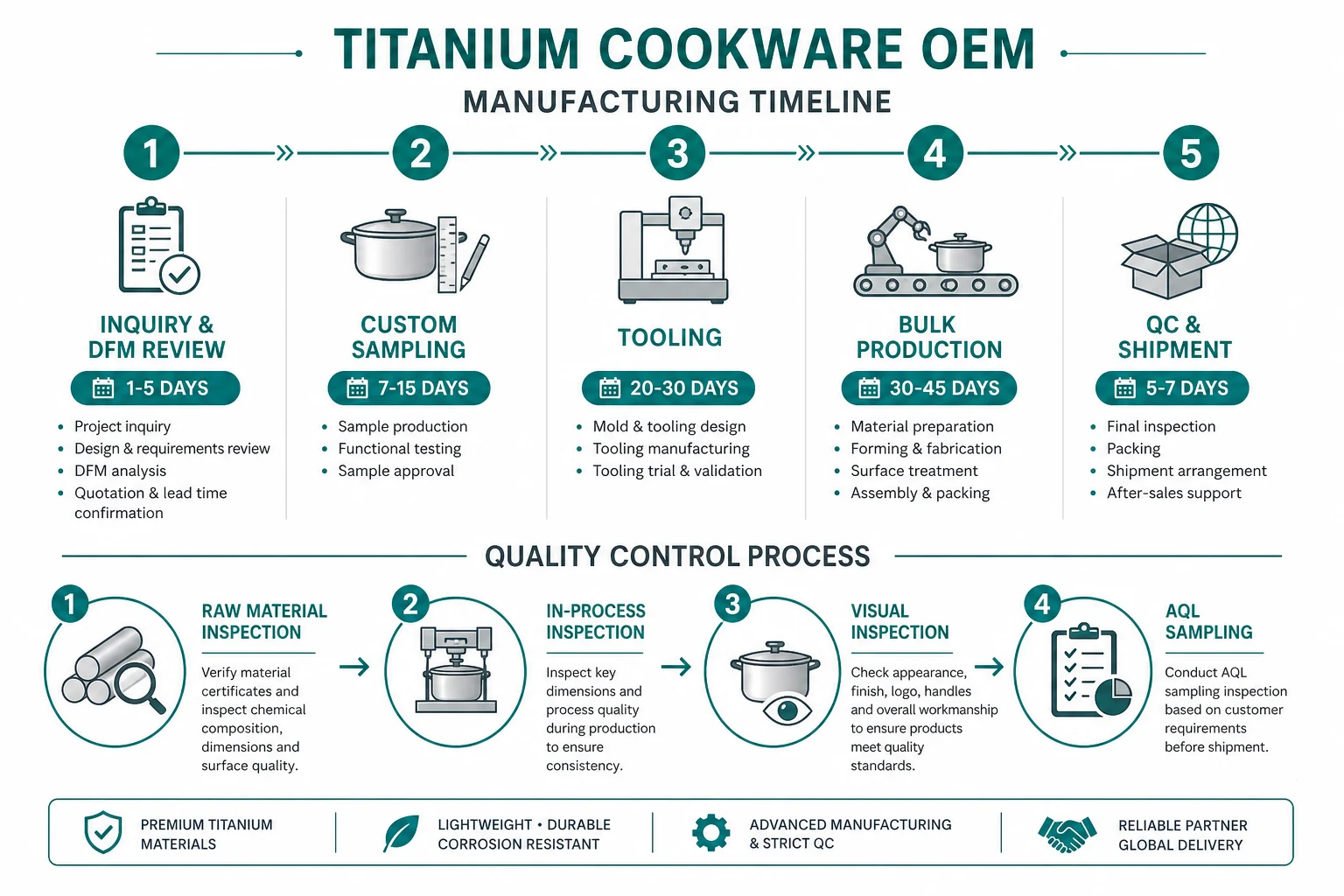
A realistic OEM engagement runs 60–90 days from first inquiry to delivery — plan your launch timeline accordingly.
The production sequence at a serious titanium cookware manufacturer looks like this:
Stage 1: Inquiry & Quotation (Days 1–5)
Submit product specifications or reference samples. Factory provides DFM (Design for Manufacturability) review within 24–48 hours if designs are submitted as STEP/IGES files. Quote valid for 30 days (titanium raw material pricing fluctuates with market spot rates).
Stage 2: Sampling (Days 6–20)
- In-stock ODM items: samples ship within 48 hours
- Custom OEM samples: 7–15 business days after design confirmation
- Sample fee typically refunded or credited against first bulk order
Stage 3: Tooling (Days 20–50)
For deep-drawn items (pots, mugs, pans), new mold tooling takes 20–30 days depending on geometry complexity — rolled edges, folded handles, and multi-piece weld assemblies each add time.
Stage 4: Bulk Production & QC (Days 50–80)
Bulk lead time is typically 30–45 days after sample approval. A credible factory runs a minimum 4-step QC process:
- Raw material inspection — titanium purity cert verified against ASTM B265 or equivalent
- In-process inspection — stamping and welding quality checked at production milestones
- 100% visual and functional inspection before packaging
- Final random sampling to AQL 2.5 standard before shipment
MOQ (Minimum Order Quantities):
- Standard OEM order: 500 pcs/item
- Trial/first-time client: 100–200 pcs (available at most serious OEM factories including Titanium Outdoor)
- ODM (existing mold): sometimes lower, varies by factory
Payment terms:
- Standard bulk: 30% T/T deposit → production starts → 70% balance before shipment
- Samples: PayPal or full T/T
Brands planning Amazon FBA launches should also ask whether the factory supports FBA labeling (UPC/FNSKU barcodes applied at factory). This eliminates a costly prep center step.
Certifications Your Titanium Pan Must Have for US & EU Markets
Certification gaps are the most common reason a first shipment gets held at customs or returned by retailers.
For titanium cookware specifically, the certification landscape is simpler than stainless steel or non-stick coatings — because Grade 1 pure titanium is inherently food-safe and biocompatible. But your end-market still requires documentation:
United States — FDA Compliance
Cookware sold in the US must comply with FDA 21 CFR 170–189 (food contact materials). For Grade 1 uncoated titanium, this is straightforward: titanium does not react with food at cooking temperatures and does not leach detectable metals. Factory should provide a test report confirming compliance. Ask for this before signing a purchase order, not after.
European Union — LFGB Certification
LFGB (Lebensmittel-, Bedarfsgegenstände- und Futtermittelgesetzbuch) is Germany’s Food and Feed Code, which effectively serves as the EU’s strictest standard for food contact materials. Articles 30 and 31 of the LFGB establish the legal basis for food contact material testing; the BfR Technical Guideline for Metals and Alloys defines the technical specification for metals including titanium. LFGB certification is required by most European distributors and retailers. Test reports are available from accredited labs in Shenzhen, Guangzhou, and Shanghai.
Additional certifications worth asking about:
- ISO 9001:2015 (factory quality management — table stakes for serious OEM partners)
- REACH compliance (EU chemical regulation — confirms no SVHC substances above threshold)
- Prop 65 (California) — if your target market includes California retail
At Titanium Outdoor, all Grade 1 titanium raw materials and finished cookware hold FDA and LFGB compliance certificates. Test reports are available upon request for wholesale and OEM partners. If a factory cannot produce test reports for their specific Grade 1 titanium stock, not just generic titanium claims, move on.
Customization Options — Beyond Just a Logo
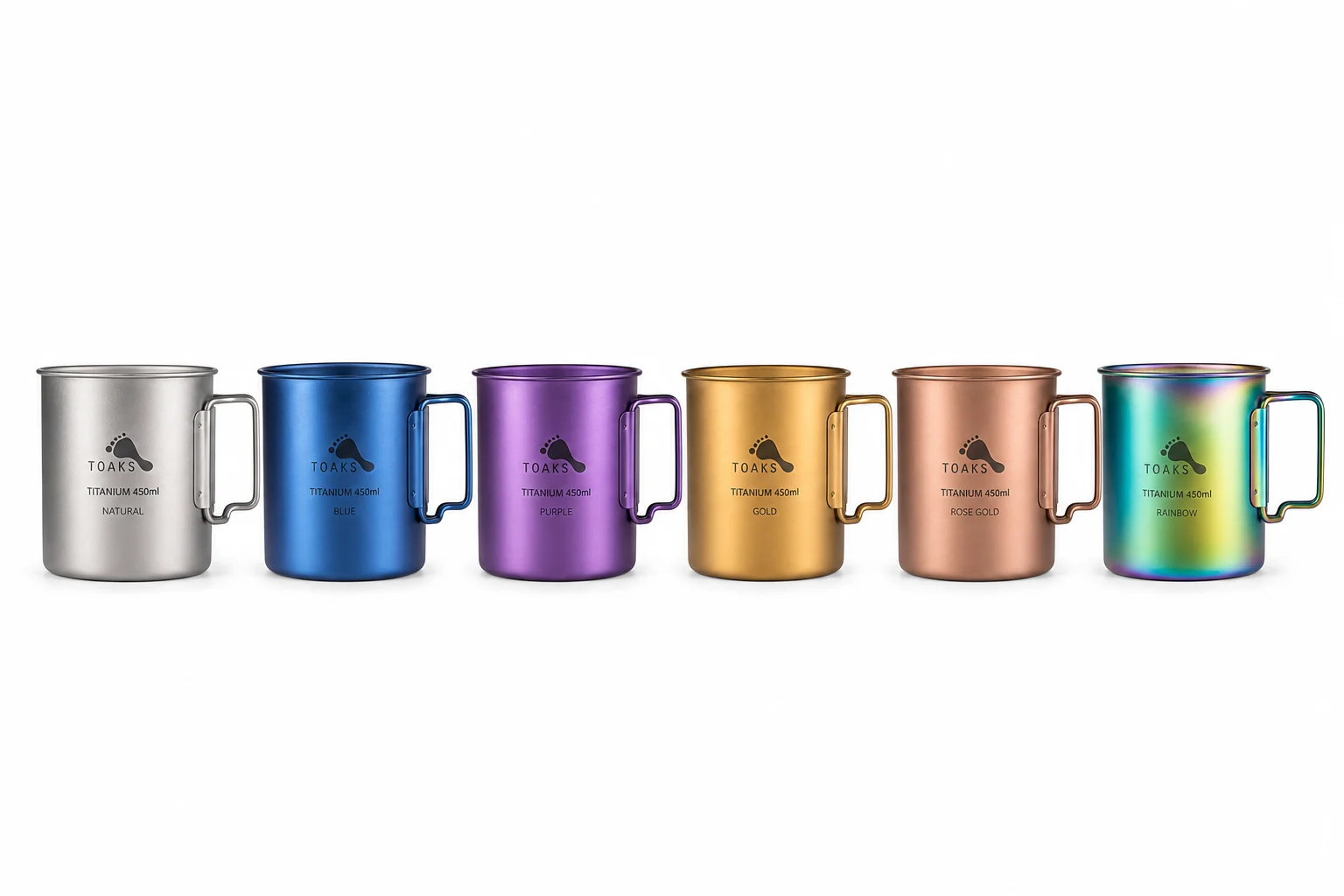
“OEM” in the titanium cookware space means far more than stamping your logo on an existing product.
After working with dozens of brand customization briefs, the most successful launches combine at least two or three of the following differentiation levers:
Surface Finishes:
- Matte sandblasting — the most common, light-scatter texture, fingerprint-resistant
- Mirror polish — premium look, higher cost, more visible scratches in field use
- Anodic oxidation (anodizing) — creates vibrant colors (blue, purple, gold, rose gold, rainbow) without paint or dye, completely food-safe and permanent. This is a serious differentiation tool for outdoor brands building a visual identity
- Ice-crackle crystallized finish — premium textured surface unique to a handful of titanium specialists, makes product photography distinctive
Structural / Functional Customization:
- Wall thickness (0.6 mm ultralight to 1.2 mm heavy-duty)
- Handle design (folding, removable, integrated, paracord wrap holes)
- Lid type (flat titanium, mesh, see-through options)
- Volume options (300 ml to 2.5 L for pots; various pan diameters)
- Engraving or laser etching (logo, coordinates, brand messaging)
Packaging:
- Custom mesh stuff sacks with printed logo
- Canvas or nylon pouches
- Retail box (corrugated, custom print)
- Amazon FBA ready — FNSKU labels, poly bags, suffocation warnings applied in factory
Multi-SKU Sets:
Many outdoor brands launch as a cookware system (pan + pot + cup + spork) sourced from one OEM factory. Consolidating to a single supplier reduces shipping complexity and ensures visual consistency across the set.
One note from experience: anodized color finishes add approximately 5–10% to unit cost compared to sandblast matte. The visual differentiation in product photography usually justifies this margin, especially for DTC brands where product images drive conversion.
How Titanium Outdoor Handles OEM Orders: A First-Hand Look
Titanium Outdoor is a 100% direct manufacturer — no trading company layer — with dedicated stamping, CNC machining, and welding facilities for titanium fabrication.
The distinction matters because it directly affects pricing transparency, IP security, and QC accountability. When a trading company places your order at three different factories to hit your MOQ, your quality consistency suffers in exactly the way that kills repeat purchases on Amazon.
Here’s how an OEM engagement typically runs at Titanium Outdoor:
Step 1: Initial contact. You share your product concept via email or WhatsApp. The engineering team responds within 24 hours (business days). No sales pitch — just a DFM review of what you’re proposing and an honest assessment of tooling requirements and cost.
Step 2: NDA execution. Before you share CAD files or detailed design drawings, the NDA is signed. This is standard protocol, not a special request. Your design stays yours.
Step 3: Prototype/sample. For custom designs, samples typically arrive in 7–15 days. These are production-equivalent — same tooling, same material cert, same finish as the bulk order. Not a hand-built proto that won’t match production.
Step 4: Bulk production with real-time updates. Production milestones are photographed and shared. You’re not waiting 45 days with no updates.
Step 5: Packaging and FBA prep. If you’re shipping to Amazon warehouses, FBA prep (FNSKU labeling, poly-bagging, box configuration) is handled in-factory before shipment — eliminating a US-side prep center step.
Step 6: Shipment. FOB Shanghai/Ningbo as standard. DDP door-to-door available for brands without freight forwarders.
Reach Titanium Outdoor at outdoortitanium.com for a no-commitment RFQ.
How to Evaluate a Titanium Cookware OEM Manufacturer (Before You Send a CAD File)
The evaluation questions that actually separate serious manufacturers from resellers posing as factories.
Most supplier pages look similar. Here’s the checklist that exposes the difference:
Factory verification:
- Direct manufacturer or trading company? Ask for factory registration documents (营业执照) or request a live video factory tour
- Do they have in-house titanium stamping equipment? Titanium requires specialized tooling — if they also do aluminum, stainless, and silicone on the same production floor, ask how the titanium line is isolated
- Can they provide raw material mill certificates for each production batch? Non-negotiable
Technical capability:
- What titanium grade is standard for cookware? Correct answer: Grade 1 TA1 (not just “pure titanium”)
- Can they deep-draw at 0.6–1.0 mm wall thickness? This requires specific press tonnage and die design expertise
- Do they have in-house anodizing capability or outsource it? Outsourcing introduces quality variability
IP and legal:
- Will they sign an NDA before seeing your designs? Yes is non-negotiable
- Do they register their own products on Alibaba under your designs after you share them? Ask for references from existing OEM clients
Quality:
- What QC standards do they reference? AQL 2.5 for outgoing inspection is industry baseline
- Can you arrange a pre-shipment inspection by a third-party inspector (SGS, Bureau Veritas, Intertek)?
- What’s their process for handling defective units?
Red flags:
- “We can do any MOQ” with no context — serious factories have real minimums driven by production economics
- No mention of titanium grade in any product description
- Quotes valid for 90+ days — titanium raw material prices move, and this likely means they’re using a cost buffer that inflates your price
Cost Breakdown: What Does Titanium Cookware OEM Actually Cost?
Titanium is one of the most expensive metals used in consumer goods — understanding the cost structure prevents sticker shock and bad negotiations.
Titanium raw material (Grade 1 sheet, 0.8 mm) currently trades at approximately $15–25 USD/kg depending on market conditions. That’s 5–10× the cost of aluminum sheet. This is the single largest driver of finished unit cost.
Indicative cost components for a custom OEM titanium frying pan (22 cm, 0.8 mm wall, sandblast matte):
| Component | Approximate Cost Share |
|---|---|
| Raw titanium material | 40–50% |
| Stamping and forming labor | 15–20% |
| Welding and assembly | 10–15% |
| Surface treatment (sandblast) | 5–8% |
| QC and testing | 3–5% |
| Packaging (basic poly bag + label) | 5–8% |
| Factory overhead and margin | 10–15% |
Typical OEM unit price ranges (FOB China, 500-pc MOQ):
- Titanium mug (450 ml, Grade 1, sandblast): $8–15/pc
- Titanium pot (900 ml, Grade 1, folding handles): $18–30/pc
- Titanium frying pan (22 cm, Grade 1, sandblast): $20–35/pc
- Titanium cookware set (pot + pan + lid, 3-piece): $45–75/set
Note: These are indicative ranges based on current market data. Actual quotes depend on order volume, customization depth, finish type, and titanium spot price at time of order.
Tooling cost:
New molds for deep-drawn titanium items typically run $500–2,000 USD depending on part complexity. Simpler forms (cylindrical mugs) sit at the low end; complex pans with integrated handles sit higher. This is a one-time cost, and molds typically produce 50,000–100,000+ parts before replacement.
Where brands overpay:
The biggest margin leak is premium pricing on “titanium-coated” pans that use titanium as a surface treatment on aluminum or stainless steel substrates. These are not titanium cookware — they’re nonstick pans with a titanium oxide particle coating, similar in concept to ceramic coatings. If your supplier can’t tell you the substrate material, the “titanium cookware” label is marketing, not material reality.
Frequently Asked Questions
What is the minimum order quantity for titanium cookware OEM from China?
Most serious titanium cookware OEM manufacturers set standard MOQ at 500 pcs per item. For first-time clients or market validation orders, reputable factories like Titanium Outdoor can support trial runs of 100–200 pcs. MOQ for ODM (existing mold) products is sometimes lower. Always ask directly — the number on the website is often a starting point for negotiation, not a hard floor.
What grade of titanium should my OEM cookware use?
Grade 1 Pure Titanium (TA1) is the correct specification for cookware, pots, mugs, and sporks. It is unalloyed, non-toxic, highly biocompatible, and offers the best formability for deep-draw stamping at thin wall thicknesses. Grade 2 is slightly stronger and used for structural items. Grade 5 (Ti-6Al-4V alloy) is not suitable for food contact applications.
Is titanium cookware from China food-safe?
Grade 1 pure titanium is inherently food-safe — it doesn’t react with food at cooking temperatures and doesn’t leach heavy metals. What matters is documented compliance. Your products need FDA test reports (for US market) and LFGB § 30/31 BfR compliance (for EU). Ask any OEM factory to provide current test reports for their specific Grade 1 raw material, not just general compliance claims.
What’s the difference between OEM and ODM for titanium cookware?
OEM: you own the design, supply the CAD files, factory manufacturers to spec. Best for unique products. Requires tooling investment and longer lead time. ODM: factory owns the mold and design, you apply your branding. Faster and cheaper to start, but you share the product design with other brands sourcing from the same factory.
How long does titanium cookware OEM production take?
Plan for 60–90 days from first contact to delivery: inquiry + DFM review (1–5 days), custom sampling (7–15 days), tooling (20–30 days), bulk production (30–45 days), QC and shipment prep (5–7 days). In-stock ODM items can ship samples within 48 hours and bulk within 3–4 weeks.
Can I get custom colors on titanium cookware?
Yes. Anodic oxidation (anodizing) produces permanent, food-safe colors — blue, purple, gold, rose gold, and rainbow — without paint or toxic dyes. Sandblast matte and mirror polish are finish options. Some titanium specialists offer premium crystallized “ice-crackle” finishes. Color anodizing typically adds 5–10% to unit cost.
How do I protect my design when working with a Chinese OEM factory?
Request an NDA before sharing any CAD files, technical drawings, or proprietary design elements. A professional titanium cookware OEM manufacturer will sign this without hesitation. Additionally, consider registering your product design with the China National Intellectual Property Administration (CNIPA) for added protection on any design you plan to sell in China.
Summary
Sourcing OEM titanium cookware from China is a viable path to launching a differentiated outdoor or kitchenware brand — but only with the right factory partner. The variables that matter most: Grade 1 TA1 titanium (not a coating), FDA/LFGB certification documentation, a transparent QC process with AQL sampling, and NDA protection for your designs.
Titanium Outdoor specializes in pure titanium OEM and ODM manufacturing for outdoor, camping, and kitchenware brands worldwide. With Grade 1 TA1 as the standard material, 500-pc standard MOQ (100–200 pcs for trial orders), full certification support, and anodizing capability for brand-specific color ranges, the factory is built for brands that want a real manufacturing partner rather than a commodity supplier. Visit outdoortitanium.com to request a quote or sample.