
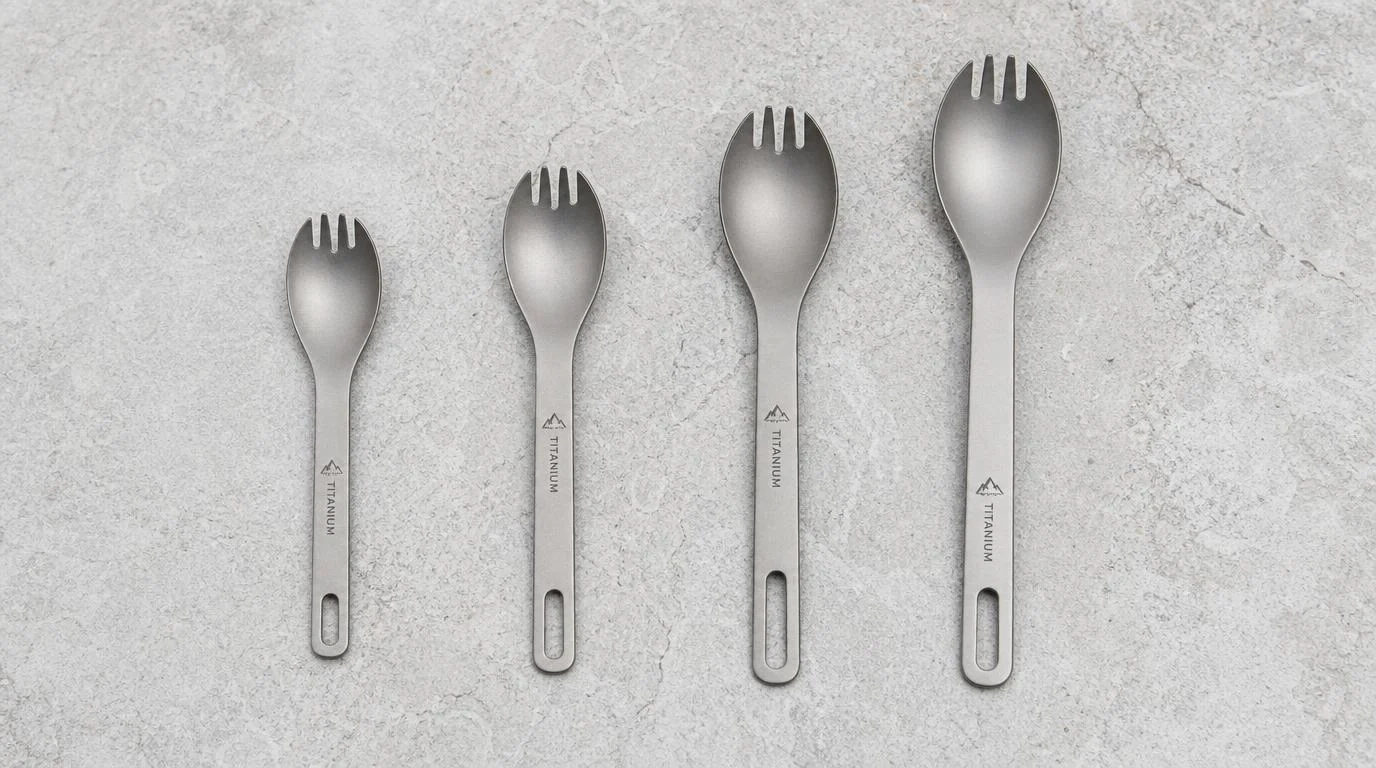
A titanium spork weighs 11–22 g depending on model, outlasts any plastic utensil, and is fully food-safe at Grade 2 CP titanium — the same grade used in surgical implants. The Snow Peak Titanium Spork ($8.95, 16 g) is the consensus best-overall pick for its balance of weight, durability, and finish. For strict ultralight packing, the TOAKS Ultralight Spork (12.5 g) is the lightest titanium option available. For freeze-dried pouch meals, the Snow Peak Long Titanium Spork (22.6 g, 8.3 in) is the better handle-depth choice. All three are made from pure titanium with no coatings, no BPA, and a realistic lifetime of decades with normal use.
The Short Answer: Which One Should You Buy?
If you want the best all-around titanium spork and don’t want to overthink it: buy the Snow Peak Titanium Spork for $8.95. It weighs 16 g, fits most pots and bowls, and has been the benchmark in the backpacking community for good reason. Snow Peak makes it in Tsubame-Sanjo, Niigata — a region of Japan with a centuries-old metalworking tradition — and the finish shows it.
The only scenario where you should choose differently is if you regularly eat out of deep freeze-dried meal pouches (go with the Snow Peak Long at $10.95) or if you’re trimming every possible gram and a 3–4 g difference matters to you (go with the TOAKS Ultralight at 12.5 g).
Everything else in between is noise.
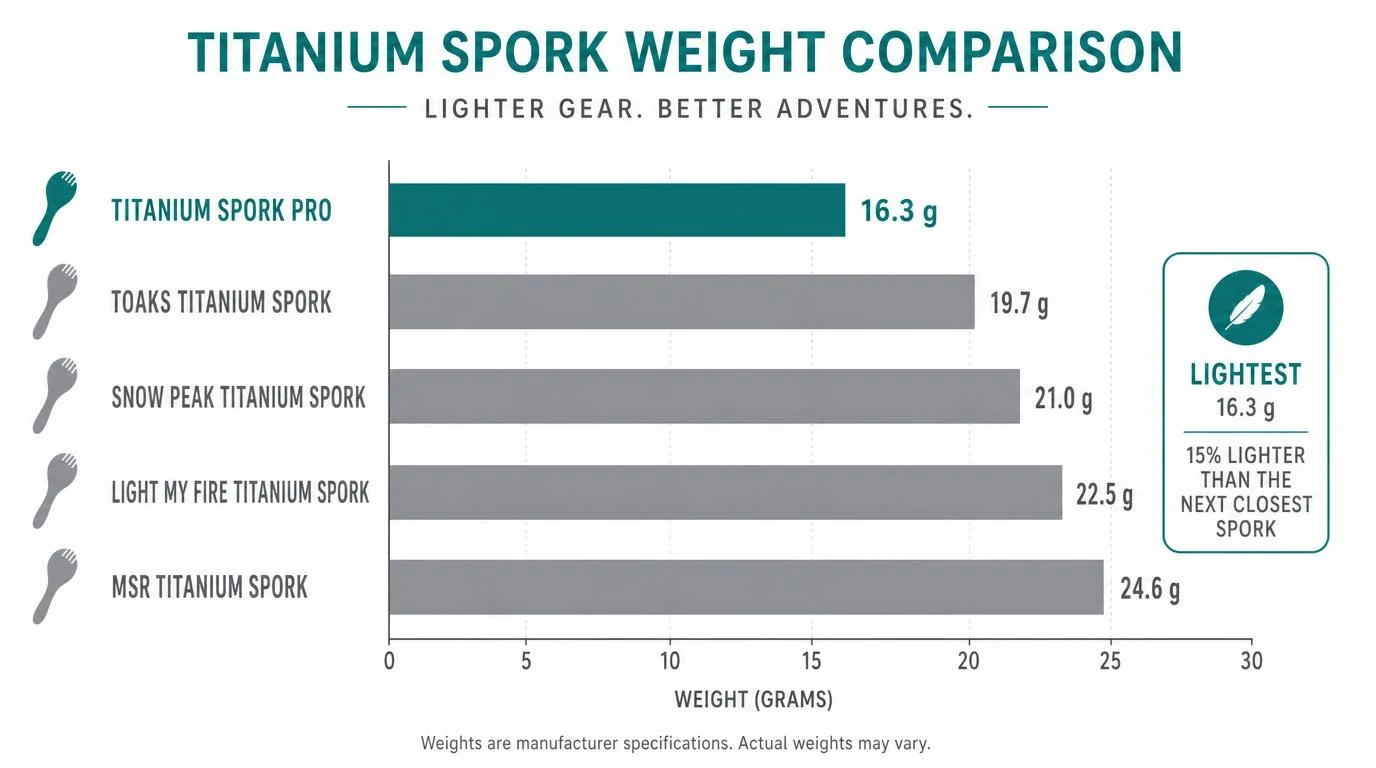
Titanium Spork Weight Comparison Table
| Model | Weight | Handle Length | Price | Fork Prongs |
|---|---|---|---|---|
| Snow Peak Titanium Spork (SCT-004) | 16 g / 0.56 oz | 6.5 in | $8.95 | Short, rounded |
| Snow Peak Long Titanium Spork (SCT-014) | 22.6 g / 0.8 oz | 8.3 in | $10.95 | Short, rounded |
| TOAKS Titanium Spork (SLV-01) | 18 g / 0.6 oz | 6.4 in | $8.95 | Moderate |
| TOAKS Ultralight Titanium Spork (SLV-04) | 12.5 g / 0.44 oz | 6.4 in | $8.95 | Moderate |
| TOAKS Long Handle Spork (SLV-14) | 19 g / 0.65 oz | 8.6 in | ~$12 | Moderate |
| Vargo Titanium ULV Spork | 11 g / 0.38 oz | 6.5 in | $11.95 | Thin |
| Vargo Titanium Spork (standard) | 14 g / 0.5 oz | 6.5 in | ~$10 | Moderate |
| Light My Fire Swedish Spork Ti | 19 g / 0.67 oz | 6.7 in | ~$15 | Knife edge too |
Weights sourced from manufacturer spec pages and independent verified reviews (bikepacking.com, cleverhiker.com).
Why Titanium? The Material Case in Plain Terms
Titanium is lighter than stainless steel by about 43% for the same volume, due to its lower density of 4.51 g/cm³ versus stainless steel’s 7.8–8.0 g/cm³. For a spork, this difference translates to roughly 10–15 g in real-world product weight versus a stainless equivalent of similar dimensions.
Beyond weight, three properties make titanium particularly suitable for eating utensils:
Food safety. Commercially pure (CP) Grade 2 titanium — the grade used in virtually all camping utensils — meets FDA and EU food contact material standards. It leaches less than 0.01 ppm into acidic foods under normal use conditions, according to data from outdoortitanium.com. It contains no nickel, no chromium coatings, and no PFAS. For comparison, some stainless steel alloys contain up to 12% nickel, which can concern people with metal sensitivities.
Corrosion resistance. Titanium forms a stable titanium dioxide (TiO₂) oxide layer on its surface that is chemically inert in nearly all environments. Salt water, acidic foods, coffee — none of it reacts with the metal. A titanium spork stored wet in a pack pocket will not rust, pit, or stain.
Mechanical behavior. Titanium bends under stress rather than cracking. A stainless spork dropped on rocks will dent; a titanium spork will flex slightly and return. This matters less for utensils than for cookware, but it’s part of why these things genuinely last a lifetime.
One honest limitation: titanium conducts heat poorly relative to its strength. For a spork this is usually irrelevant (you’re not cooking with it), but if you use a spork to stir hot food straight from a titanium pot, the handle can get warm faster than you’d expect from a metal utensil. It’s not a safety issue — just something to know.
The Snow Peak Titanium Spork: Still the Benchmark
The Snow Peak Titanium Spork remains the most widely recommended titanium spork in 2026. It earns that position not because it’s the lightest or the cheapest, but because it gets the balance of dimensions, finish, and price right in a way that no other manufacturer has clearly beaten at this price point.
Measured weight from bikepacking.com’s independent test: 15.3 g (Snow Peak’s spec is 16 g — both figures float around in reviews; the difference is measurement methodology). At $8.95 and made in Japan’s Tsubame-Sanjo metalworking district, this is one of the better value-to-quality ratios in outdoor gear.
What the Snow Peak spork does well:
- The spoon bowl is generously sized (2 × 1.5 in) and holds solid food well
- Brushed anodized titanium finish is smooth enough that it doesn’t scratch your palate
- Multiple color options (purple, orange, blue, natural) — useful for finding it in a dark pack
- Built-in hanging hole on handle for clipping to a carabiner
- Dishwasher safe
Where it genuinely falls short:
- The fork prongs are short and rounded. They’ll split soft food rather than pierce it cleanly. For actual forking of vegetables or pasta, they’re weak. This is not a Snow Peak-specific problem — it’s a spork physics problem — but it’s worth being honest about.
- At 6.5 in, the standard version struggles to reach the bottom of tall freeze-dried meal pouches without a knuckle-dipping problem. CleverHiker’s field test on the Wonderland Trail specifically flags this: the short handle works best with pots under 1 liter.
- The brushed finish scratches easily over time. It won’t affect function, but it will look worn.
The Long version (SCT-014, $10.95, 22.6 g, 8.3 in) solves the pouch problem completely. You give up 6.6 g and gain clean access to the bottom of a Mountain House pouch without getting sauce on your hand. For hikers who rely heavily on freeze-dried meals, it’s the better default choice.
Snow Peak is made in Japan. Not a marketing claim: the official product page specifies Tsubame-Sanjo, Niigata as the manufacturing location. For a $9 utensil, that provenance matters — it’s the same region that makes high-end Japanese kitchen knives and metalwork.
The TOAKS Titanium Sporks: Best Value and Best Ultralight
TOAKS makes a confusingly large lineup of titanium sporks. The two worth knowing:
TOAKS Titanium Spork (SLV-01) — 18 g, $8.95. Essentially Snow Peak’s competitor at the same price. Slightly heavier, uncoated matte finish (no anodizing), and the bowl is polished on some variants which makes it easier to clean thoroughly. The color options are limited (natural titanium only), but the build quality is solid. A reasonable alternative if Snow Peak is out of stock.
TOAKS Ultralight Titanium Spork (SLV-04) — 12.5 g, $8.95. This is the model that ultralight obsessives on r/Ultralight actually recommend when gram counts matter. At 12.5 g it’s the lightest full-function titanium spork at this price point, 3.5 g lighter than the standard Snow Peak. It achieves this by thinning the handle and reducing the spoon bowl slightly. The trade-off is that it feels more fragile in hand — not fragile in practice, but the thinner handle requires a more deliberate grip for long stirring sessions. For pure eating (scoop and transport food to mouth), it’s fine for most people.
The TOAKS Long Handle Spork (SLV-14, 19 g, 8.6 in) is the best long-handle option if you want polished bowl material rather than Snow Peak’s brushed finish. At $12–13 it costs slightly more than Snow Peak Long, but the polished bowl is noticeably easier to clean and doesn’t discolor over time.
Vargo Titanium ULV: The Gram-Counter’s Spork
The Vargo Titanium ULV Spork weighs 11 g ($11.95) — the lightest titanium spork currently available from a mainstream brand. At 6.5 in it’s the same length as the standard Snow Peak.
The weight saving versus Snow Peak is achieved through a notably thinner profile. The spoon bowl is smaller, and the handle is more wand-like. From my research across bikehikesafari.com’s 2026 roundup and Reddit’s r/ultralight threads, it’s consistently recommended as the best ultralight option — specifically for backpackers whose base weight is already sub-10 lbs and who are genuinely counting grams at the utensil level.
At $11.95 it’s priced $3 more than Snow Peak for 5 g less weight. Whether that trade-off makes sense is a personal decision. For most people it doesn’t. For SUL (sub-ultralight) hikers, it’s the obvious pick.
Short Handle vs. Long Handle: A Simple Decision Framework
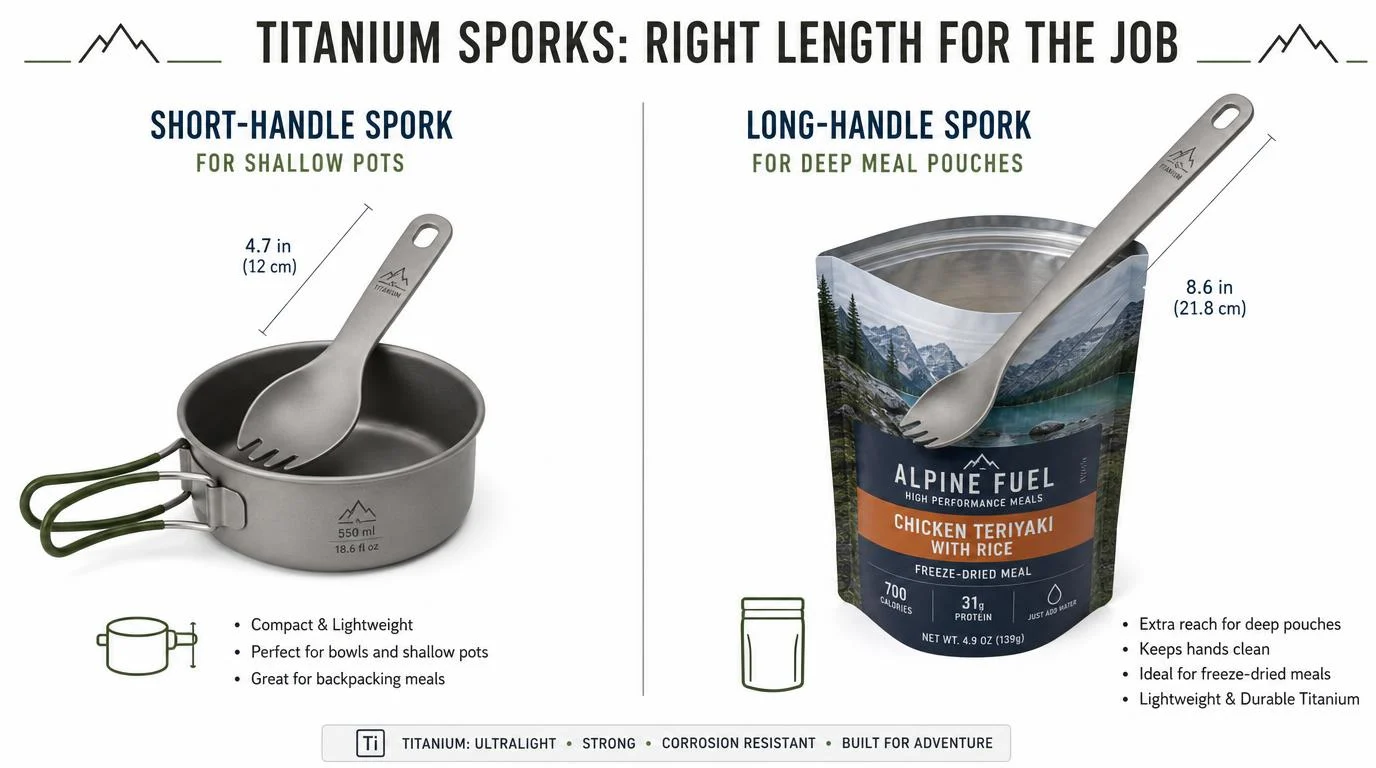
This is the question most buying guides either ignore or answer vaguely. Here’s a direct answer:
Choose the standard (short) handle if:
- You eat from a pot, bowl, or plate of 1 liter or less
- You mostly cook at home or car camp (not pouch meals)
- You want minimum weight
Choose the long handle if:
- You regularly eat freeze-dried or dehydrated meals directly from the pouch
- Your cooking pot is taller than 4 inches (most 1.5–2 L pots)
- You don’t mind the extra 5–7 g
The Reddit consensus on this is clearer than most gear sites admit: “long handle for pouch meals, short handle for everything else.” A user on r/BuyItForLife summarized it well: “I love my long handle one for those camping meals in a bag.” Another on r/onebag: “The long handle makes it easier to get to the bottom of whatever you’re eating out of without getting a soupy fist.”
The weight difference between Snow Peak standard (16 g) and Snow Peak Long (22.6 g) is 6.6 g. That’s the weight of a small coin. If you do pouch meals regularly, the long handle is worth it.
Real-World Use: What the Fork Prongs Are Actually For
Every titanium spork review mentions the fork prong issue. Most brush past it. Here’s the honest version:
Spork fork prongs are functional for light duty and essentially useless for real forking. They’re fine for stabbing a soft pasta piece, picking up a bite of cooked vegetable, or impaling a piece of bread. They cannot reliably pierce a raw vegetable, a firm piece of cooked chicken, or anything with resistance. The rounded, wide-set prongs of the Snow Peak in particular split food rather than skewer it.
This is not a defect — it’s physics. A spork fork tine has half the cross-section of a proper fork tine, which means half the penetrating force for the same hand pressure.
What this means practically:
- For backpacking meals (ramen, freeze-dried, instant rice): the fork function is perfectly adequate
- For car camping with real food (steak, salad, pasta): bring a real fork
- For thru-hiking: you almost certainly only need a spoon; the fork end is a nice-to-have
One comment from the Reddit r/CampingGear thread (Dec 2024) put it best: “The spork is so dull (and the prongs so short) that it’s almost useless as a fork.” That’s an outlier take — most users find the prongs acceptable for trail food — but it’s a useful gut-check. If you genuinely need fork functionality on the trail, buy a separate titanium fork or a fork-spoon set.
FAQ
Which titanium spork is the best?
The Snow Peak Titanium Spork (SCT-004) is the best overall choice at $8.95 and 16 g. For ultralight backpackers who want to save every gram, the TOAKS Ultralight Spork at 12.5 g is the lightest option at the same price. For freeze-dried pouch meals, the Snow Peak Long (22.6 g, 8.3 in) is the better fit.
How much does a titanium spork weigh?
Titanium sporks weigh between 11 g and 22.6 g depending on model. The Snow Peak standard weighs 16 g (0.56 oz). The lightest widely available titanium spork is the Vargo ULV at 11 g (0.38 oz). The TOAKS Ultralight is 12.5 g (0.44 oz).
Is titanium cutlery worth it?
Yes, for backpacking. Titanium sporks cost $9–15 versus $3–5 for quality plastic, but they last indefinitely, handle heat without warping, and are food-safe without coatings or BPA concerns. For casual picnics or car camping where weight doesn’t matter, plastic or stainless steel are fine alternatives.
Is the Snow Peak titanium spork food safe?
Yes. Snow Peak uses CP Grade 2 titanium (uncoated), which meets FDA and EU food contact material standards. It contains no nickel, no PFAS, and no BPA. Grade 2 CP titanium is the same material used in medical implants and surgical instruments.
Where is the Snow Peak titanium spork made?
Snow Peak manufactures its titanium products in Tsubame-Sanjo, Niigata Prefecture, Japan — a region historically known for high-quality metalworking, particularly cutlery and kitchen tools.
Titanium spork vs. stainless steel spork — which is better?
Titanium is roughly 43% lighter than stainless steel for comparable dimensions. A stainless steel spork of similar size typically weighs 28–35 g versus 16–19 g for titanium. Titanium is also more corrosion-resistant. Stainless steel costs less and is slightly more scratch-resistant. For backpacking, titanium wins on the weight math; for home use, stainless steel is fine.
The Bottom Line
A titanium spork is one of the few pieces of camping gear where the upgrade from plastic genuinely pays off over time. The Snow Peak Titanium Spork at $8.95 is the right choice for most people. It’s 16 g, made in Japan, food-safe, and built to outlast anything in your kit.
If you do a lot of freeze-dried pouch meals, spend the extra $2 and get the Long version (22.6 g, 8.3 in). If you’re deep in the ultralight obsession and every gram of base weight matters, the TOAKS Ultralight at 12.5 g or the Vargo ULV at 11 g will save you a few grams at the same or slightly higher price.
Don’t expect the fork prongs to work like a real fork. Accept that going in and the spork will serve you well for years.