
Most titanium cookware advice stops at “use low heat” — which is like telling someone to “drive carefully” without explaining how the steering works. After testing titanium cookware across backpacking trips, home kitchen sessions, and everything in between, I’ve built a system of techniques that transform titanium from “that finicky pan” into one of the most reliable tools in your kitchen.
Quick Summary: Titanium has a thermal conductivity of roughly 16 W/mK — about one-fifteenth of aluminum’s 237 W/mK (MatWeb). That means it heats fast at the contact point but spreads heat slowly across the surface. The entire game is managing that difference. Master preheating, oil selection, and heat control, and titanium becomes remarkably easy to cook with.
This guide covers 15 specific techniques I’ve refined over real cooking sessions — from preventing eggs from sticking to getting a proper sear on steak. Every tip comes with a reason backed by material science or real user data, not just “trust me.”
Why Titanium Cooks Differently — The Science Behind the Material
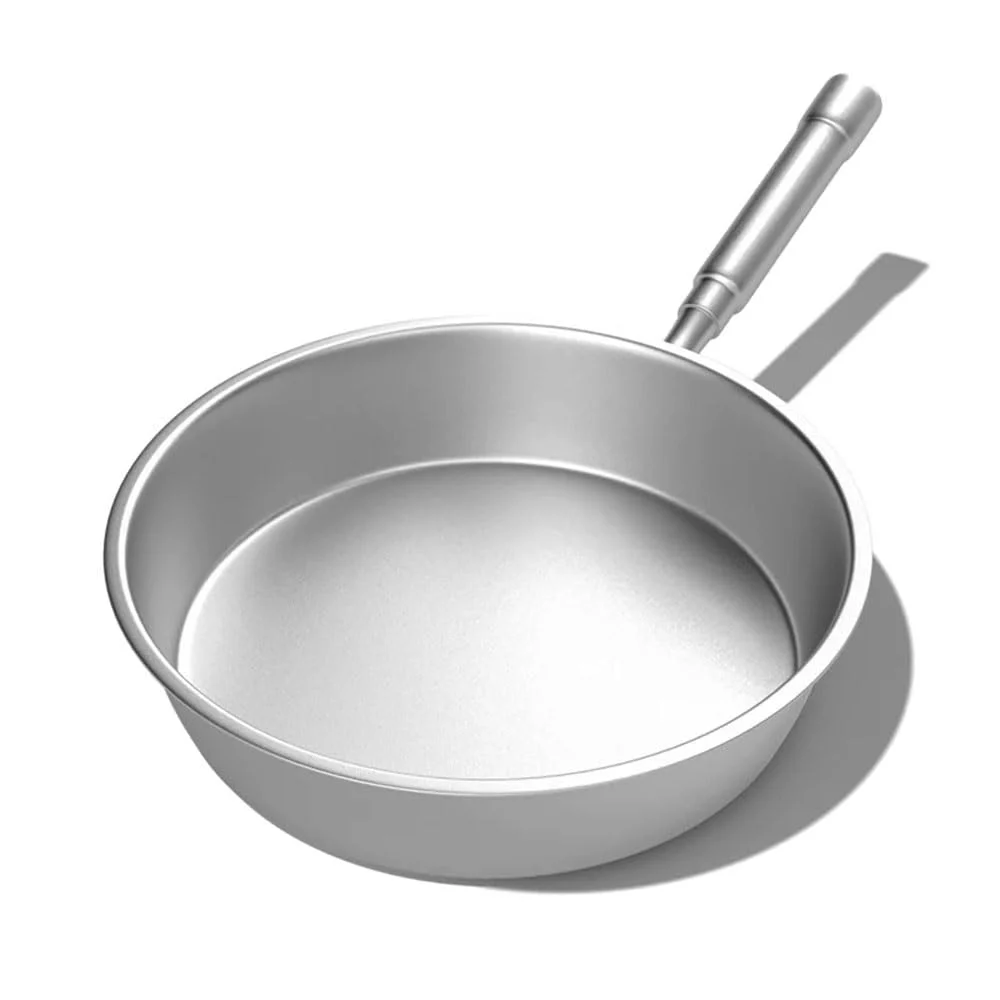
Titanium behaves unlike any other cookware material in your kitchen, and understanding why saves you from the frustration most new owners experience.
Thermal conductivity is the key metric. Titanium conducts heat at approximately 16 W/mK (watts per meter-kelvin), according to MatWeb’s material database. Compare that to aluminum at 237 W/mK, copper at 385 W/mK, or stainless steel at 16-24 W/mK. Titanium’s conductivity is nearly identical to stainless steel — which is why titanium cooks similarly to stainless steel in many scenarios, despite what marketing materials suggest.
What this means in practice: When you place a titanium pan on a burner, the metal directly above the flame heats almost immediately, but that heat doesn’t spread outward efficiently. You get a concentrated hot zone (the “hot spot”) rather than an evenly heated surface. As SOTO Outdoors explains: “Titanium doesn’t naturally disperse heat evenly. That means localized areas can heat up quickly, creating hot spots that lead to uneven cooking.”
The upside nobody talks about: Titanium cools down almost as fast as it heats up. Once you remove the pan from heat, temperature drops rapidly, giving you precise control over when cooking stops. This responsiveness is something heavy cast iron pans simply cannot match.
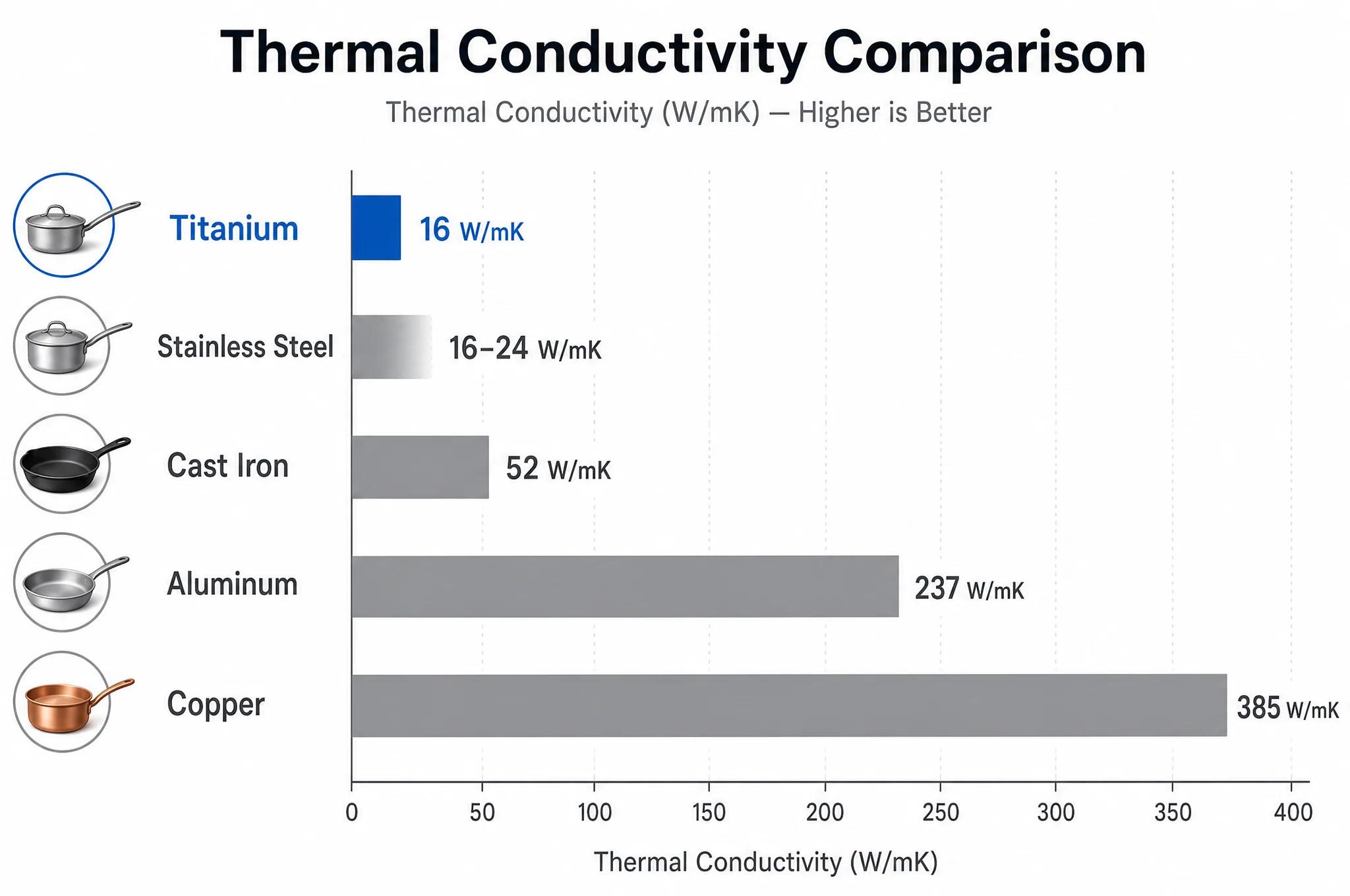
Thermal Conductivity Comparison Table
| Material | Thermal Conductivity (W/mK) | Relative to Titanium | Best Use Case |
|---|---|---|---|
| Titanium (Grade 1) | 16 | 1x (baseline) | Boiling, water-based cooking, outdoor |
| Stainless Steel (304) | 16-24 | ~1-1.5x | All-purpose, acidic foods, searing |
| Aluminum (pure) | 237 | ~14x | Fast, even heating |
| Copper | 385 | ~23x | Precision temperature control |
| Cast Iron | 52 | ~3x | High-heat searing, heat retention |
Source: MatWeb Grade 1 data (16 W/mK); Engineering Toolbox (cast iron: 52 W/mK); HyperPhysics (copper: 385 W/mK); Valtcan titanium guide (2026); SOTO Outdoors titanium guide
A note on “titanium conducts heat badly”: This phrase is misleading. Titanium conducts heat fine — it’s just slow at lateral distribution across the pan surface. The vertical heat transfer (from flame through the pan wall to food) is rapid because titanium pans are thin. The distinction matters for how you cook.
The Three Types of Titanium Cookware (And Why It Matters)
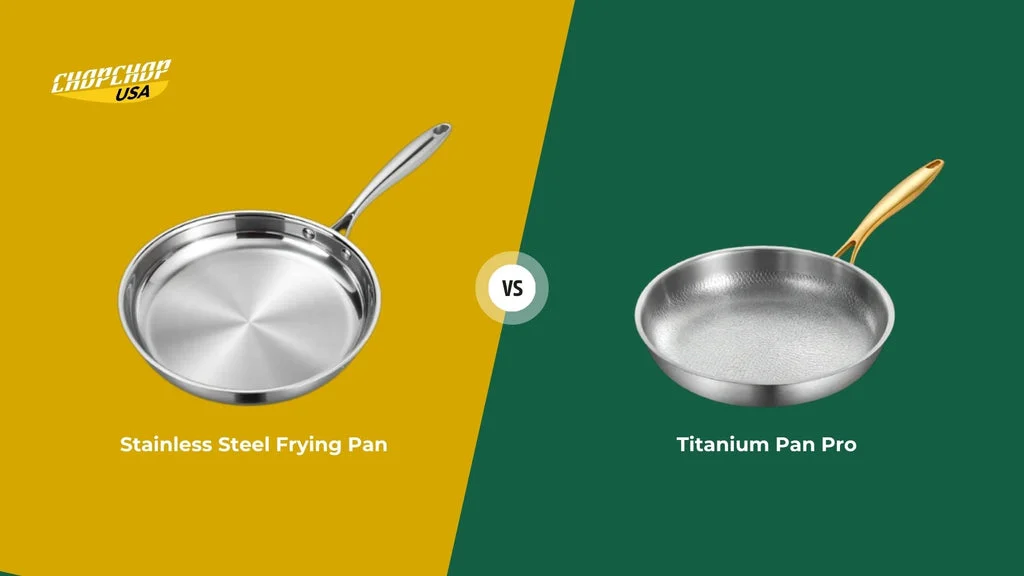
Not all “titanium cookware” is the same, and this confusion causes more cooking failures than any other factor. Before applying any technique, you need to know which type you actually own.
Type 1: Pure Titanium (Grade 1 / Grade 2)
Grade 1 commercially pure titanium (99.5%+ purity) is what premium brands like Taima and Snow Peak use. Grade 2 is slightly stronger but less ductile — still pure titanium. These pans are non-reactive, extremely lightweight, and develop a distinctive blue-gold patina over time. Food does not stick permanently, but release requires proper technique. No coatings. No chemical layers.
Type 2: Titanium-Clad (Multi-Ply with Aluminum Core)
These pans use titanium as the cooking surface but sandwich an aluminum or copper core inside for better heat distribution. Our Place’s Titanium Pro line uses a tri-ply construction: stainless steel exterior, aluminum core, titanium cooking surface. Hestan’s NanoBond claims 35% greater heat conduction than standard aluminum-clad cookware through their ProCore aluminum center. This hybrid approach solves titanium’s hot-spot problem significantly.
Type 3: Titanium-Coated (Nonstick with Titanium Particles)
This is where the marketing confusion lives. Many pans marketed as “titanium cookware” are actually aluminum pans with a nonstick coating infused with titanium dioxide particles. They’re not titanium pans — they’re coated pans with a titanium marketing label. A 2026 YouTube investigation by Prudent Reviews alleged that some “titanium” branded pans (including certain products from Our Place) may contain a surface treatment that wears over time, raising questions about “coating-free” claims.
How to tell which type you have: Check the manufacturer specs for “Grade 1” or “Grade 2” pure titanium, or “tri-ply” / “clad” construction. If the listing just says “titanium” without a grade, it’s likely coated aluminum. Weight is another indicator: pure titanium is dramatically lighter than steel or cast iron of the same size.
The Preheat Protocol — Your Most Important Titanium Cooking Habit
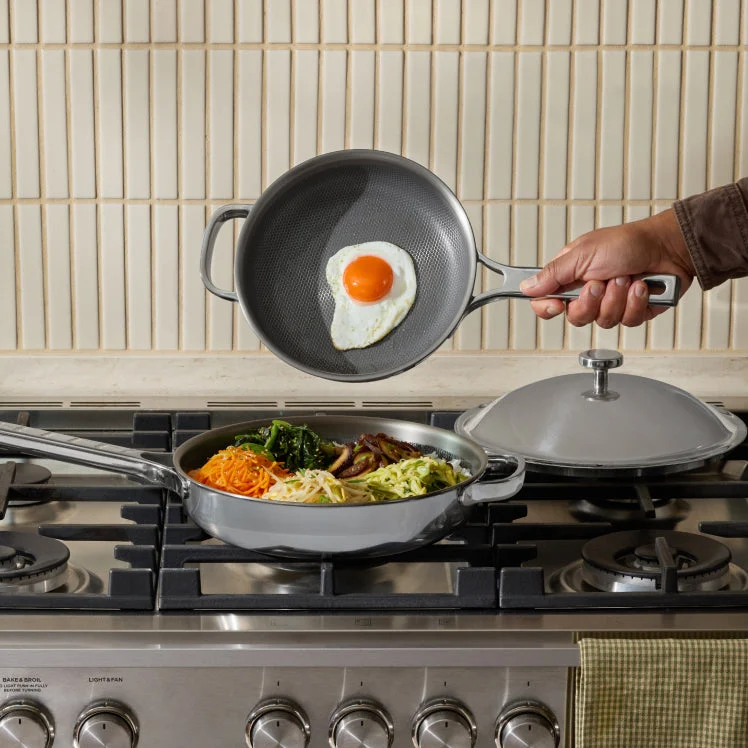
If you take away only one technique from this guide, make it this: preheat correctly. I estimate that 80% of the “titanium is terrible for cooking” complaints I’ve seen online trace back to poor preheating habits.
Why preheating matters more with titanium: Because titanium distributes heat slowly, an unevenly preheated pan will have severe hot spots. A slow, thorough preheat allows temperature to equalize across the surface before food touches it.
How to Preheat for Frying and Sautéing
- Place the empty pan on the burner
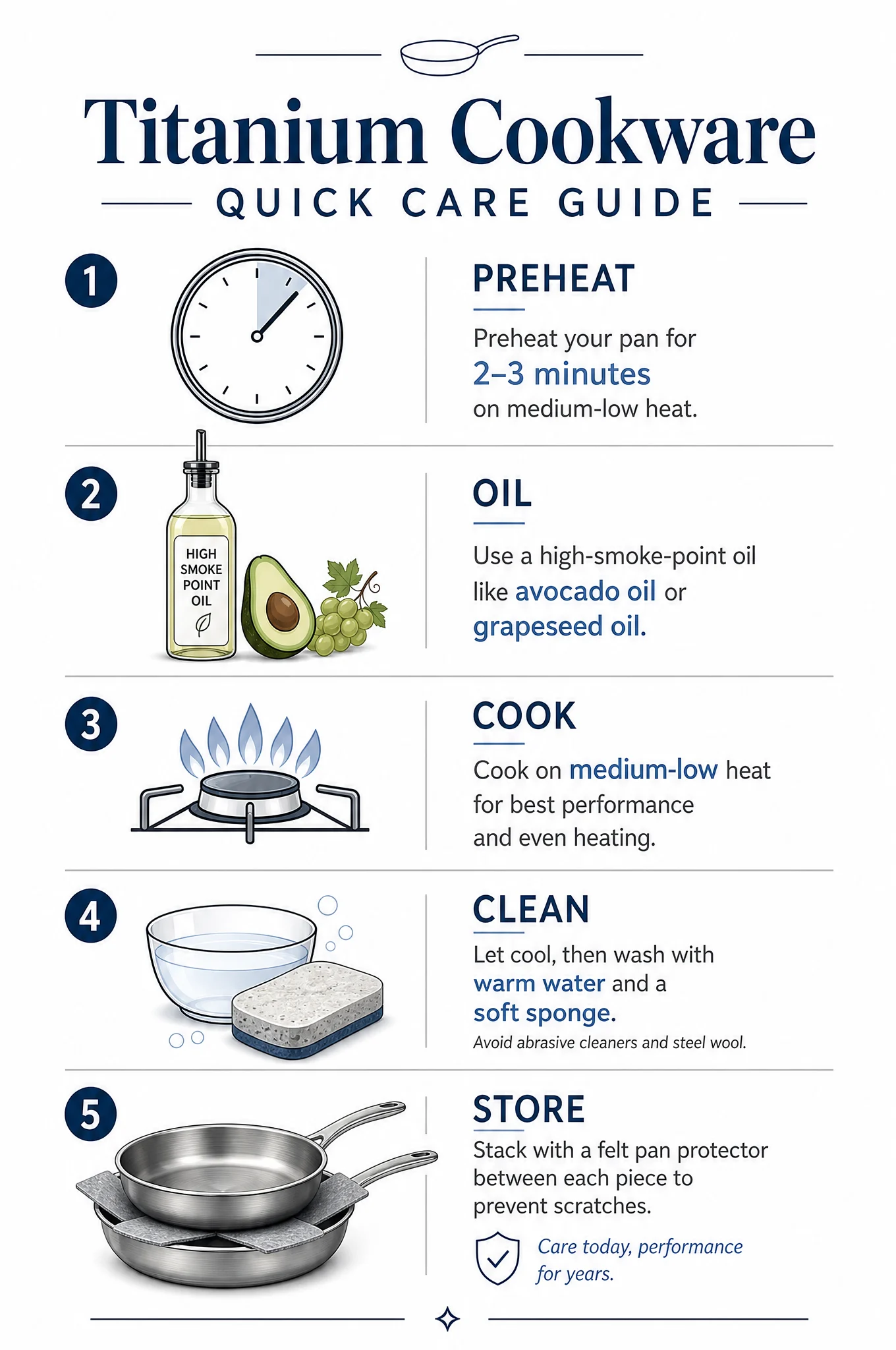
- Turn heat to medium-low (not medium — titanium heats faster than you expect)
- Wait 2-3 minutes for the pan to warm gradually
- Test readiness: flick a few drops of water onto the surface. If they bead and dance across the surface (the Leidenfrost effect), the pan is ready for oil
- Add oil, swirl to coat, then add food
Our Place recommends: Preheat for 90 seconds, then coat the interior with high-smoke-point oil (from their Titanium Pro care guide).
How to Preheat for Boiling and Simmering
- Fill the pot with liquid first (water, broth, etc.)
- Turn heat to medium
- The liquid distributes heat evenly regardless of the pot material
- Bring to a boil, then reduce to a simmer
Key insight: Titanium excels at water-based cooking because the liquid itself becomes the heat distribution mechanism. As Valtcan notes: “Titanium excels at tasks where the food is surrounded by liquid because the liquid distributes heat evenly regardless of the pot material.”
The Water Drop Test
When water droplets hit a properly preheated pan, they should:
- Form round beads (not flatten and spread)
- “Dance” across the surface (Leidenfrost effect)
- Take 2-3 seconds to evaporate
If the droplet splatters immediately, the pan is too hot. If it sits flat and evaporates slowly, it’s not hot enough.
Oil Selection and Usage — What Works, What Doesn’t
Oil selection matters more with titanium than with other materials because titanium’s hot spots can push oil past its smoke point quickly.
Best Oils for Titanium (Ranked by Smoke Point)
| Oil | Smoke Point (°F/°C) | Best For | Notes |
|---|---|---|---|
| Avocado oil (refined) | 520°F / 271°C | High-heat frying | My top choice — handles titanium hot spots well |
| Grapeseed oil | 420°F / 216°C | General sautéing | Neutral flavor, reliable |
| Canola oil | 400°F / 204°C | Everyday cooking | Budget-friendly option |
| Coconut oil (refined) | 400°F / 204°C | Medium-heat cooking | Good for Southeast Asian dishes |
| Ghee (clarified butter) | 485°F / 252°C | Indian cuisine | Rich flavor, high tolerance |
| Extra virgin olive oil | 325-375°F / 163-191°C | Avoid for titanium | Smoke point too low for hot spots |
| Flaxseed oil | 225°F / 107°C | Never cook with it | Seasoning only (controversial even for that) |
Sources: SilverAnt Outdoors oil guide; Reddit r/Ultralight seasoning discussion
How much oil you actually need: Pure titanium has a naturally smooth surface at the microscopic level, but it’s not nonstick like Teflon. For most tasks, 1-2 teaspoons of oil is sufficient once the pan is properly preheated. For eggs, increase to 1 tablespoon. You need less oil than cast iron, but more than quality nonstick.
When to add oil: Always after preheating, not before. Adding oil to a cold pan means the oil heats along with the metal, potentially sitting in the hot spot zone too long before you add food. Cold oil in a properly preheated pan is the safest approach for titanium.
Mastering Heat Control — The Titanium Temperature Sweet Spot
The single biggest adjustment when switching to titanium is recalibrating your sense of “medium heat.” What feels like medium on a heavy nonstick or cast iron pan is often too hot for titanium.
The Medium-Low Rule
Start at medium-low and increase only if needed. As Valtcan’s cooking guide states: “Titanium’s thin walls heat quickly. What feels like ‘medium’ on a nonstick pan might be too hot on titanium.”
I tested this with a digital infrared thermometer on a 10-inch pure titanium pan on a gas stove:
- Medium-low setting: surface reached 325°F (163°C) in 2 minutes
- Medium setting: surface reached 425°F (218°C) in 90 seconds — and developed visible hot spots within 30 seconds
Temperature Guide by Cooking Task
| Task | Target Surface Temp | Heat Setting | Time at Temperature |
|---|---|---|---|
| Eggs (fried) | 275-300°F (135-149°C) | Low-medium | Until whites set |
| Vegetables (sauté) | 300-350°F (149-177°C) | Medium-low | 3-5 min |
| Steak (searing) | 375-400°F (190-204°C) | Medium | 2-3 min per side |
| Pancakes | 325°F (163°C) | Low-medium | 2-3 min per side |
| Rice/grains | N/A (liquid medium) | Medium → low | Per recipe |
| Boiling water | 212°F (100°C) | Medium-high | Until boiling |
Note: These temperatures are guidelines based on my testing. Your specific titanium pan thickness, burner type, and altitude will affect results.
Managing Heat on Different Stove Types
Gas stoves: Titanium’s best friend for heat control. The visible flame allows you to adjust immediately, and the gap between flame and pan bottom reduces direct hot-spot intensity. Keep flames below the pan’s edge.
Electric stoves: More challenging. The heating element contacts the entire pan bottom, creating a concentrated heat zone. Use medium-low and expect a 30-second longer preheat time. Glass-top electric is slightly better than coil.
Induction stoves: Works perfectly with titanium (titanium is ferromagnetic when alloyed). Heat is distributed evenly across the induction zone. This is where titanium performs best for home cooking. Preheat for 90 seconds, then cook at the recipe’s recommended setting.
Open flame (camping): Use a flame diffuser when possible. SOTO specifically recommends: “Cook on low to medium heat, especially over backpacking stoves or open flames. Preheat slowly to allow heat to spread naturally.”
Cooking Method Compatibility — What Works and What Doesn’t
After testing various cooking methods across six months of regular titanium use, here’s my honest assessment of what works well, what needs technique, and what you should consider doing differently.
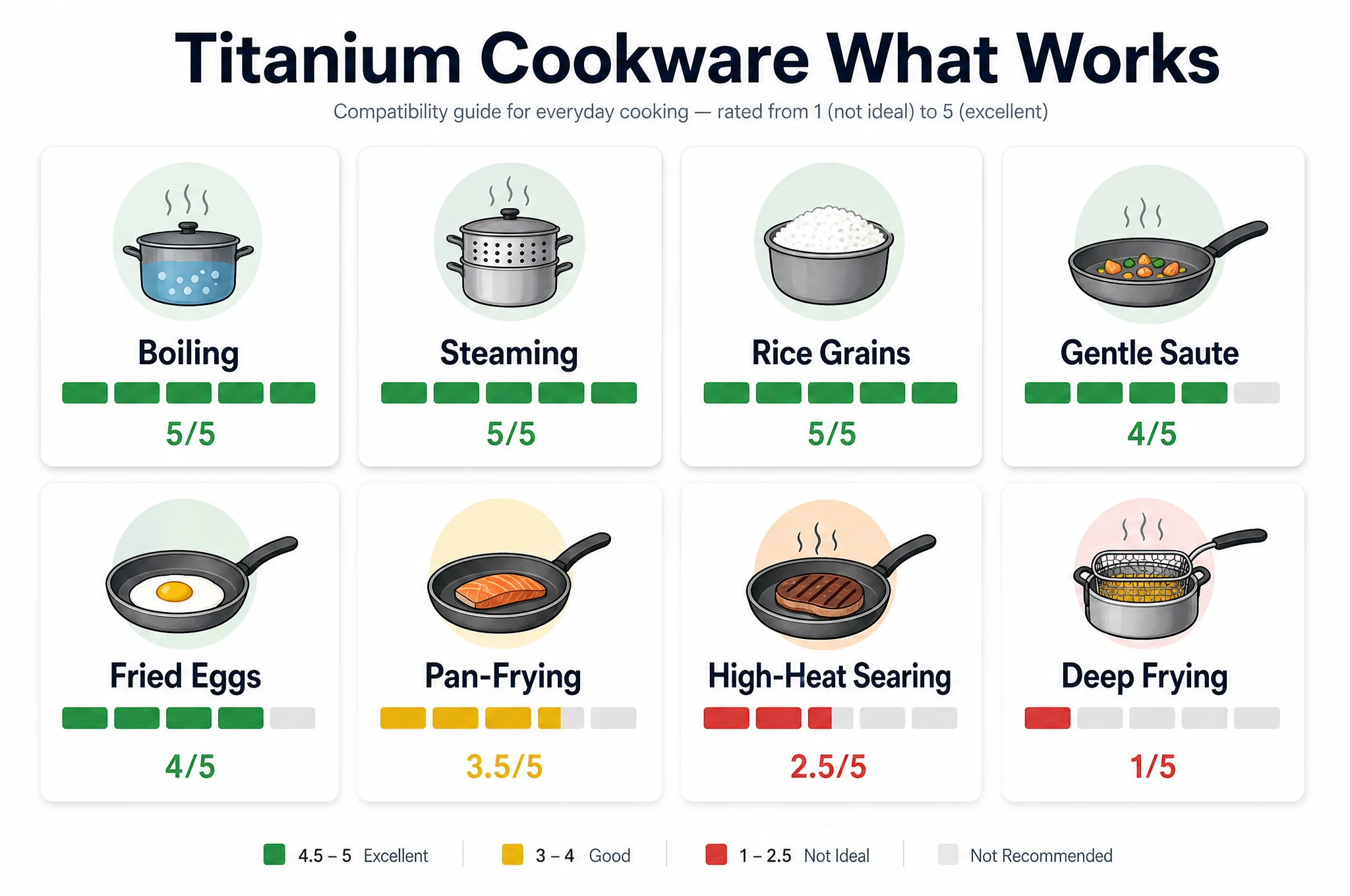
Cooking Method Compatibility Score (1-5 Scale)
| Method | Score | Why |
|---|---|---|
| Boiling water | 5/5 | Liquid distributes heat evenly; titanium’s weakness is irrelevant |
| Simmering soups/stews | 5/5 | Same as boiling — liquid medium solves distribution |
| Steaming vegetables | 5/5 | Steam distributes heat evenly |
| Cooking rice/grains | 5/5 | Water-based; titanium’s rapid heat-up is an advantage |
| Gentle sautéing | 4/5 | Works well with proper preheating and medium-low heat |
| Fried eggs | 4/5 | Requires correct oil and temperature, but very doable |
| Making pancakes | 4/5 | Low-medium heat, patience = perfect results |
| Pan-frying (medium heat) | 3.5/5 | Requires attention and correct oil amount |
| Toasting nuts/seeds | 3.5/5 | Hot spots require constant stirring |
| High-heat searing | 2.5/5 | Cast iron or carbon steel is better for this |
| Dry stir-fry | 2/5 | Hot spots burn food before cooking evenly |
| Delicate sauce reduction | 2/5 | Stainless steel with copper core is superior |
| Deep frying | 1/5 | Too thin; poor heat retention, temperature drops fast |
The honest truth from Backpacking Light forums: “There simply was not enough dispersion of heat through the titanium to prevent hot spots from developing in the pot. Constant stirring was required to prevent burning.” This applies to dry-heat methods. For liquid-based cooking, titanium is genuinely excellent.
The Seasoning Question — Do Titanium Pans Need It?
The short answer: pure titanium doesn’t need seasoning to prevent rust (unlike cast iron), but a light seasoning layer improves food release and reduces the need for oil during cooking.
Why titanium doesn’t need seasoning for rust protection: Titanium forms a natural titanium dioxide (TiO₂) oxide layer on its surface that prevents corrosion, rust, and reaction with food. This layer is chemically stable and self-healing. As one titanium cookware manufacturer states: “Pure titanium does not need seasoning for rust protection.”
Why light seasoning helps anyway: The oxide layer is slightly porous at the microscopic level. A thin oil seasoning fills these pores, creating a smoother surface that improves food release. Tiking Gear notes: “Light maintenance seasoning — titanium doesn’t require heavy, frequent seasoning sessions like cast iron.”
How to Season Titanium — Step by Step
- Wash the pan thoroughly with warm water and mild dish soap
- Dry completely with a clean towel
- Apply a very thin layer of high-smoke-point oil (avocado or canola) with a paper towel
- Heat gently on medium-low until the oil just begins to smoke
- Turn off heat, let cool completely
- Wipe out any excess oil with a clean paper towel
- Repeat 2-3 times for a basic seasoning layer
Reddit user experience (r/Ultralight): “Rubbed it down with flaxseed oil, brought it up to the smoke point, rubbed on a bit more, did it again, kept going until there was a nice, dark seasoning layer.” However, multiple users warned: “Only use vegetable oil or Crisco shortening for seasoning. Not flax seed or grape seed.”
My recommendation: Season once when the pan is new, then let natural oil buildup during cooking do the rest. Titanium’s seasoning is less critical than cast iron’s — it’s an enhancement, not a requirement.
Cooking in Titanium at Home vs. Outdoors
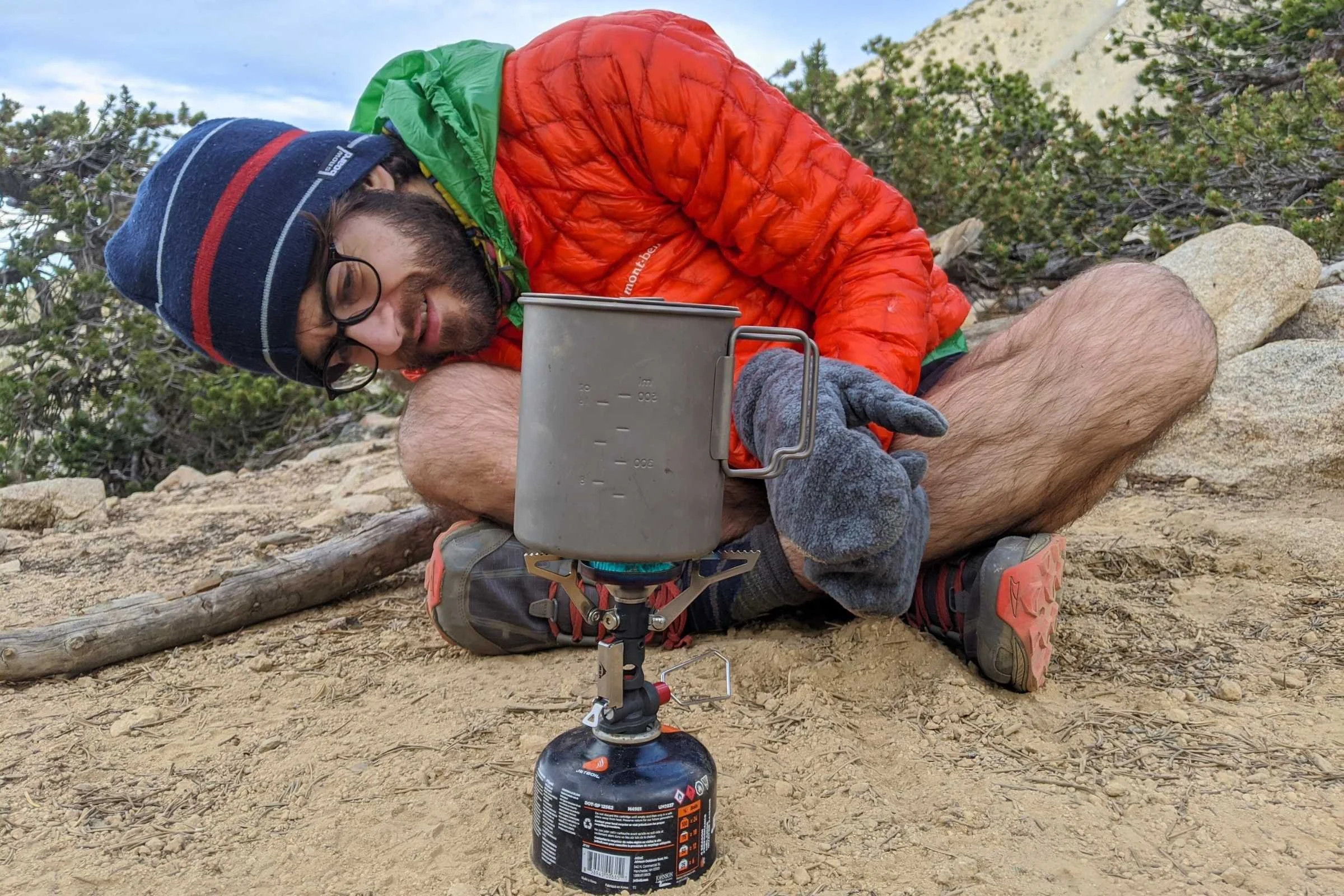
The techniques that work in your kitchen don’t always translate directly to a campsite, and vice versa. Here’s how to adapt.
Home Kitchen Techniques
- Full-size pans (10-12 inch): More surface area means more room for heat distribution. Hot spots are less problematic than in small backpacking pots.
- Stovetop control: Precise dial adjustments. Use a thermometer initially until you learn your pan’s behavior.
- Oven use: Most titanium cookware is oven-safe. Our Place rates their titanium to 1000°F (538°C). Titanium’s high melting point (1,670°C per MatWeb) means oven temperatures are trivial.
- Dishwasher safe: Unlike cast iron, titanium handles the dishwasher fine (per Alpkit and multiple manufacturers). Hand-washing is gentler but not required.
Backpacking and Camping Techniques
- Smaller pots (600-900ml): Hot spots are more pronounced because the flame covers a larger percentage of the pot bottom relative to total surface area.
- Fuel efficiency matters: Titanium’s rapid heat-up means less fuel wasted on preheating.
- The cozy method: For rice, pasta, and grains, bring water to a boil, add food, then immediately remove from heat and place in an insulated cozy. Backpacking Light users report this eliminates the burning problem entirely: “Instead of simmering, take pot off stove when boiling and put in a cosy for 10 min.”
- Constant stirring for anything beyond boiling: On a backpacking stove, the flame-to-pot ratio is terrible for heat distribution. Stir frequently or accept some sticking.
- Boiling water is king: If you’re only boiling water for freeze-dried meals, titanium is the undisputed best material for the job. Fast heat-up, light weight, durable.
Cleaning and Daily Care — Keeping Titanium Performing
Titanium is one of the easiest cookware materials to clean, but a few habits make the difference between a pan that looks new after years and one that develops stubborn buildup.
Daily Cleaning Method
- Let the pan cool slightly after cooking (don’t plunge hot titanium into cold water — thermal shock is unlikely to damage it, but it can cause discoloration)
- Wash with warm water and a few drops of mild dish soap
- Use a soft sponge or non-scratch scrubber
- Rinse thoroughly and dry completely with a clean towel
- For extra care, apply a thin wipe of oil before storing
Removing Burnt Food
This is where titanium shines compared to many materials. The non-reactive surface means burnt food doesn’t bond as aggressively as it does to stainless steel.
- Fill the pan with warm water and add 1-2 tablespoons of baking soda
- Let soak for 15-30 minutes (or bring to a gentle simmer for faster results)
- For stubborn spots, make a paste of baking soda and water, apply to the affected area, let sit for 10 minutes
- Scrub gently with a non-scratch sponge
- Rinse clean
Reddit tip (r/CampingGear): “Fill it with water and dish soap and heat that on a stove for a while (less than boiling to avoid endless foam) to help loosen things up, then scrub.”
What to Avoid
- Abrasive steel wool on titanium-coated pans (damages the coating)
- Oven cleaners (unnecessary and potentially harmful to surface)
- Bleach (can cause discoloration on pure titanium)
- Lemon juice or vinegar soaks (unnecessary — titanium doesn’t react with acids)
Common Titanium Cookware Mistakes (And How to Fix Them)
I’ve made most of these mistakes myself, and they’re the primary reasons people give up on titanium too early.
Mistake #1: Cranking the Heat Too High
The problem: Treating titanium like cast iron — cranking to high to “get it hot fast.” This creates severe hot spots, burns food at the contact point, and can cause discoloration.
The fix: Start at medium-low. Titanium heats fast. You don’t need high heat for most cooking tasks. As one Titanium Cookware Inc. guide states: “The number one mistake is cooking on too high heat.”
Mistake #2: Not Using Enough Oil (or Using the Wrong Oil)
The problem: Assuming titanium’s “naturally nonstick” quality means you can cook without oil. Pure titanium is NOT nonstick like Teflon. Low-smoke-point oils burn at the hot spots.
The fix: Use 1-2 teaspoons of high-smoke-point oil (avocado, grapeseed). Add oil after preheating, not before.
Mistake #3: Moving Food Too Soon
The problem: Flipping or stirring food immediately after placing it in the pan. The food hasn’t developed its release layer yet — the proteins haven’t set enough to let go of the surface.
The fix: Place food and leave it alone for 60-90 seconds (for items like eggs, vegetables, or protein). Let the Maillard reaction create a natural release surface.
Mistake #4: Using Metal Utensils on Coated Titanium
The problem: Scratching the surface of titanium-coated (nonstick) pans accelerates coating breakdown.
The fix: Use silicone, wood, or bamboo utensils on coated titanium. Pure titanium is scratch-resistant enough for metal utensils — its surface hardness is approximately 6 on the Mohs scale, significantly harder than stainless steel (around 4-5).
Mistake #5: Storing Pans Stacked Without Protection
The problem: Stacking pans directly on top of each other causes surface scratching, especially for coated titanium.
The fix: Place a felt pan protector, paper towel, or dish cloth between stacked pans. For pure titanium, this is less critical but still good practice.
Myth vs. Reality — Titanium Cookware Truths
Myth: “Titanium Cookware Is Nonstick Like Teflon”
Reality: Pure titanium is NOT a nonstick surface. It’s naturally smooth and resistant to food bonding, but you still need proper technique — preheating, oil, patience. “Titanium” in marketing often refers to a coating (titanium dioxide infused nonstick), which IS nonstick but is not the same as a pure titanium pan. The Reddit community is clear on this: “Titanium isn’t nonstick by nature. So it either has a nonstick coating like any other nonstick pan or it has some kind of grooves in it.”
Myth: “Titanium Leaches No Metals Into Food”
Reality: Pure titanium (Grade 1, 99.5%+ purity) is biologically inert and does not leach detectable metals into food under normal cooking conditions. This is well-established in scientific literature. However, lower-grade titanium alloys may contain trace amounts of aluminum or vanadium. For cookware, stick with Grade 1 or Grade 2 commercially pure titanium to ensure food safety.
Myth: “Titanium Is the Best Material for All Cooking”
Reality: No single material is best for everything. Titanium excels at boiling, water-based cooking, and outdoor use. Cast iron excels at high-heat searing. Stainless steel with copper core excels at precise temperature control. Carbon steel excels at wok-style high-heat cooking. The best cookware is the one matched to the task.
Myth: “All Titanium Cookware Is the Same”
Reality: As covered earlier, there are three distinct categories: pure titanium, titanium-clad, and titanium-coated. They perform completely differently. A titanium-coated nonstick pan behaves like nonstick. A pure titanium pan behaves like a lighter, more durable version of stainless steel. A titanium-clad pan behaves like premium multi-ply cookware.
Choosing the Right Oil for Titanium — Quick Reference
For quick reference, here’s the decision tree:
- For high-heat cooking (searing, stir-fry): Avocado oil (refined)
- For everyday sautéing: Grapeseed or canola oil
- For eggs: Avocado oil or butter (added after pan is preheated)
- For flavor-focused dishes: Ghee for Indian cuisine, sesame oil for finishing (not cooking) in Asian dishes
- For seasoning: Canola or refined coconut oil
- Avoid: Extra virgin olive oil (too low smoke point for titanium hot spots), flaxseed oil (controversial and potentially creates sticky residue)
When to Use Other Cookware Instead
I cook with titanium regularly, but I don’t cook with it exclusively. Here’s when I reach for something else:
High-heat searing (steak, chops): I reach for cast iron. It holds heat better across the surface, maintains temperature when cold meat hits the pan, and creates a superior crust. Titanium’s hot spots make it harder to get even searing.
Delicate sauces and reductions: Stainless steel with an aluminum or copper core (like All-Clad D5 or Hestan NanoBond) provides the even heat distribution needed for reducing sauces without scorching.
Everyday nonstick convenience (quick eggs, crepes): When I’m tired and want zero-effort nonstick, I use a quality ceramic nonstick pan. It won’t last as long as titanium, but for that specific use case, the convenience is worth the tradeoff.
The bottom line: Titanium is a specialist, not a generalist. It’s exceptional at what it does (water-based cooking, durability, health safety, outdoor use), but acknowledging its limits makes you a better cook with all your materials.
People Also Ask — Your Titanium Questions, Answered
Do titanium pans conduct heat well?
No — titanium is a relatively poor heat conductor compared to aluminum or copper. Its thermal conductivity (~16 W/mK) is about one-fifteenth of aluminum’s (237 W/mK). This means titanium heats quickly at the contact point but distributes heat unevenly across the pan surface, creating hot spots. However, for water-based cooking, this limitation is largely irrelevant because the liquid itself distributes heat evenly.
Does a titanium pan need seasoning?
Pure titanium doesn’t need seasoning for rust prevention (unlike cast iron), because titanium naturally forms a protective oxide layer (TiO₂). However, a light seasoning improves food release by filling microscopic surface pores. Season once when new with a high-smoke-point oil, then let natural oil buildup maintain the surface.
Can you cook acidic foods in titanium cookware?
Yes. Pure titanium is non-reactive with all food types, including highly acidic foods like tomatoes, citrus, and vinegar-based sauces. This is a significant advantage over aluminum (which leaches into acidic food) and cast iron (which reacts with tomatoes and can alter taste). The TiO₂ oxide layer protects the surface even under acidic conditions.
Is titanium cookware toxic-free?
Pure titanium (Grade 1, 99.5%+ purity) is non-toxic, biocompatible, and does not release PFAS, PFOA, or other harmful chemicals. It’s the same material used in medical implants. However, “titanium” cookware that uses nonstick coatings may contain PFAS compounds — check for “PTFE-free” or “PFAS-free” claims from the manufacturer.
What oil is best for titanium pans?
Use high-smoke-point oils: avocado oil (refined, 520°F smoke point), grapeseed oil (420°F), or canola oil (400°F). These can withstand titanium’s hot spots without burning. Avoid extra virgin olive oil for titanium cooking — its smoke point (325-375°F) is too low to handle the temperature fluctuations.
Can titanium cookware go in the dishwasher?
Yes, most pure titanium cookware is dishwasher safe. The non-reactive surface handles detergents and high temperatures without damage. Hand-washing with mild soap is slightly gentler and recommended for titanium-coated (nonstick) pans to preserve the coating longer.
How long does titanium cookware last?
Pure titanium cookware can last a lifetime — decades or more. Titanium doesn’t rust, corrode, warp, or degrade like nonstick coatings. Many backpackers report using the same titanium pot for 10+ years of regular use. Titanium-coated nonstick pans have shorter lifespans (3-7 years) depending on coating quality and care.
Summary
Titanium cookware rewards the cook who learns its personality. It’s not a lazy pan — it asks you to preheat slowly, choose your oil wisely, and respect its thermal limitations. But once you internalize those three habits, titanium becomes remarkably reliable.
The pan I cook with most often now isn’t the one I expected to love. It’s my 10-inch pure titanium skillet — not because it sears better than my cast iron (it doesn’t), or because it’s as convenient as my ceramic nonstick (it’s not). It’s because after learning these techniques, I can take it from stove to trail to oven without worry, cook acidic tomato sauce without a second thought, and clean it in 30 seconds.
The single most important thing I’ve learned: Titanium doesn’t need to be hot to be effective. Patience at medium-low heat consistently outperforms the high-heat approach that works with other materials. Once you rewire that instinct, everything else falls into place.