
Grade 2 is commercially pure titanium — softer, more formable, better corrosion resistance, and the standard choice for cookware, water bottles, and food-contact outdoor gear. Grade 5 (Ti-6Al-4V) adds 6% aluminum and 4% vanadium to deliver roughly 2.5× higher tensile strength, making it the material of choice for knife handles, structural components, and aerospace parts. They weigh virtually the same. For outdoor gear, the right grade depends entirely on what the product needs to do — not which grade sounds more impressive. This article breaks down the specs, the real-world applications, and the one question most comparison guides avoid: is Grade 5 actually safe for food contact?
Grade 2 vs Grade 5 at a Glance
If you’ve spent any time shopping for titanium camping gear or sourcing titanium products for your brand, you’ve seen both grade designations — sometimes on products in the same category, sometimes with almost no explanation of why. Here’s the short version before we get into the numbers.
Grade 2 is the workhorse of commercially pure (CP) titanium. It’s been the backbone of titanium cookware, water bottles, and marine hardware for decades because it’s easy to form, welds cleanly, and has outstanding corrosion resistance in wet environments. Grade 5, also called Ti-6Al-4V, is an alpha-beta alloy that adds significant strength at the cost of formability and food-contact suitability. It dominates aerospace, medical implants, and high-wear EDC tools.
The single most important takeaway: stronger doesn’t mean better for every application. Grade 5’s strength advantage is genuinely irrelevant when you’re making a 0.6mm camping mug wall. What matters there is formability, thermal conductivity, and weld quality — and Grade 2 wins on all three.
Full Property Comparison

| Property | Grade 2 (CP Titanium) | Grade 5 (Ti-6Al-4V) |
|---|---|---|
| Titanium content | ≥98.9% | Balance |
| Alloying elements | Trace Fe, O, N only | 5.5–6.75% Al, 3.5–4.5% V |
| Tensile strength | ≥345 MPa | ≥895 MPa |
| Yield strength | ≥275 MPa | ≥828 MPa |
| Elongation | ≥20% | ≥10% |
| Density | 4.51 g/cm³ | 4.43 g/cm³ |
| Thermal conductivity | ~16 W/m·K | 6.5–7.2 W/m·K |
| Max service temp | ~315°C continuous | ~400°C continuous |
| Weldability | Excellent | Good (demanding) |
| Formability | Excellent | Poor |
| Machinability | Moderate | Difficult |
| Food contact | Yes (industry standard) | Not recommended |
| ASTM sheet standard | B265 | B265 / AMS 4911 |
| Price premium vs Gr2 | Baseline | 20–50% higher |
Tensile/yield values per ASTM B348 minimums. Thermal conductivity per multiple industrial technical data sheets.
What “Commercially Pure” Actually Means
Grade 2 is classified as commercially pure titanium — meaning it’s essentially unalloyed titanium with only trace amounts of iron, oxygen, nitrogen, and carbon permitted within ASTM limits. It’s not 100% pure, but it’s close enough that the alloying effect is negligible compared to structural titanium alloys.
There are four CP grades (1–4) that differ mainly in allowed oxygen content. Grade 1 has the lowest oxygen content and is the softest and most formable. Grade 2 has slightly more oxygen, which bumps its strength just enough to be practical for most fabricated products without sacrificing much formability. Most titanium camping gear labeled “titanium” is Grade 1 or Grade 2 — brands like Snow Peak, TOAKS, Evernew, and SilverAnt all use CP grades for their cookware and drinkware.
Grade 5 earns its strength from a carefully controlled mix of aluminum and vanadium. Those two elements change the titanium’s crystal structure from a single alpha phase into a mixed alpha-beta microstructure that significantly increases strength and hardness. That transformation is precisely why Grade 5 performs so well under mechanical stress — and why it introduces composition concerns for food-contact applications.
The Strength Gap: Real Numbers, Real Context
Grade 5’s tensile strength of ≥895 MPa is roughly 2.5× that of Grade 2’s ≥344 MPa. In yield strength (the point where permanent deformation begins), it’s ≥828 MPa vs ≥275 MPa — about a 3× advantage.
Those are genuinely impressive numbers. But here’s the context that most comparison articles skip: outdoor gear doesn’t need that strength.
A titanium backpacking pot wall is typically 0.5–0.8mm thick. The structural loads it sees during normal use are negligible. The engineering challenge isn’t tensile strength — it’s whether you can form a piece of titanium sheet into a complex shape without cracking it, and whether you can weld the seams without introducing porosity. Grade 2’s ≥20% elongation (vs Grade 5’s ≥10%) means it can be cold-stamped, deep-drawn, and hydroformed into shapes that Grade 5 would crack or spring-back from.
Where Grade 5’s strength actually matters in outdoor gear: knife handle scales that get pried, compressed, and twisted; framelock interfaces that take repeated impact; high-cycle mechanical parts. That’s why every serious EDC and knife brand — Benchmade, Chris Reeve, Zero Tolerance — defaults to Grade 5 for handle scales. It’s not marketing. It’s the right material for parts under real mechanical stress.
Thermal Conductivity: The Reason Grade 2 Heats Better
This is the data point almost no competitor article covers, and it’s arguably the most practical for outdoor cooking.
Grade 2 has a thermal conductivity of approximately 16 W/m·K. Grade 5 drops to 6.5–7.2 W/m·K. That means Grade 2 conducts heat roughly 2× more efficiently than Grade 5 across the cooking surface.
In a camp pot or pan, uneven heat distribution means hot spots — food burns in the center while the edges stay cool. Grade 2’s higher thermal conductivity gives it a meaningful advantage for cookware performance that has nothing to do with food safety and everything to do with actual cooking results.
This is also why titanium cookware in general requires a bit of technique (lower heat, more movement) compared to stainless with an aluminum core — even the best CP titanium doesn’t match the conductivity of a clad pan. But within titanium options, Grade 2 is clearly the better cooking grade.
Is Grade 5 Safe for Food Contact?
This is the question that gets the most searches and the least honest answers.
The short version: Grade 5 is not recommended for direct, long-term food contact, and the reason is its composition. The 6% aluminum and 4% vanadium alloying elements are not approved for food-contact applications under the same biocompatibility frameworks that cover commercially pure titanium. Vanadium in particular is a biologically active element — it’s why Grade 5 implants (used for orthopedic screws and spinal hardware) are increasingly being replaced by Grade 23 (Ti-6Al-4V ELI) or other grades with tighter composition controls.
The honest caveat: there’s no widely-cited primary regulatory document (FDA, LFGB, EU 10/2011) specifically prohibiting Grade 5 cookware. The industry consensus against it is strong and consistent across cookware brands, outdoor gear manufacturers, and materials suppliers — but it’s driven by precautionary reasoning about vanadium bioavailability, not a specific regulatory ruling.
What we can say with confidence: Every established titanium cookware brand (Snow Peak, TOAKS, Valtcan, Keith Titanium, SilverAnt) uses Grade 1 or Grade 2 for all food-contact surfaces. None use Grade 5 for pots, cups, or utensils. That’s not coincidence.
For OEM buyers sourcing food-contact titanium products: specify Grade 1 or Grade 2 in your purchase order and request mill certificates confirming the grade. Don’t accept “titanium alloy” as a specification on food-contact items.
Grade 2 vs Grade 5: Which Outdoor Products Use Which

Understanding the application split is the practical output of all the specs above.
Grade 2 (CP Titanium) — standard for:
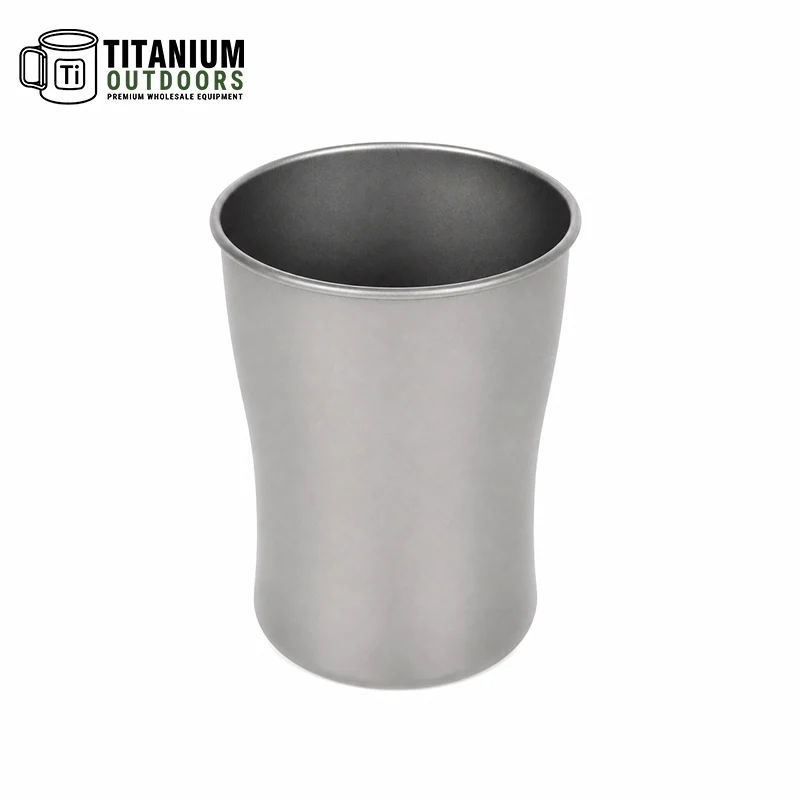
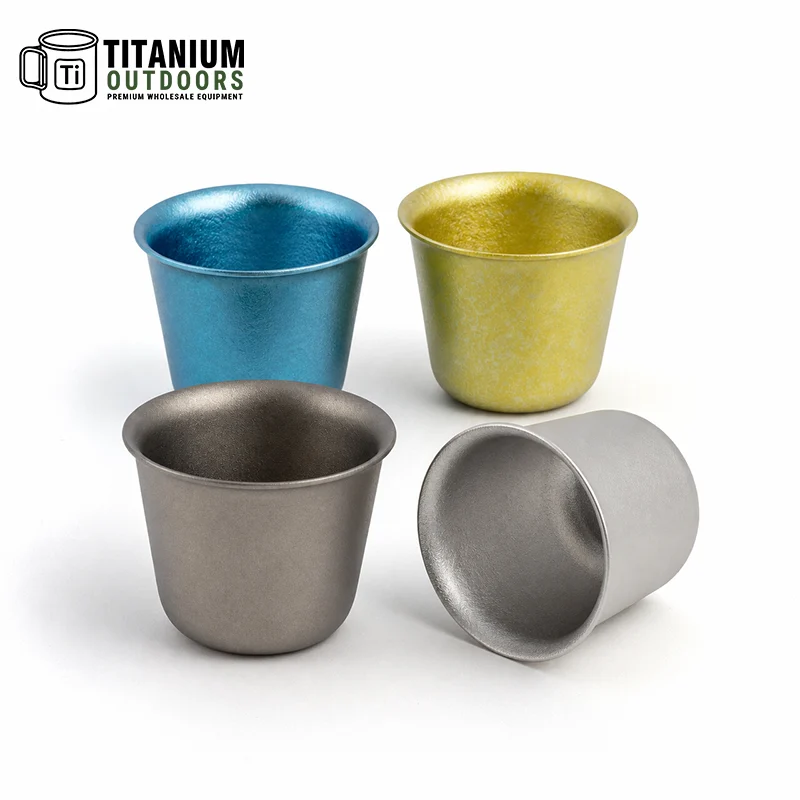
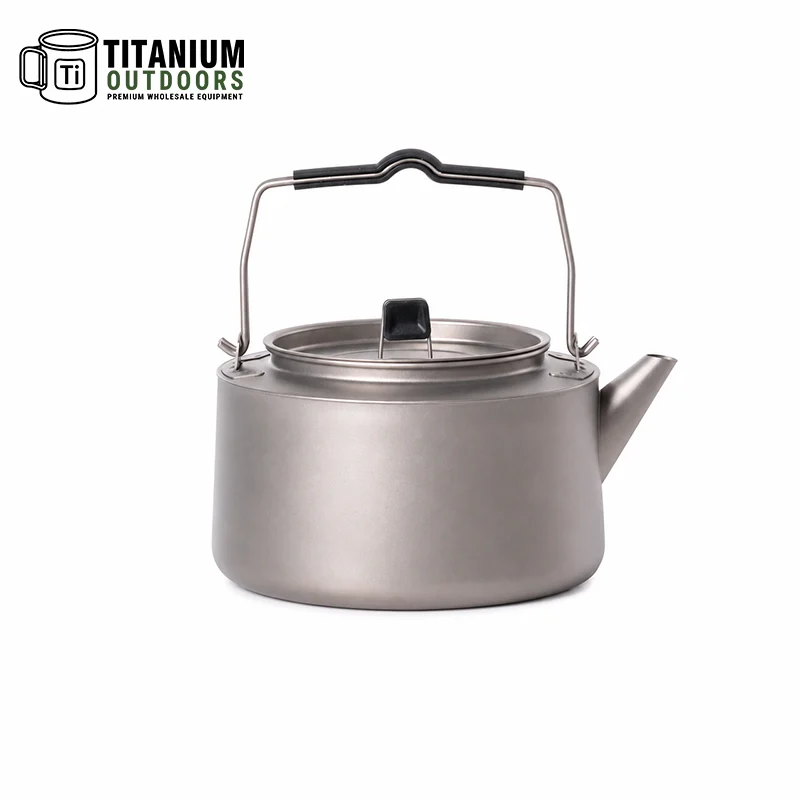
- Backpacking cookware: pots, cups, mugs, bowls (all major brands)
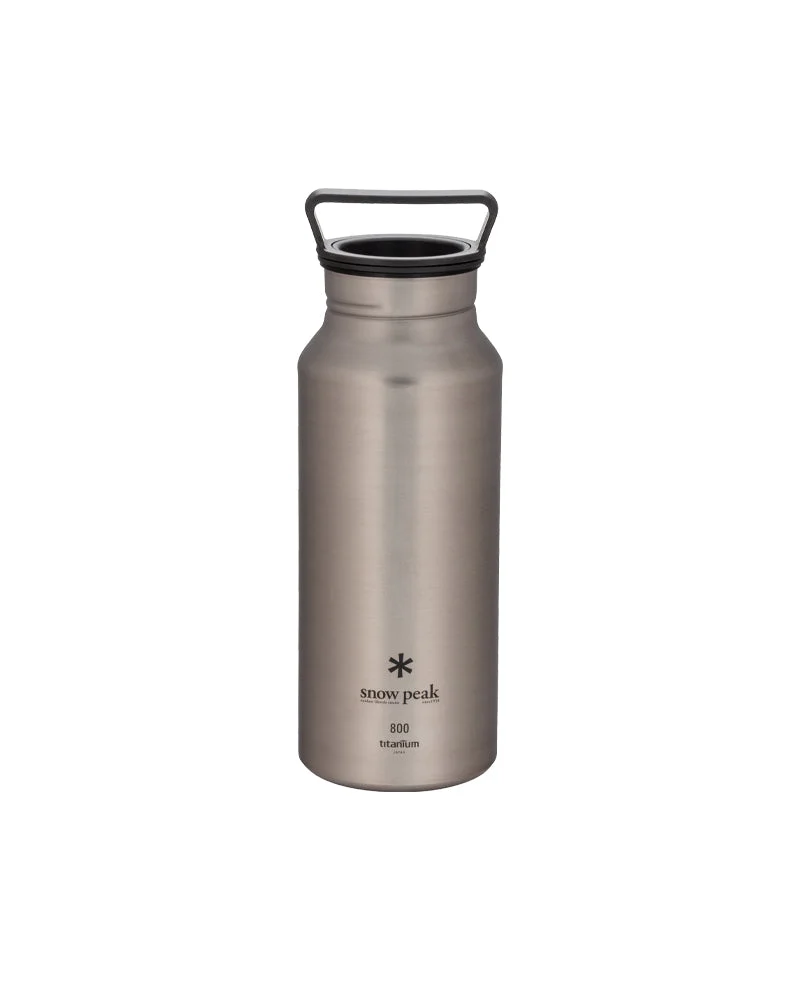
- Water bottles and hydration containers
- Sporks and utensils
- Titanium tent stakes and small hardware
- Pocket clip screws, standoffs, and lanyard tubes in EDC gear
- Bicycle bolts, bottle cages, and small accessories
Grade 5 (Ti-6Al-4V) — standard for:

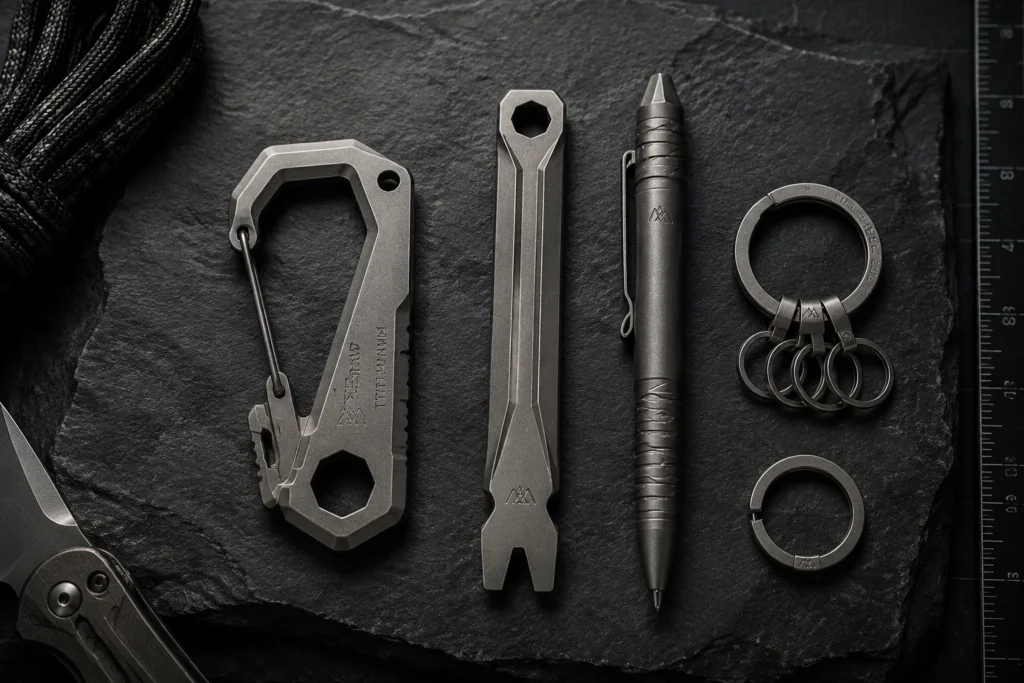
- Knife handle scales and framelock interfaces
- Premium multi-tool frames and high-stress pivot hardware
- Elite bicycle components: bottom bracket shells, dropouts, head tubes
- Flashlight bodies and high-wear EDC tool frames
- Aerospace fasteners and structural aircraft components
- Orthopedic and dental implants
- Apple iPhone frames (Apple specifies Grade 5 for the titanium chassis)
The mixed-grade pattern: Many high-end EDC products use Grade 5 for the main structural piece (handle scale, frame) alongside Grade 2 hardware (screws, standoffs). This isn’t cost-cutting — it’s deliberate engineering. The hardware benefits from Grade 2’s easier threading and torque compliance; the high-stress frame needs Grade 5’s hardness.
Weldability and Formability: Why It Matters for Manufacturers
If you’re an OEM buyer or a product designer working with a titanium factory, these two properties matter more than tensile strength for most outdoor product categories.
Formability: Grade 2 can be cold-stamped, deep-drawn, and spun into thin-wall shapes. Grade 5 is far less ductile (10% vs 20% elongation) and will crack or spring-back under the same forming operations. Thin-wall cookware simply cannot be economically manufactured from Grade 5 sheet — it would require hot forming or machining from billet, adding significant cost and complexity.
Weldability: Grade 2 welds reliably with ERTi-2 filler under inert gas shielding. Grade 5 requires tighter process control, strict shielding gas coverage, and careful heat input management with ERTi-5 filler. Both are weldable, but Grade 2 gives fabricators a wider process window. Weld color is a reliable quality indicator for both grades: silver to light straw is good; blue, purple, or dark means the weld is overheated or contaminated.
For outdoor gear manufacturing, Grade 2’s processing advantages translate directly into lower scrap rates, faster cycle times, and more consistent quality — which is why experienced titanium manufacturers default to it for stamped and welded products.
The Weight Question (and Why It’s a Non-Issue)
One of the most persistent misconceptions in online titanium discussions is that Grade 5 is somehow lighter than Grade 2. It’s not — and it’s almost the opposite.
Grade 2 density: 4.51 g/cm³
Grade 5 density: 4.43 g/cm³
The difference is 0.08 g/cm³ — less than 2%. On a 500ml camping mug, that works out to roughly 1–2 grams of difference. Below the measurement threshold of a consumer scale, and completely negligible for any gear weight comparison.
If a product review claims “Grade 5 is lighter than CP titanium,” that’s technically accurate by a rounding-error margin but practically meaningless. Weight reduction in titanium outdoor gear comes from wall thickness and geometry, not from switching between these two grades.
Corrosion Resistance: Grade 2’s Edge
Both grades form a passive titanium dioxide (TiO₂) oxide layer that provides excellent corrosion protection and regenerates when the surface is scratched. Neither will rust.
That said, Grade 2 has a slight advantage in the most demanding corrosion environments:
- Seawater and chloride media: Grade 2’s corrosion rate in wet chlorine environments runs approximately 0.001 mm/year — effectively nil. Grade 5 performs well but is slightly more susceptible in high-chloride conditions.
- Reducing acids: Neither grade is recommended for strong reducing acids (hydrochloric, sulfuric at elevated temps), but Grade 2 has a slightly better track record in chemical processing applications.
- Galvanic corrosion: Grade 5, when in contact with dissimilar metals in an electrolyte, can set up galvanic cells. Grade 2 is less reactive in mixed-metal assemblies.
For outdoor gear used in saltwater, coastal, or humid environments, either grade performs excellently — but Grade 2 is the more conservative choice for long-term marine exposure.
Pricing: What the Grade Premium Costs
Grade 5 commands a raw material premium of roughly 20–50% over Grade 2 at the mill level, driven by alloying element costs, tighter process controls, and lower machining speeds.
In finished consumer goods, Urban EDC’s analysis puts the Grade 5 premium at 30–50% in comparable product categories. A titanium mug made from Grade 5 material would cost meaningfully more to produce — and since the Grade 2 version is objectively better for the application, that premium buys you nothing useful.
The Grade 5 premium is well-justified for knife handles, structural EDC components, and aerospace parts where the strength advantage matters. For cookware, bottles, and general outdoor gear, specifying Grade 5 adds cost without adding functional value.
Frequently Asked Questions
Why is Grade 5 titanium stronger than Grade 2?
Grade 5 adds 5.5–6.75% aluminum and 3.5–4.5% vanadium to the titanium matrix, creating a mixed alpha-beta crystal microstructure. That structure resists deformation far more effectively than the single alpha-phase structure of commercially pure Grade 2, resulting in ~2.5× higher tensile strength (895 MPa vs 344 MPa).
What grade of titanium is used in camping cookware?
Grade 1 or Grade 2 (commercially pure titanium) is the standard for all cookware, cups, bottles, and food-contact outdoor gear. Every major titanium cookware brand — Snow Peak, TOAKS, Evernew, SilverAnt, Valtcan — uses CP titanium for food-contact surfaces. Grade 5 is not used for cookware due to its aluminum and vanadium content.
Is Grade 5 titanium safe for food contact?
Grade 5 is generally not recommended for direct, repeated food contact. Its 6% aluminum and 4% vanadium alloying elements are not approved for food-contact use under the same frameworks that cover commercially pure titanium. While no specific regulatory ban exists, industry consensus across cookware brands and material suppliers consistently avoids Grade 5 for food-contact surfaces.
Do Grade 2 and Grade 5 titanium weigh the same?
Essentially yes. Grade 2 has a density of 4.51 g/cm³ and Grade 5 has 4.43 g/cm³ — a difference of less than 2%. On any real outdoor gear item, this translates to 1–2 grams. Grade selection does not meaningfully affect product weight.
Which grade is better for machined titanium parts?
Neither grade is easy to machine — both generate heat and wear tools faster than steel. Between the two, Grade 2 has higher machinability ratings (cutting speeds 60–90 m/min vs Grade 5’s 40–70 m/min) but tends to smear and adhere to cutting tools. Grade 5 generates more heat at the tool interface due to its low thermal conductivity, accelerating tool wear. Most CNC shops consider Grade 5 more difficult overall.
Can I weld Grade 2 and Grade 5 titanium together?
Yes, dissimilar titanium grades can be welded, but it requires careful process control. ERTi-2 or ERTi-5 filler can be used depending on the application, and strict inert gas shielding is essential for both. The Grade 5 side of any weld needs careful heat input management. For outdoor gear manufacturing, mixing grades in the same weld joint is uncommon and adds process complexity.
Why do some EDC products mix Grade 2 and Grade 5?
It’s deliberate engineering. The main structural piece (knife handle, tool frame) uses Grade 5 for hardness and wear resistance. Hardware like screws and standoffs uses Grade 2 because it’s easier to thread, has better torque compliance, and doesn’t need the structural strength. This is the same reason aerospace assemblies mix titanium grades — matching material properties to part function rather than using one grade for everything.
Summary
Grade 2 and Grade 5 titanium serve different engineering purposes, and confusing them leads to real problems: over-specified products that cost more for no functional gain, or under-specified parts that fail prematurely.
For outdoor gear, the rule is straightforward: food contact and thin-wall fabricated products belong in Grade 2; high-stress structural and wear-surface components belong in Grade 5. The strength difference that makes Grade 5 essential for a knife framelock is genuinely irrelevant for a camp mug. And Grade 2’s better thermal conductivity, formability, and food-contact safety profile make it the technically correct choice for cookware — not just the cheaper one.
OEM buyers should specify grade by product category and request mill certificates. Consumers buying titanium outdoor gear should look for “Grade 1” or “Grade 2” on food-contact items — not because Grade 5 is dangerous, but because the established cookware brands all default to CP titanium for good engineering reasons, and that track record matters.