Titanium mugs weigh 55–130g depending on size and wall design, outperforming stainless steel by roughly 40% in weight for the same capacity. Grade 1 and Grade 2 titanium are the food-safe standards used in quality drinkware — both are inert, BPA-free, and campfire-safe up to 1,668°C. This guide covers every standard size from 250ml to 750ml, explains single-wall vs double-wall designs, and walks through the OEM/private-label process for brands sourcing custom titanium mugs. Titanium Outdoor manufactures to all major certifications including FDA, REACH, and LFGB.
Why Titanium Outperforms Other Mug Materials
Titanium mugs have earned their premium position in outdoor gear, but the reason goes beyond marketing. The core physics: titanium’s density is 4.51 g/cm³ vs stainless steel’s 7.9 g/cm³, which means a titanium mug with identical wall thickness and volume weighs roughly 43% less than its steel counterpart.
For a backpacker carrying a 450ml mug, that’s the difference between 160g of steel and about 85g of titanium — saving 75g that could mean an extra day of fuel or a lighter pack on a 10-day trail.
Beyond weight, titanium offers three properties that matter for daily use:
- Corrosion resistance: Titanium forms a stable TiO₂ oxide layer on its surface. Unlike steel, it won’t rust or leach metallic taste into your coffee after years of use. I’ve used the same titanium mug on over 60 trips, and it still tastes clean with plain water on the first day out.
- Biocompatibility: Food-grade titanium (Grade 1 and Grade 2) is the same material used in medical implants. No BPA, no heavy metals, no coatings to flake off.
- Heat tolerance: Titanium’s melting point of 1,668°C means you can set it directly on a camp stove or low wood fire without any structural risk. The lower thermal conductivity (21.9 W/m·K vs steel’s typical 16–50 W/m·K range) also means the outer body stays cooler to touch than thin steel cups at equivalent temperatures.
What titanium doesn’t do well: it’s not a great heat distributor. If you’re cooking in it, expect hotter spots near the flame and cooler edges. That’s a cookware problem, less so a mug problem.

Understanding Titanium Grades: Grade 1 vs Grade 2
Most buyers encounter this question when sourcing: “Is your mug Grade 1 or Grade 2?” The answer matters, but the practical difference is narrower than the marketing suggests.
| Property | Grade 1 (CP Ti) | Grade 2 (CP Ti) |
|---|---|---|
| Titanium purity | ≥99.5% | ≥99.2% |
| Tensile strength | 240 MPa | 345 MPa |
| Corrosion resistance | Excellent | Excellent |
| Food safety | Yes | Yes |
| Typical use | Medical devices, thin-wall cups | Outdoor gear, mugs, cookware |
| Weight impact | Marginally lighter for same strength | Standard for most drinkware |
| Price | Slightly higher | Standard |
For most buyers, Grade 2 is the right choice. It’s stronger, handles the minor dents and drops of outdoor use better, and the food-safety profile is identical. Grade 1 makes sense for ultra-thin-wall cups where maximum purity matters — niche applications like titanium espresso cups or medical-adjacent contexts.
What to avoid: Grade 5 titanium (Ti-6Al-4V) is an aerospace alloy containing 6% aluminum and 4% vanadium. It’s not food-safe and is never used in legitimate drinkware. If a supplier can’t tell you which grade they use, that’s a red flag.
At Titanium Outdoor, all mugs are manufactured from Grade 1 or Grade 2 commercially pure titanium, with full material traceability documentation available for OEM clients.

Titanium Mug Sizes: Which Capacity Is Right?
This is the question most buying guides skip past with a vague “it depends.” Here’s a practical framework based on use case and number of servings.
Size Comparison Table
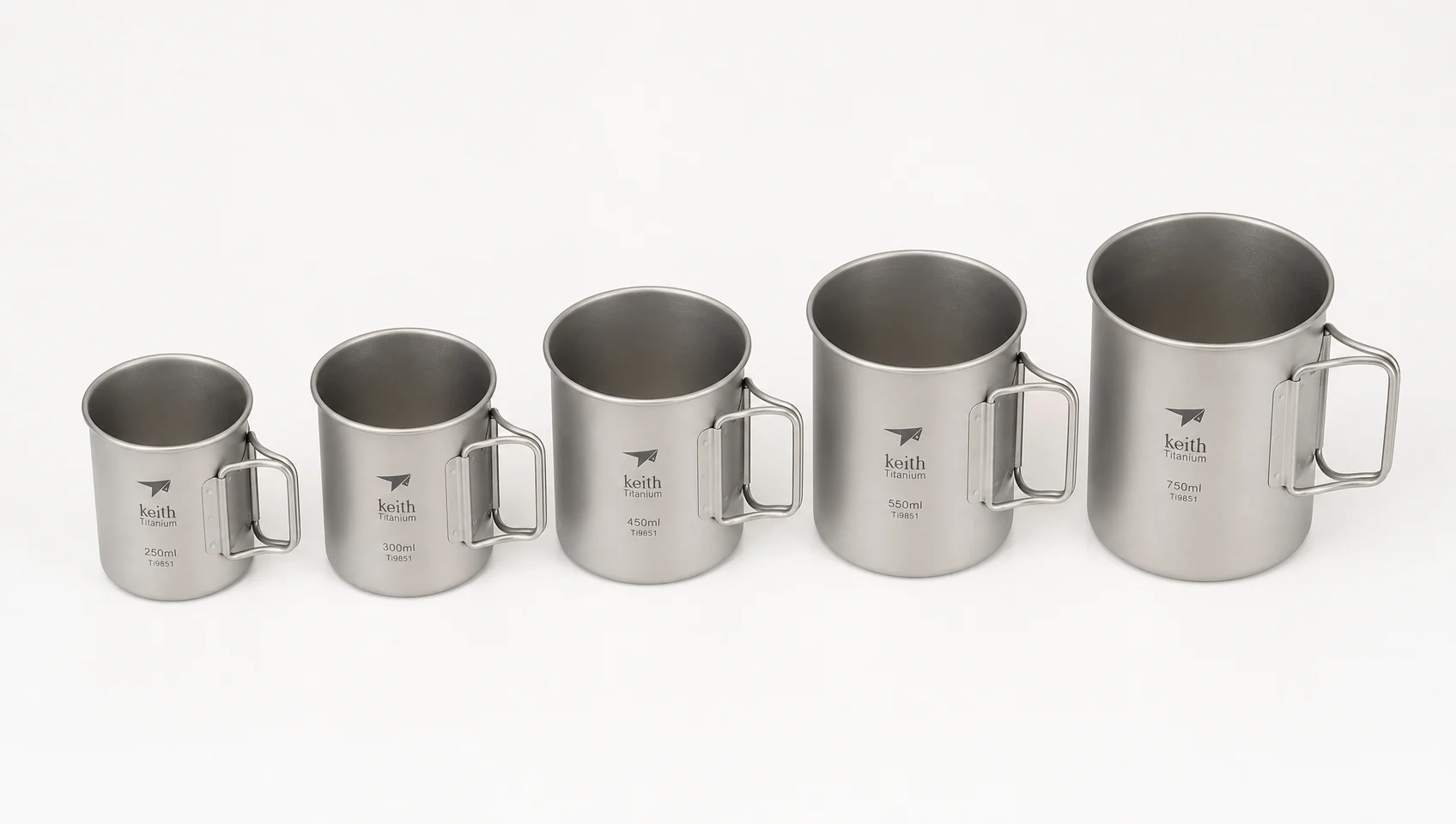
| Size | Fluid oz | Best Use | Typical Weight (single-wall) | Typical Weight (double-wall) |
|---|---|---|---|---|
| 250ml | 8.5 oz | Espresso, short tea, ultralight carry | ~50–60g | ~75–90g |
| 300ml | 10 oz | Single coffee, everyday carry | ~58–70g | ~85–100g |
| 450ml | 15.2 oz | Standard camping mug, two small coffees | ~70–90g | ~100–125g |
| 550ml | 18.6 oz | Large coffee, trail lunch prep | ~85–100g | ~115–140g |
| 750ml | 25.4 oz | Boiling water, solo cookpot hybrid | ~115–140g | N/A (typically single-wall) |
The 450ml is the most versatile size — it fits a standard double espresso plus milk, holds a comfortable serving of ramen, and still weighs under 90g in single-wall form.
For ultralight backpacking, 300ml is the sweet spot if you’re disciplined about one hot drink per meal break. The 250ml espresso size is almost exclusively for specialty coffee setups or pairing with a separate cook pot.
The 750ml crosses from mug to pot territory. It’s popular as a system piece — boil water, make pour-over coffee, pour into a smaller mug for drinking. Weighs around 130g in single-wall titanium, which competes favorably against 200–250g aluminum pots of similar volume.
Titanium Mug Styles: Single-Wall, Double-Wall & Beyond
The size choice is simpler than the style choice. Here’s what actually changes between designs.
Single-Wall Titanium Mugs
The original and still the most popular for outdoor use. One layer of titanium, typically 0.6–0.8mm thick. Pros: lightest possible weight, cheapest to manufacture, easiest to clean. Cons: the outer surface gets hot within 30–60 seconds of adding boiling liquid, heat loss is faster than double-wall.
Single-wall mugs work best with a silicone sleeve or handle grip. Without one, you’re picking up a 90°C object barehanded — fine on the trail when you’re used to it, awkward at the office.
Double-Wall Titanium Mugs
Two concentric titanium shells with an air gap between them (typically 3–5mm). The inner wall contacts your drink; the outer wall stays close to ambient temperature. Benefits: comfortable to hold with hot liquids, keeps drinks hot 30–45 minutes longer than single-wall, looks cleaner for everyday carry contexts.
The tradeoffs are real: double-wall adds 30–50% weight and roughly 40–60% to manufacturing cost vs single-wall. For a hiking purist watching every gram, that extra 40–50g matters. For a coffee drinker who wants a titanium mug they can also use at their desk, it’s worth it.
Folding Handle vs Fixed Handle vs No Handle
- No handle (straight-sided cup): Lightest, nests inside other gear, often paired with a silicone sleeve. Common in ultralight setups.
- Folding handle: Titanium wire handle that folds flat for packing. Adds ~8–15g but significantly improves usability around a stove. Most popular in outdoor/camping category.
- Fixed D-ring handle: Heavier, more durable, better for everyday carry mugs. Standard in office-oriented titanium coffee mugs.
Insulated Titanium Mugs (Vacuum)
The premium tier: double-wall with the air gap evacuated to create a vacuum, equivalent to a vacuum flask. These keep drinks hot 6–12 hours and cold even longer. Weight penalty is significant (150–200g range), and these are typically produced in larger volumes at higher tooling cost.
Titanium Mug with Lid Options
Lids vary from simple friction-fit titanium discs to silicone-sealed pour lids. For OEM clients, lid design is often the biggest customization lever — a lid with logo engraving or a branded color silicone seal differentiates the product more visibly than mug shape alone.

Titanium Coffee Mugs: From Trail to Desk
The titanium coffee mug market has split into two distinct segments, and it’s worth understanding both if you’re designing a product line.
Outdoor-first titanium mugs prioritize weight and packability. They’re typically single-wall, 300–450ml, with a folding handle or no handle. Finish is bare metal or light brushed. These sell through outdoor retailers, Amazon outdoor category, and direct-to-consumer gear brands.
Everyday-carry titanium coffee mugs prioritize aesthetics and heat retention. Double-wall or vacuum-insulated, 350–500ml, with a fixed handle and sometimes a colored exterior coating. Often marketed as “titanium travel mugs” or “titanium commuter cups.” These compete with premium stainless travel mugs but carry a lighter weight advantage.
The overlap product — and what many brands get right — is a mid-weight double-wall 450ml with folding handle. It works on the trail and at the office, photographs well for e-commerce, and the titanium premium feels justified at both use contexts. Weight typically 100–115g, which is still 40–50g lighter than an equivalent stainless double-wall.
For OEM clients building a first titanium mug SKU, this format has the broadest appeal and the most reorder potential.

Titanium Camping Cup vs Titanium Mug: What’s the Difference?
The terms are used interchangeably in marketing, but there are functional distinctions worth knowing.
A titanium camping cup is usually designed for cooking or boiling as well as drinking — wider, more cylindrical, often 450–750ml, with a folding wire handle designed to grip with gloved hands or tongs over a stove. The bottom is flat and heat-tolerant. Think GSI Halulite style but in titanium.
A titanium mug in the strict sense is optimized for drinking comfort — taller profile, often with a handle designed for one-handed grip, sometimes with a lid. Heat from a stove isn’t always the primary design concern.
In practice, most single-wall titanium cups straddle both uses. A 450ml single-wall Titanium Outdoor cup works fine on a gas canister stove, in hand at a trailhead, and as a desk cup. The camping cup vs mug distinction matters more for marketing segmentation than actual product design.
For your SEO and product naming: “titanium camping cup” gets significant search volume from hikers and backpackers; “titanium coffee mug” captures everyday carry and gift buyers. Both keywords should be in your product listing.

OEM Titanium Mug Manufacturing: What Brands Need to Know
This section addresses the most underserved content need in the titanium drinkware space: how does OEM actually work?
What OEM Means for Titanium Mugs
OEM (Original Equipment Manufacturing) means you provide the brand, design specifications, and packaging requirements; a manufacturer like Titanium Outdoor produces the mugs to your spec. ODM (Original Design Manufacturing) means you pick from existing designs and apply your branding. Most first-time titanium mug brands start with ODM (pick a proven shape, add your logo) and graduate to OEM (custom shape, proprietary features) once they’ve validated demand.
Standard OEM Process
Step 1 — Spec Sheet Submission
Provide: capacity (ml), wall type (single/double/vacuum), handle style, finish (brushed/polished/anodized), lid requirement, packaging, certification targets (FDA, REACH, LFGB).
Step 2 — Sample Production (2–4 weeks)
Factory produces 2–5 samples to your spec. Expect to pay a sample fee ($50–$150 per sample, refunded on first order). Review weight, finish quality, and lid fit.
Step 3 — Certification Testing
If required, the manufacturer submits samples to a third-party lab (SGS, Intertek, Bureau Veritas) for food contact migration testing. Timeline: 10–20 business days. Cost: $300–$800 depending on certifications required. Titanium Outdoor provides pre-qualified base products with existing FDA/REACH/LFGB test reports, which reduces this step to updating the report for your specific product variant.
Step 4 — MOQ and Pricing
Standard MOQ at Titanium Outdoor is 300 units for ODM (existing mold) and 1,000 units for OEM with custom mold. Custom engraving (laser logo) starts at 200 units. Prices vary by design; request a quote at inquiry stage.
Step 5 — Production Run (3–6 weeks)
Manufacturing, quality control, packaging. Final inspection report provided before shipment.
Step 6 — Shipping
Most OEM clients use sea freight from China. A standard 20’ container holds approximately 8,000–12,000 units depending on packaging. Air freight is also available for smaller first orders or urgent restocks.
Customization Options at Titanium Outdoor
| Element | Customization Options |
|---|---|
| Capacity | 250ml / 300ml / 350ml / 400ml / 450ml / 500ml / 550ml / 750ml |
| Wall type | Single-wall / Double-wall / Vacuum-insulated |
| Finish | Brushed / Mirror polished / Anodized (colored) / Sandblasted |
| Handle | No handle / Folding wire / Fixed D-ring / Folding loop |
| Logo | Laser engraving / Screen print / Embossed |
| Lid | No lid / Friction-fit titanium / Silicone-sealed pour lid / Screw cap |
| Packaging | Bulk / Individual kraft box / Custom branded box |
| Certifications | FDA / EU REACH / LFGB / California Prop 65 |
Questions to Ask Before Choosing a Titanium Mug OEM Supplier
- Can you provide mill certificates for the titanium raw material? (Grade verification)
- Do you have existing food-contact test reports, or will testing be required from scratch?
- What’s your QC process — in-house inspection, third-party, or both?
- What’s your on-time delivery rate for orders in the 500–2,000 unit range?
- Can I visit the factory or receive a factory audit report?
Titanium Outdoor maintains complete material traceability and can provide Grade 2 mill certificates, current FDA/REACH compliance reports, and factory audit results on request.

Titanium Mug Care & Maintenance
Titanium is low-maintenance compared to most materials, but a few practices extend its life and keep it performing.
Cleaning: Hand wash with mild dish soap and warm water. Titanium is dishwasher-safe, but high-temperature cycles with harsh detergents can dull a polished finish over time. For camping use, a quick rinse after each use is sufficient — titanium won’t absorb food odors or develop bacterial films the way plastics can.
Removing tea/coffee stains: A paste of baking soda and water applied with a soft cloth removes most staining without scratching. Avoid abrasive steel wool — it will scratch titanium, though it won’t damage the metal structurally.
Storage: No special requirements. Titanium doesn’t rust, corrode, or degrade in storage. The main thing to avoid is storing with a wet lid sealed tight — any trapped moisture isn’t a titanium problem, but silicone seals can develop mold.
Long-term durability: Titanium will dent before it cracks, and it won’t corrode. A 10-year-old titanium mug with dents and scratches is functionally identical to a new one. This is both the premium and the value proposition — a well-made titanium mug should be a one-time purchase.
FAQ
Is titanium safe to drink from every day?
Yes. Grade 1 and Grade 2 commercially pure titanium is fully biocompatible and used in medical implants. It doesn’t leach metals or chemicals into food or drink, even with acidic beverages like coffee, juice, or sports drinks. Daily use for years presents no safety concerns.
How much does a titanium mug weigh compared to stainless steel?
A standard 450ml single-wall titanium mug weighs 70–90g. The equivalent stainless steel mug weighs 130–160g. Titanium is approximately 40–43% lighter by volume for the same wall thickness — the weight advantage is consistent regardless of capacity.
Can I use a titanium mug directly on a campfire?
Yes. Titanium’s melting point is 1,668°C — far beyond any campfire temperature (typically 600–900°C at the cooking zone). Single-wall titanium mugs and cups are safe on gas stoves, alcohol stoves, and wood fires. The outer wall will get hot quickly on direct flame — use a glove or folding handle.
What is the minimum order quantity for OEM titanium mugs?
At Titanium Outdoor, ODM orders (existing mold, custom logo) start at 300 units. Custom OEM orders with proprietary mold development start at 1,000 units. Laser engraving on stock designs is available from 200 units.
What’s the difference between a titanium mug and a titanium camping cup?
The terms overlap significantly. Titanium camping cups tend to be wider and optimized for both boiling and drinking; titanium mugs often have a taller profile and a handle for comfortable drinking. In practice, most single-wall titanium cups serve both purposes. The distinction matters more for product naming and SEO targeting than product design.
How long does a titanium mug last?
Indefinitely, with normal use. Titanium doesn’t corrode, rust, or degrade over time. The only failure modes are physical damage (major dent or crack from extreme impact) or wear to coatings/finishes if you have an anodized color version. The bare titanium body is essentially permanent.
Summary
Titanium mugs outperform stainless steel on weight by ~40%, outlast aluminum on corrosion resistance by decades, and carry no BPA, coating, or safety concerns in daily use. The two decisions that actually matter when buying or sourcing are: single-wall vs double-wall (weight vs heat retention trade-off) and capacity (450ml is the universal default; 300ml for ultralight, 750ml for pot-hybrid use).
For brands entering the titanium drinkware market, the OEM pathway is well-established. Titanium Outdoor supplies private-label titanium mugs and cups to outdoor gear brands, Amazon sellers, and specialty coffee brands worldwide — from 100-unit custom-engraved runs to full OEM production with proprietary design and certification documentation.
The titanium mug premium is real, but so is the value: one well-made cup that lasts a lifetime, on every trail and in every coffee routine you take it through.