
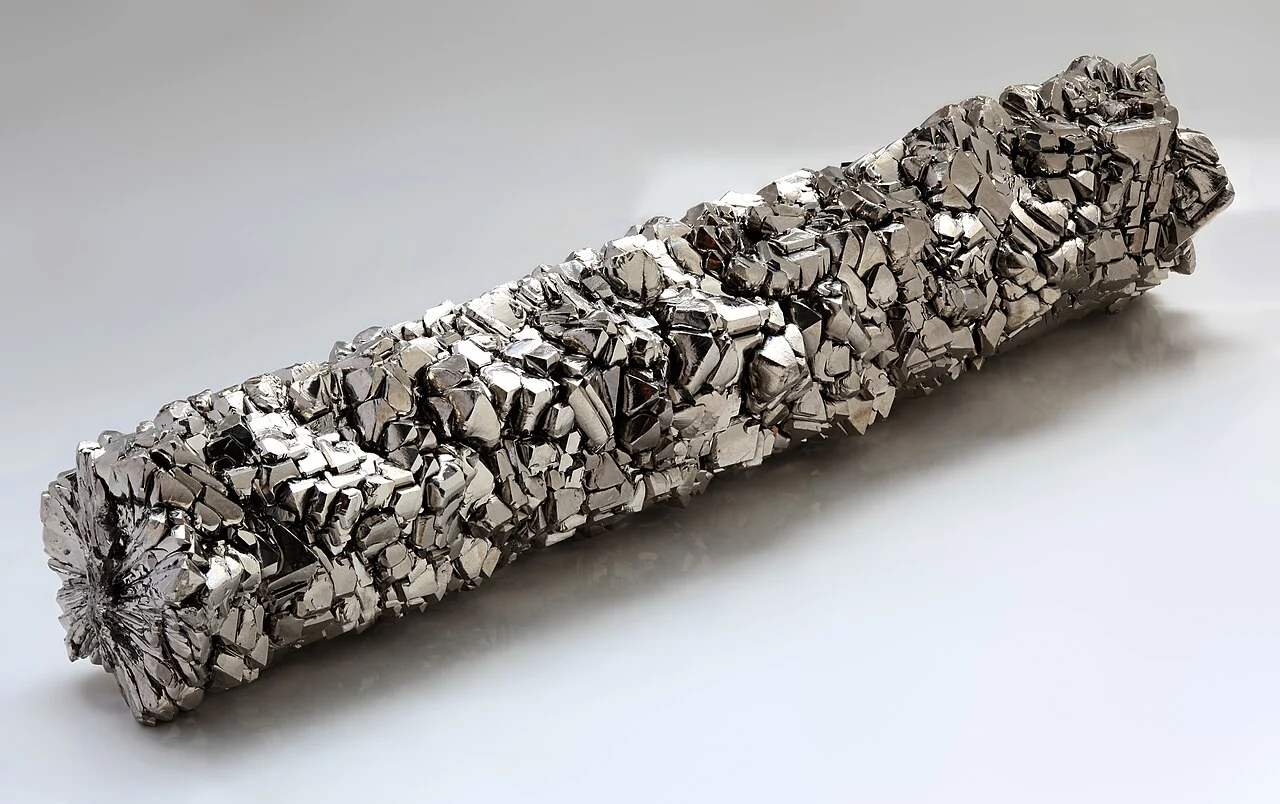
Pure titanium has a density of 4.506 g/cm³ (4,506 kg/m³ / 0.163 lb/in³), placing it between aluminum (2.70 g/cm³) and carbon steel (7.85 g/cm³). Titanium is approximately 43% lighter than stainless steel and about 67% heavier than aluminum by volume. Grade 5 (Ti-6Al-4V), which accounts for over 50% of global titanium consumption, runs slightly lighter at 4.43 g/cm³ due to its aluminum content. The number that drives material selection, though, is specific strength — tensile strength divided by density — where Grade 5 titanium (214 MPa·cm³/g) outperforms stainless steel (65) and most aluminum alloys. This guide covers exact density values across all common grades, direct comparisons with steel and aluminum, a specific strength table, and a weight calculation formula for procurement and design teams.
Titanium Density in Every Unit You Need
Most materials databases lead with g/cm³. Engineers in North American shops need lb/in³. Procurement teams ordering by the ton need kg/m³. Below are the figures for commercially pure (CP) titanium — Grades 1 through 3 — converted across every common unit:
| Unit | Value |
|---|---|
| g/cm³ (grams per cubic centimeter) | 4.506 |
| kg/m³ (kilograms per cubic meter) | 4,506 |
| lb/in³ (pounds per cubic inch) | 0.163 |
| lb/ft³ (pounds per cubic foot) | 281.3 |
These figures are drawn from ASM International physical properties tables for CP titanium. Grade 4 runs slightly higher at 4.54 g/cm³ — its higher oxygen content increases mass without meaningfully changing volume.
A quick field check: titanium is roughly 4.5× denser than water. A solid titanium rod should feel substantially heavier than an aluminum one of identical size. If it doesn’t, something’s wrong with the material.
Not All Titanium Has the Same Density
The industry habit of quoting a single “titanium density” number obscures meaningful variation across grades. Alloying elements shift the final density — lighter elements like aluminum pull it down, heavier elements like chromium and molybdenum push it up.
| Grade | Designation | Density (g/cm³) | Notes |
|---|---|---|---|
| Grade 1 | CP Ti | 4.51 | Softest, highest formability |
| Grade 2 | CP Ti | 4.51 | Most common CP grade globally |
| Grade 3 | CP Ti | 4.51 | Stronger than G2, same density |
| Grade 4 | CP Ti | 4.54 | Highest-strength CP grade |
| Grade 9 | Ti-3Al-2.5V | 4.48 | “Half-6-4,” bicycle frames, tubing |
| Grade 5 | Ti-6Al-4V | 4.43 | Workhorse alloy, ~50% of global Ti use |
| Beta C | Ti-3Al-8V-6Cr-4Zr-4Mo | 4.81 | High-strength, spring applications |
Source: AZoM / ASM International physical properties tables
Grade 5’s density drops to 4.43 g/cm³ because its 6% aluminum addition — density 2.70 g/cm³ — dilutes the mixture. Beta alloys run heavier because chromium, molybdenum, and vanadium all exceed titanium in density. If you’re specifying titanium for a weight-critical application and someone quotes you “4.51,” ask which grade. Substituting Beta C for Grade 5 adds roughly 8% to part weight at equal volume.
Titanium vs Steel Density: The 43% Gap
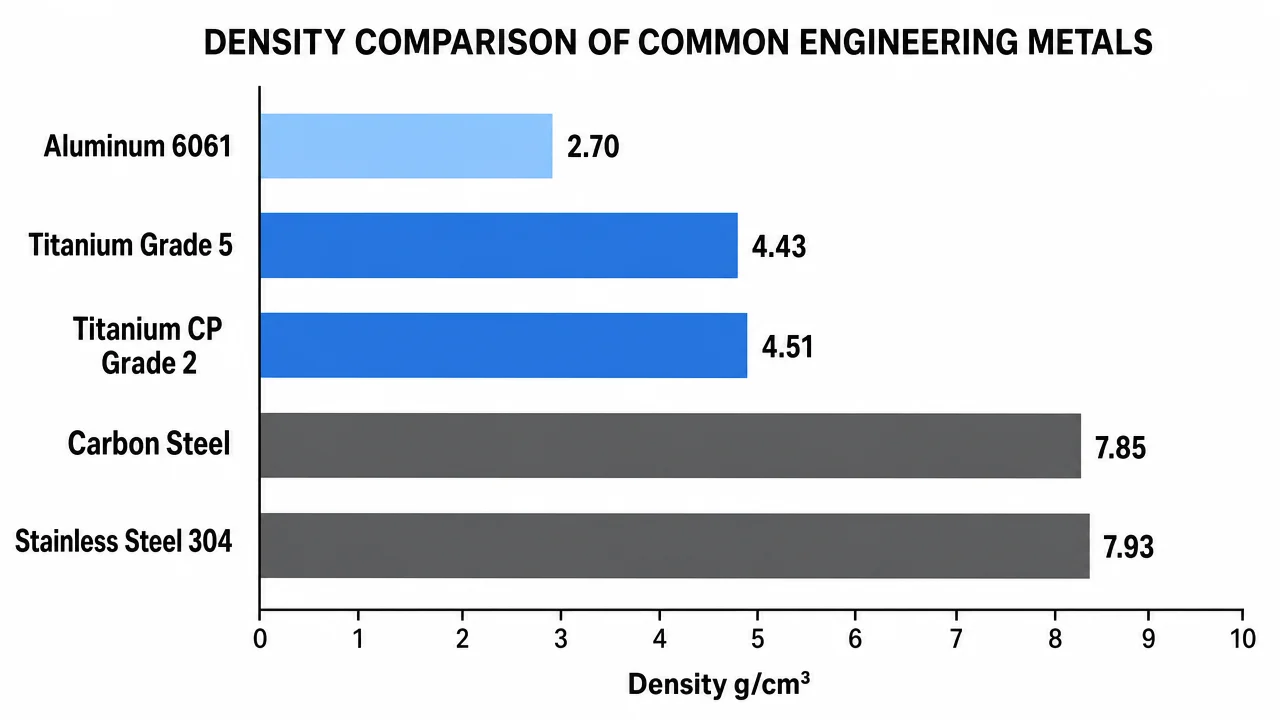
Steel has been the default structural metal for over a century. Every titanium substitution analysis starts here.
| Material | Density (g/cm³) | Density (kg/m³) |
|---|---|---|
| Titanium Grade 2 (CP) | 4.51 | 4,510 |
| Titanium Grade 5 (Ti-6Al-4V) | 4.43 | 4,430 |
| Carbon steel AISI 1020 | 7.85 | 7,850 |
| Stainless steel 304 | 7.93 | 7,930 |
| Stainless steel 316 | 8.00 | 8,000 |
CP titanium (Grade 2) is 43% lighter than 304 stainless by volume. Grade 5 saves an additional fraction on top. A stainless steel component weighing 10 kg in 304 would weigh approximately 5.7 kg in CP titanium at identical geometry — the same volume, 4.3 kg less.
That delta compounds fast. On a production run of 5,000 fasteners, it translates to hundreds of kilograms of weight eliminated from an assembled structure. In aerospace, where fuel burn scales directly with airframe mass, that kind of systemic weight reduction has measurable economic value across a fleet’s operational life.
The more significant story, though, is strength. 304 stainless steel has an ultimate tensile strength (UTS) around 515 MPa. Grade 5 titanium reaches 950 MPa in the annealed condition. Because you can design thinner walls to carry equivalent loads, the real weight advantage in a strength-driven design exceeds the raw 43% density gap. Aerospace engineers routinely report 50–65% total weight savings when redesigning steel components in titanium — the extra savings come from reducing cross-section.
Titanium vs Aluminum Density: Heavier Metal, Often Lighter Part
Aluminum is the default “lightweight metal” in automotive, consumer electronics, and bicycle manufacturing. Titanium is heavier by every density measure. Here’s where it gets counterintuitive.
| Material | Density (g/cm³) | UTS Typical (MPa) | Specific Strength (MPa·cm³/g) |
|---|---|---|---|
| Aluminum 6061-T6 | 2.70 | 310 | 115 |
| Aluminum 7075-T6 | 2.81 | 572 | 204 |
| Titanium Grade 2 (CP) | 4.51 | 340 | 75 |
| Titanium Grade 5 (Ti-6Al-4V) | 4.43 | 950 | 214 |
| Stainless steel 304 | 7.93 | 515 | 65 |
UTS sources: AMS 4928 (Grade 5 annealed), ASTM A276 (304 SS), ASTM B209 (6061-T6, 7075-T6)
Titanium is denser than aluminum by approximately 67% on a per-volume basis. An identical bar in titanium weighs 1.67× more than one in aluminum.
But notice specific strength. Grade 5 titanium (214 MPa·cm³/g) narrowly outperforms 7075-T6 aluminum (204) while more than doubling 6061-T6 (115). For applications where tensile strength and fatigue life govern design — landing gear fittings, surgical implants, high-load bicycle components — you can design the titanium part with a smaller cross-section. The finished titanium part can end up comparable in weight to its aluminum equivalent, despite the higher density.
Grade 2 CP titanium tells a different story: specific strength of 75 falls below even 6061 aluminum. CP titanium is chosen for corrosion resistance and biocompatibility, not structural efficiency. If you’re sourcing CP titanium for a weight-critical structure, you’re probably using the wrong grade. Grade 5 is the answer.
The other argument that closes the Ti-vs-Al decision is temperature. 7075-T6 aluminum begins losing strength above approximately 150°C. Grade 5 titanium maintains its mechanical properties to around 315°C. For structures near engine bays, exhaust systems, or re-entry vehicles, aluminum fails the thermal requirement regardless of specific strength.
The Number That Actually Drives Material Selection: Specific Strength
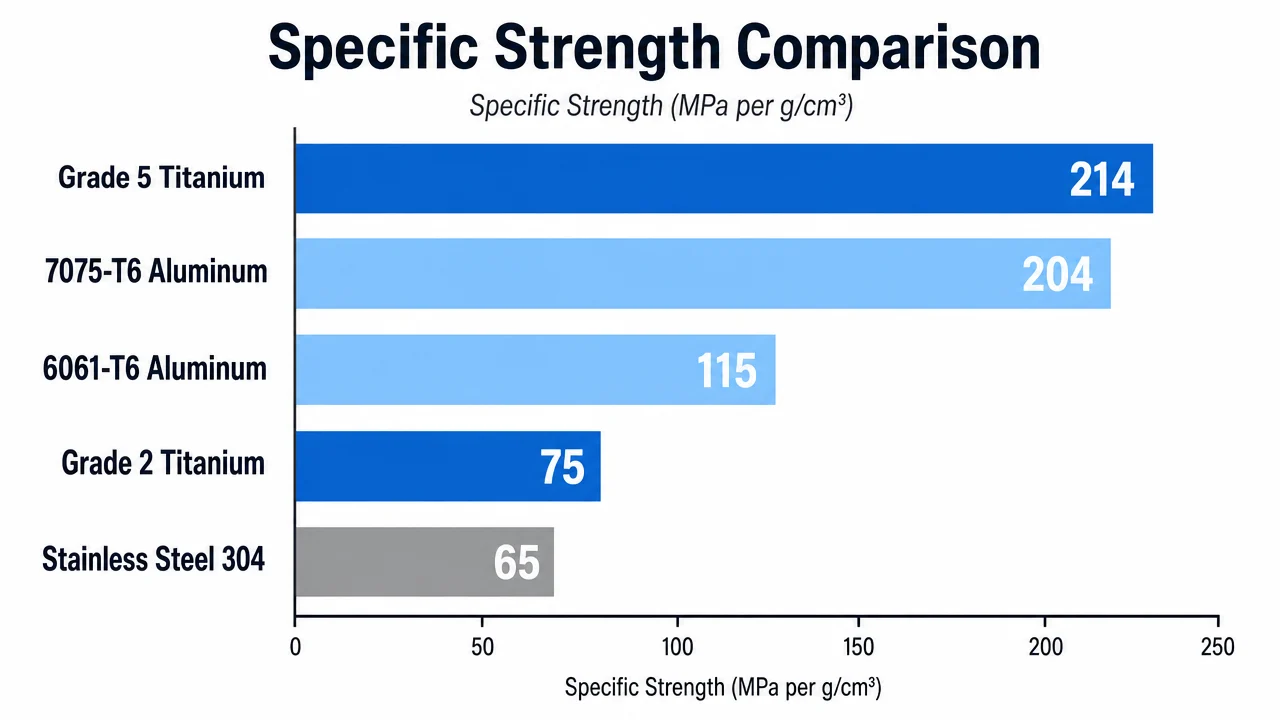
Density tells you how heavy a given volume of metal is. Specific strength tells you how much structural load that metal can carry per unit of mass. For comparing materials across an engineering design, specific strength is the relevant figure.
Specific Strength = UTS (MPa) ÷ Density (g/cm³)
Comparing Grade 5 titanium to 304 stainless: 950 ÷ 4.43 = 214 vs 515 ÷ 7.93 = 65. Grade 5 delivers more than 3× the structural performance per gram. That ratio is why the aerospace industry migrated critical fasteners and structural members from steel to titanium over several decades — not because titanium is lighter in absolute terms, but because for a given structural requirement, the titanium solution is dramatically lighter.
The aluminum-versus-titanium comparison is closer. 7075-T6 at 204 is almost equal to Grade 5 at 214. This is why the choice between them in aerospace isn’t a density argument — it’s a temperature argument. Where temperatures stay below 150°C and cost matters, 7075 wins. Where temperatures exceed 150°C or fatigue life is critical, Grade 5 wins.
For reference: carbon fiber reinforced polymer (CFRP) has a specific strength around 375 — roughly 1.75× Grade 5 titanium. The reason titanium persists alongside CFRP in aerospace is repairability, isotropy, and machinability. Titanium can be welded, machined, and repaired in field conditions. CFRP cannot.
Weight Calculation for B2B Procurement
Once you’ve settled on a grade, calculating part weight is straightforward. The core formula:
Weight = Volume × Density
For a rectangular plate (metric units):
Weight (kg) = [L (mm) × W (mm) × T (mm) × density (g/cm³)] ÷ 1,000,000
Worked example — Grade 5 plate, 500 mm × 300 mm × 6 mm:
500 × 300 × 6 × 4.43 ÷ 1,000,000 = 3.99 kg
Same plate in 304 stainless (density 7.93 g/cm³):
500 × 300 × 6 × 7.93 ÷ 1,000,000 = 7.14 kg
Same geometry: Grade 5 titanium is 44% lighter. On a production run of 500 units, that’s approximately 1,575 kg of weight removed from the final assembly — directly impacting shipping cost and, for aerospace or automotive assemblies, fuel efficiency over the product’s lifetime.
For round bar stock:
Weight (kg) = π × (D/2 in mm)² × L (mm) × density (g/cm³) ÷ 1,000,000
For imperial (lb/in³), replace the density value with 0.160 for Grade 5 or 0.163 for CP Grade 2, and input dimensions in inches. Drop the ÷ 1,000,000 adjustment — the result is in pounds directly.
When Titanium’s Density Advantage Matters — and When It Doesn’t
Titanium’s weight advantage is genuine, but it isn’t always the decision-governing factor.
Titanium density advantage is decisive when:
- Strength-to-weight is the primary design constraint: aerospace structures, performance automotive components, medical implants
- Operating temperatures exceed 150°C, ruling out high-strength aluminum alloys
- Corrosion resistance is required and stainless steel’s weight penalty is unacceptable
- Fatigue life under high-cycle loading is the limiting design criterion
Titanium density advantage is secondary — or irrelevant — when:
- Cost governs: titanium runs 5–10× the price of stainless steel per kg; the weight saving rarely pays off for static, ground-mounted structures
- Machinability matters: titanium’s low thermal conductivity and tendency to work-harden make it significantly slower and more expensive to machine than steel or aluminum
- Volume is high and tolerances are loose: aluminum remains cheaper and faster for high-volume, moderate-performance parts
- The component isn’t weight-constrained: a structural support in a fixed industrial installation doesn’t benefit from saving 4 kg per unit
When evaluating a titanium substitution in B2B manufacturing, the first question isn’t “how dense is titanium?” — it’s whether the weight saving generates measurable value. For a medical implant reducing patient load or a satellite bracket enabling a heavier payload, every gram matters. For a ground-based pump housing, the density advantage is largely academic.
FAQ
What is the density of titanium?
Pure (commercially pure) titanium has a density of 4.506 g/cm³, or 4,506 kg/m³, or 0.163 lb/in³. The most widely used alloy, Grade 5 (Ti-6Al-4V), is 4.43 g/cm³. Beta alloys like Beta C can reach 4.81 g/cm³.
Is titanium lighter than steel?
Yes. Titanium is approximately 43% lighter than stainless steel 304 by volume. A 10 cm³ block of titanium weighs about 45 g; the same block of 304 stainless weighs approximately 79 g.
Is titanium heavier than aluminum?
Yes — by about 67% on a per-volume basis. However, Grade 5 titanium’s specific strength (214 MPa·cm³/g) is comparable to high-strength 7075-T6 aluminum (204), meaning a titanium part designed for the same structural load often ends up at similar weight to its aluminum counterpart.
Why does Grade 5 titanium have lower density than pure titanium?
Grade 5 (Ti-6Al-4V) contains 6% aluminum, which has a density of only 2.70 g/cm³ — well below titanium’s 4.506. Adding this lighter element to the alloy reduces overall density from 4.51 (CP Grade 2) to 4.43 g/cm³.
What is titanium density in kg/m³?
4,506 kg/m³ for CP titanium (Grades 1–3). Grade 5 is 4,430 kg/m³. Grade 4 is 4,540 kg/m³.
Is titanium the lightest structural metal?
No. Aluminum (~2.70 g/cm³) and magnesium (~1.74 g/cm³) are lighter. Titanium’s advantage is its superior specific strength and high-temperature performance relative to those lighter metals — not absolute lightness.
Summary
Titanium sits at 4.506 g/cm³ — 43% lighter than stainless steel, 67% heavier than aluminum. The grade you specify matters: Grade 5 at 4.43 g/cm³ is the lightest commonly used structural alloy; Beta C at 4.81 is notably heavier. The density number alone rarely drives the decision. Specific strength — where Grade 5 titanium (214 MPa·cm³/g) outperforms stainless steel (65) and most aluminum alloys — is what justifies titanium’s cost premium in structural applications. For B2B procurement and component design, the weight saving calculation is straightforward: multiply volume by density, compare grades, and evaluate whether the mass reduction generates value proportional to titanium’s price premium.